
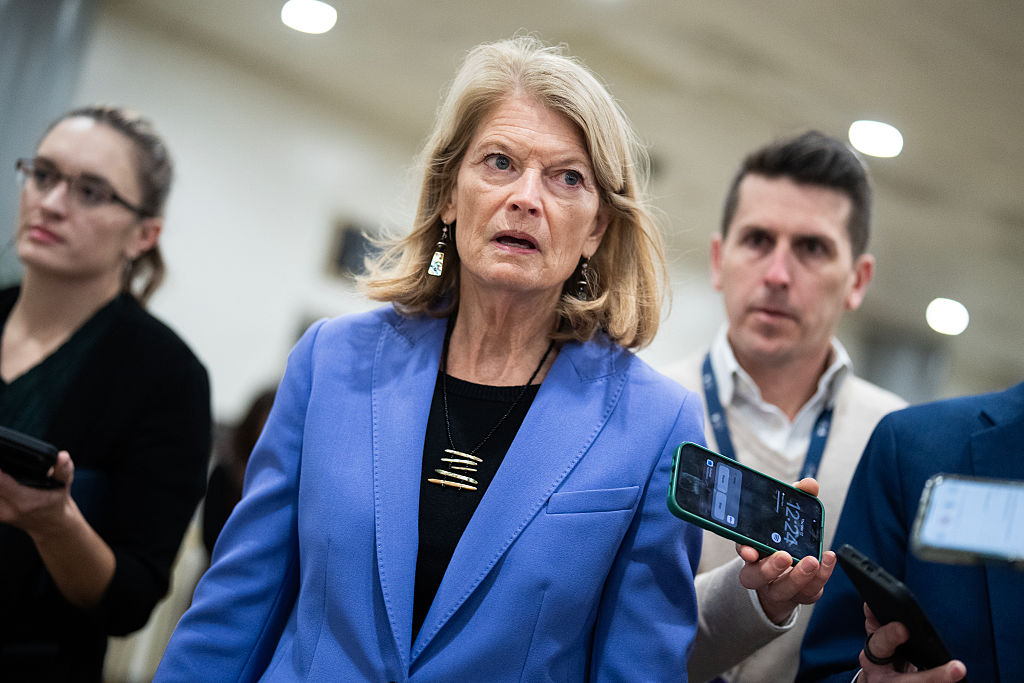
Senate Republicans on Wednesday narrowly blocked the strongest congressional effort yet to force an end to the war with Iran, as three Republican senators broke with their party over President Donald Trump’s handling of the conflict.
The measure, brought under the 1973 War Powers Resolution, failed by a single vote, 50 to 49. It was the seventh attempt in the Senate to pass such a measure since the war began in late February, and the first time Senator Lisa Murkowski, Republican of Alaska, voted for it.
Murkowski was joined by Republicans Susan Collins of Maine and Rand Paul of Kentucky in backing the resolution. Collins first broke with Republican leadership on the issue last month, shortly before the expiration of a 60-day legal window that some legal experts argue required the Administration to seek congressional authorization for continued military action. Paul, a longtime critic of expansive presidential war powers, has voted for all seven attempts.
“You've got a timeline that has taken us beyond the 60 days,” Murkowski told reporters after the vote. “I thought that perhaps we would get …more clarity from the administration in terms of where we are, and I haven't received it.”
The deciding vote was cast by Senator John Fetterman, a Pennsylvania Democrat and staunch supporter of Israel, who again crossed party lines to side with Republicans and oppose the measure.
Under the War Powers Resolution, presidents may introduce U.S. armed forces into hostilities for 60 days without congressional approval, after which authorization from Congress is required for military operations to continue. That clock began on March 2, when Trump formally notified Congress of military action against Iran, following joint U.S.-Israeli strikes launched days earlier.
The Trump Administration, however, has argued that the legal deadline no longer applies because a ceasefire with Iran halted the hostilities before the 60-day period elapsed. In a May 1 letter to Congress, Trump said there had been “no exchange of fire” since April 7 and declared that “the hostilities that began on February 28, 2026, have terminated.”
But Democrats—and now a small but growing number of Republicans—have rejected that interpretation, pointing to continued military activity in the region, including U.S. naval operations blockading Iranian ports and recent Iranian attacks in the region that prompted American retaliation. Sen. Jeff Merkley, the Oregon Democrat who sponsored Wednesday’s resolution, argued on the Senate floor that “both sides are engaged in a daily war.”
The dispute over whether hostilities are legally ongoing has become central to the congressional battle over the conflict. TIME previously reported that some Democrats are privately discussing whether to sue the President over military operations continuing beyond the deadline without authorization, setting up a potential constitutional clash over the separation of powers.
The White House argues the War Powers Act is unconstitutional, and that Trump is only complying with “elements” of it to maintain good relations with Congress. “The War Powers Act is unconstitutional, 100 percent,” Secretary of State Marco Rubio told reporters during a recent White House briefing, claiming that the same position has been shared by “every single president” since the law passed in 1973. Defense Secretary Pete Hegseth told senators Tuesday that if Trump decided to restart combat operations, the Administration believed it already had “all the authorities necessary to do so.”
Most Republicans remained aligned with Trump. “I think it would be best if everybody hung together and supported the president,” Senate Majority Leader John Thune told reporters ahead of the vote. Others accused Democrats of attempting to undermine the president while he traveled overseas for high-stakes meetings with Chinese President Xi Jinping.
“The President made it very clear: clear that the major fighting has halted, clear that the American ceasefire has held for more than a month, and our naval blockade is working,” said Sen. John Barrasso of Wyoming, the no. 2 Senate Republican. “This week, President Trump is meeting with China overseas. Democrats right here in the Senate want to pull the rug out from under him.”
Yet the narrow margin revealed growing discomfort within the Republican Party, particularly among senators who had previously warned that the Administration would face tougher scrutiny once the 60-day window expired.
Murkowski’s shift appeared especially significant because she had previously resisted efforts to force an end to military operations, arguing that an outright cutoff could be too abrupt. In recent weeks, however, she has increasingly questioned the administration’s insistence that the conflict had effectively ended and has explored the possibility of drafting a separate authorization for the use of military force against Iran.
A few other Republicans who had publicly raised concerns about the legal deadline ultimately voted against the resolution Wednesday, including Senators John Curtis of Utah and Thom Tillis of North Carolina. Both had previously suggested Congress should play a larger role if military operations extended beyond the statutory limit, but neither joined the effort to curtail the war.
For Democrats, Wednesday’s vote nonetheless served as evidence that Republican unity behind the war may be eroding.
“We know what our colleagues are hearing,” Senator Tim Kaine of Virginia said before the vote. “We’re starting to hear doubt creep into their words.”
Hence then, the article about 3 republicans join democrats in closest senate vote yet to halt iran war was published today ( ) and is available on Time ( Middle East ) The editorial team at PressBee has edited and verified it, and it may have been modified, fully republished, or quoted. You can read and follow the updates of this news or article from its original source.
Read More Details
Finally We wish PressBee provided you with enough information of ( 3 Republicans Join Democrats in Closest Senate Vote Yet to Halt Iran War )


Also on site :
- Watch Sheryl Crow Surprise Fans With New ‘Cars’ Song ‘Built to Last’ Ahead of Spin-Off Disney Jr. Series
- Walmart’s Chunky Knee-High Boots Look So Similar to a Beloved Premium Leather Style for Nearly 90% Less
- Iran, the economy and mending fences: Top takeaways from Trump interview with friend-turned-foe Michael Cohen