
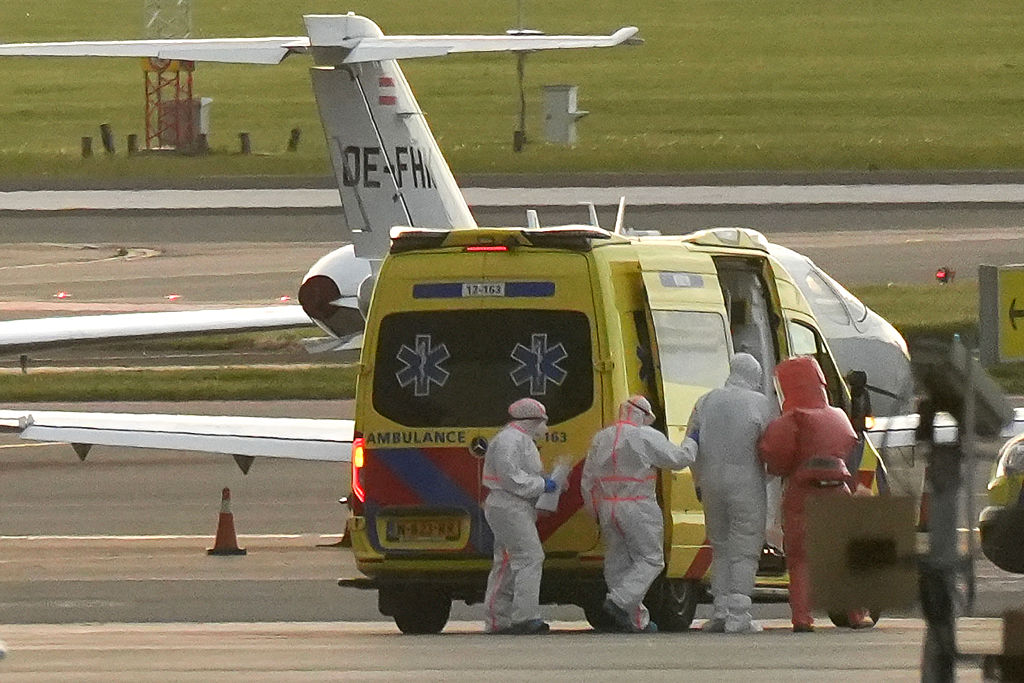
Scroll through any newsfeed right now, and you’ll see news of a cruise ship with a cluster of fatal hantavirus cases—and a collective freak-out unfolding in real time. The situation is triggering an eerie sense of déjà vu and fear. In Reddit forums and on social media, people are telling each other in earnest that they can’t do this again, that they’re not equipped to retreat into their homes for months or get reacquainted with the art of social distancing.
It’s too soon to know exactly how the outbreak will play out (though health experts insist that hantavirus is not COVID, and the risk to the general public is low). Hantavirus is rare and does not spread easily among people, and it typically affects fewer than 100 people in the U.S. per year. Yet the fear surrounding it is real and widespread, and—according to historians and psychologists—it makes a lot of sense.
Here’s why your brain is doing this, and what actually helps when it does.
Dr. Howard Markel, a medical historian and author of books including When Germs Travel: Six Major Epidemics That Have Invaded America Since 1900 and the Fears They Have Unleashed, has spent his career studying how societies respond to health threats. He used to tell anyone who asked that the final act of any pandemic is what he calls “global amnesia”—the moment when people dust themselves off, go on their merry way, and largely forget all about it. That’s what happened after the 1918 flu, for example, which gave way to the Roaring Twenties; F. Scott Fitzgerald called the decade that followed “the grandest, gaudiest spree in American history.”
Markel expected the same pattern to happen after COVID. He was wrong, he now acknowledges. “Here’s one more instance where you don’t ever ask a historian to predict, because they’re always wrong,” he says. “I said we’ll go back to being normal.”
Two things, he believes, broke the cycle. The first was scale. COVID didn't just make people sick; it stopped the world. Schools closed, offices made employees work from home, weddings and funerals were postponed or held on Zoom. "It really fundamentally changed life for a couple of years," Markel says, "particularly if you had kids and they weren’t really going to school." The second has to do with the fact that so many got it wrong the first time around. In early 2020, plenty of people—including health officials—assumed the virus would burn itself out in a few months. (That’s also true of Markel, who you can thank for helping to develop the concept of “flattening the curve” during COVID.) It didn't work. That assumption, Markel suggests, has left a residue: an instinct to overcorrect the next time a virus appears in the news.
Read More: The Difference Between Stress and Anxiety
Six years on, Markel sees a population that hasn’t forgotten, that’s still washing its hands more, still masking in some settings, and still recoiling at headlines about viruses (then feverishly clicking them). “I think a lot of people have kind of a post-traumatic stress disorder as a result,” he says. “And then hantavirus, whether it’s on a boat or not, because it is so sudden if you do contract it—that’s very scary.”
That tracks with what Dana Rose Garfin, a psychologist and professor at University of California, Los Angeles, who studies collective trauma, sees in her data. Major events like COVID, she says, rewire people. “Those types of events do tend to sensitize people to respond more negatively to future events,” Garfin says. “And this is happening on the backdrop of intense political polarization and geopolitical instability—people are really inundated with bad news about these escalating threats.”
There’s a longer arc to this anxiety, too. J. Alex Navarro, a historian and senior research associate at the University of Michigan Medical School, points out that earlier generations were, in a strange way, less reactive to disease outbreaks because death from illness was so common. “Mothers died in childbirth. Kids would die in infancy. People died of disease all the time,” Navarro says of the 1918 era. “That’s not the case today. We sort of believe in the miracle of modern medicine to save us.” That belief has made modern Americans healthier than any generation in history—and also, paradoxically, more anxious. Because past generations expected to lose people to disease, and we don’t, new viruses feel particularly destabilizing, he says.
All of this leaves a physiological scar. Reid Wilson, director of the Anxiety Disorders Treatment Center in Chapel Hill, N.C., says collective trauma changes how the brain processes future threats. “Trauma can leave a deep imprint on the nervous system,” he says. “When people confront a serious threat such as COVID, the brain shifts into a heightened state of vigilance, mobilizing defenses meant to protect us. Even after the immediate danger fades, that alertness can linger, and habits formed during the crisis may persist because they once felt necessary.”
Those habits, Wilson says, can reappear when a new danger feels similar enough to trigger them. “People may instinctively reach for a mask,” he says, “tense up when someone coughs, or keep more distance than they used to.”
Why this virus, and why now?
Something about hantavirus touches a nerve. Navarro points out that hantavirus normally generates almost no news coverage at all. Because it’s so rare, only specialists tend to pay close attention. "Suddenly now it's in the news," Navarro says—a shift he attributes in part to the post-COVID climate, in which any virus story registers louder than it would have a decade ago.
The cruise-ship setting doesn’t help. Navarro notes that some of the earliest U.S. COVID cases came off of cruise ships, which makes the current story feel uncomfortably familiar. And the comparison many people are reaching for—Ebola in 2014—isn’t a coincidence either. Both diseases are rare in the U.S., and both are deadly when contracted.
Karen Cassiday, a clinical psychologist and author of Freedom from Health Anxiety, says the word itself does some of the damage. When people hear “hantavirus,” she says, their memory pulls up haunting associations of catastrophic illness and death. “It’s kind of like black plague,” she says. “You remember Ebola—that name, it’s sort of like, ‘Oh, you don’t want that one.’”
The rodent connection adds another layer. Hantavirus typically spreads through contact with rats and mice—or, more precisely, with their droppings, urine, and saliva. For anyone with even a mild rodent aversion, that can trigger shivers of disgust. "When people come into contact with rodents now, they may feel increased distress, even though it's going to be very rare that they're a carrier and they'll contract it,” Garfin says.
The trigger for worry usually isn’t bad news itself—it’s uncertainty. The less tolerant you are of not knowing, the more your brain will zip through every worst-case scenario in the name of preparation, Cassiday says.
The trouble is what happens next. “Our bodies are kind of stupid,” Cassiday says. “When we imagine something, we get the same physiological reaction as we do if we encounter the real thing.” Your heart races, you start sweating, and, because your body is reacting as if the threat is real, your brain takes that as confirmation that it is. You’re not preparing, she says; you’re spiraling.
Read More: How to Manage Catastrophic Thinking
Doomscrolling makes this dramatically worse. Garfin’s research has found that what predicts poor mental health during a crisis isn’t simply being aware of it: it’s repeated, high-volume media exposure over time. “It’s not necessarily leaving you more informed, but it is leaving you more activated,” she says.
So how do you know when normal vigilance has tipped into something unhealthy? Cassiday’s test is simple: It’s when you can’t redirect your attention. “If it’s getting that sticky Velcro kind of thing and you keep coming back to it or you can’t let it go,” she says, that’s the signal. People with manageable worry can think, this isn’t solving anything, and move on. People who are stuck can’t.
What actually helps
If any of this sounds familiar, the good news is that concrete techniques can help you keep your anxiety in check. Here’s what experts recommend:
Cassiday calls compulsive news-reading a form of reassurance-seeking—and the worst possible response to anxiety. “It’s a negative reinforcer that makes all the worry worse,” she says. Her advice: Stick to a small number of outlets you trust and consider fact-based, and stay off social media. These platforms can “fan the flames of fear and anxiety,” she warns.
Don’t mistake similarity for sameness
Anxious brains, Cassiday says, latch onto whatever they share with the people in a scary news story—and then assume the same fate is coming. For example, you might think: “I’ve been on a cruise. I do international travel. I’m middle-aged, like that couple who got sick.” The leap feels logical in the moment, but it isn’t. “Just because I could imagine myself going on a cruise, or I’ve done that, it starts feeling like I’m going to have the same fate,” she says. Yet we usually don’t make this mistake in other parts of life: You wouldn’t assume that because you share a gender or a hometown with another person, your lives will play out identically. When you catch yourself doing it, pause and ask whether the similarity actually means anything, she advises.
Pick one or two specific times a day to check for updates, and stop there. Continuous refreshing isn’t keeping you informed—it’s exploiting what psychologists call the availability heuristic, the brain’s tendency to judge how likely something is by how easily examples come to mind, Wilson says. The more vivid stories about hantavirus you consume, the more common and imminent the threat feels, regardless of what the actual numbers say. “Media doesn’t just inform,” he says. “It can systematically shift risk perception away from the actual base rates.”
Try a worry appointment
This one is counterintuitive but effective. The technique, developed by Penn State psychologist Thomas Borkovec, calls for setting aside three minutes a day to deliberately think through the worst-case scenario. David H. Rosmarin, an associate professor in the department of psychiatry at Harvard Medical School and founder of the Center for Anxiety, recommends it to his patients. You might think to yourself: “What if I got this thing and died? What would be in my will? Who would be at my funeral? What would my kids say?”
The point is to actually visit the fear instead of orbiting it. “You’re keeping it at a low level,” Rosmarin says. “You’re not really thinking about the depth of your fear.” Going there, briefly and on purpose, often defangs it.
Cassiday’s favorite intervention with anxious patients is to ask: “How would someone who isn’t a worrier respond to this news?” Or: “Before you started worrying, what would you have done today?” Both questions snap you out of the imagined catastrophe and back into the present, she says.
Read More: Hobbies May Be the Key to a Satisfying Life. Here’s How to Find One
Stop researching symptoms
Rosmarin is blunt about this. For someone with health anxiety, he says, searching your own symptoms is “basically like somebody who has a drug or alcohol problem going near a substance.” A scratchy throat or a headache might mean nothing, he says—but type those words into any search engine, and you might find yourself convinced you have whatever's in the news. It feels like research, but it functions like a relapse.
Talk to someone—but not about the virus
When a friend is spiraling, Cassiday suggests a soft redirect: “It looks like you’re really anxious right now, and I’m finding it more helpful for me not to talk about this. Can we talk about something else?” Then ask them about something you actually share. Connection helps, she says; the doom loop doesn’t.
Remember: If it’s not hantavirus, it’s something else
Rosmarin offers one final thought worth sitting with. “If it’s not the hantavirus, it’s something else,” he says. “It’s just the way it is. Tomorrow could be literally nuclear war.”
Ironically, it’s a freeing thought: There will always be a next headline, a next outbreak, a next reason to feel that the floor is about to give way. The goal, Rosmarin argues, is to stop trying to control what was never controllable in the first place. “The healthiest people aren’t those who eliminate uncertainty,” he says. “They’re the ones who learn to live meaningful lives despite it.” That, in the end, is what separates productive worry from the kind that hollows you out.
Hence then, the article about how to manage your health anxiety about hantavirus was published today ( ) and is available on Time ( Middle East ) The editorial team at PressBee has edited and verified it, and it may have been modified, fully republished, or quoted. You can read and follow the updates of this news or article from its original source.
Read More Details
Finally We wish PressBee provided you with enough information of ( How to Manage Your Health Anxiety About Hantavirus )


Also on site :
- 1982 Steven Spielberg Tearjerker, Featuring One of the Saddest Movie Scenes Ever, Is Still Just as Powerful 44 Years Later
- 1976 Rock Song, Written by Tom Petty After His Solo Deal Fell Apart, Launched One of Rock’s Greatest Bands
- Ana Luisa’s ‘Dainty’ Crystal Huggie Earrings Capture the Essence of ‘Minimalist Chic,’ Now on Sale at Nordstrom