
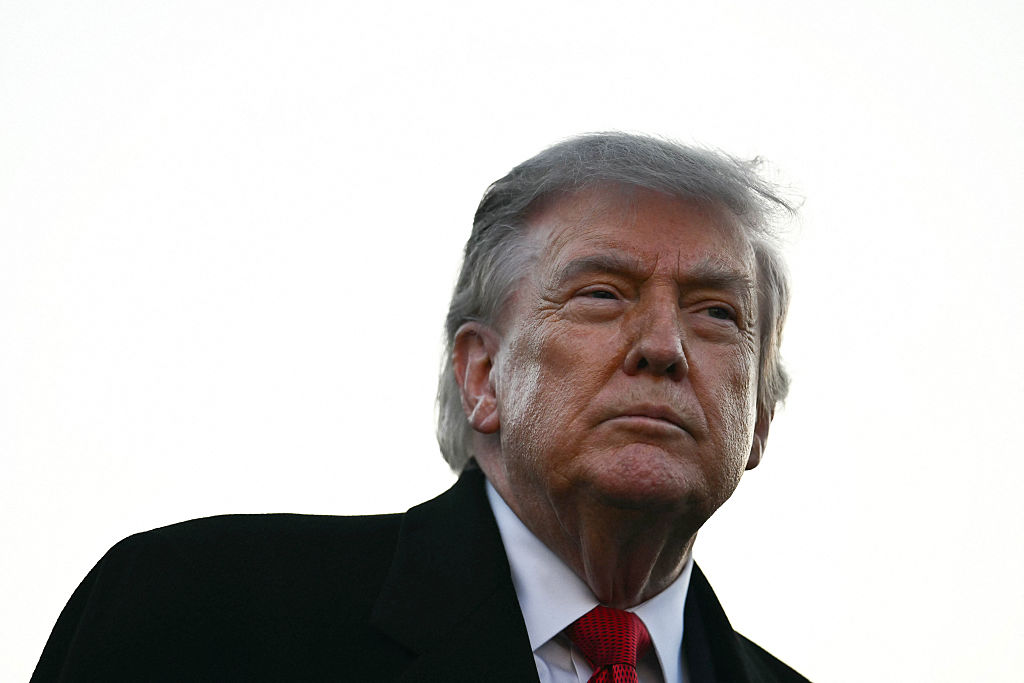
A U.S. trade court has delivered another reversal to President Donald Trump's plan for global 10% tariffs, at the same time as he threatened “much higher” levies on the European Union.
In a 2–1 decision, a three-judge panel of the U.S. Court of International Trade on Thursday found that Trump exceeded his legal authority when he imposed across-the-board global tariffs in February.
“Well, we were surprised,” Trump said when asked about the court’s ruling. “We had one very positive vote, we had two radical left judges that voted against it. Nothing surprises me with the courts.”
The tariffs were introduced by Trump after the Supreme Court in February struck down his use of emergency powers under the International Emergency Economic Powers Act (IEEPA), which had served as a cornerstone of his global tariff agenda, and used to impose several reciprocal tariffs on multiple countries.
“The Supreme Court’s Ruling on tariffs is deeply disappointing! I am ashamed of certain members of the court for not having the courage to do what is right for our country,” Trump said at the time.
The small businesses that brought the case argued the administration was attempting to bypass the Supreme Court ruling through a new legal mechanism.
In February, in the immediate aftermath of the Supreme Court's decision, Trump announced he would issue “an order to impose a 10% global tariff, under Section 122, over and above our normal tariffs already being charged.”
The trade court ruled that the type of trade deficits cited by Trump did not justify such broad tariff powers and emphasized that Section 122 of the Trade Act was intended to give tariff-setting authority to Congress, not the Executive branch.
“Section 122 is a narrow, time-limited tool intended to address specific balance-of-payments crises—not a blank check for the executive branch to impose worldwide trade restrictions in response to ordinary trade deficits or to circumvent prior judicial rulings,” said the Liberty Justice Center, the law firm representing the plaintiffs.
The ruling applies only to the state of Washington and the two companies involved in the lawsuit, with the judges declining to issue a nationwide injunction. However, the plaintiffs are set to receive refunds for tariffs under Section 122, with interest.
“Nothing surprises me. So, we always do it a different way, we get one ruling and we do it a different way,” Trump said in light of the court’s decision.
Thursday’s decision marks another setback for Trump’s economic agenda and could open the door to further legal challenges.
“This decision is an important win for American companies that rely on global manufacturing to deliver safe and affordable products. Unlawful tariffs make it harder for businesses like ours to compete and grow,” said Jay Foreman, CEO of Basic Fun!
“We are encouraged by the court’s recognition that these tariffs exceeded the President’s authority. This ruling brings needed clarity and stability for companies navigating global supply chains,” Foreman added.
The Administration has also begun processing refunds tied to Trump’s original IEEPA tariffs, with companies expected to receive billions of dollars in repayments.
Meanwhile, Trump announced Thursday night a new deadline for finalizing a trade deal with the European Union.
“I’ve been waiting patiently for the E.U. to fulfill their side of the historic trade deal we agreed in Turnberry, Scotland, the largest trade deal, ever!” he said.
Trump added that despite a “great call” with European Commission President Ursula von der Leyen, tariffs “would immediately jump to much higher levels” if the agreement is not completed by July 4.
President Donald Trump and President of the European Commission Ursula von der Leyen shake hands as they announce a U.S.-E.U. trade deal after a meeting at Trump Turnberry golf club on July 27, 2025 in Turnberry, Scotland. —Andrew Harnik––Getty ImagesThe agreement, reached in July last year, established a 15% tariff ceiling on most European goods. In return, the E.U. agreed to eliminate duties on U.S. industrial goods, including automobiles.
However, E.U. negotiators have yet to pass the legislation required to implement the agreement, a delay that has frustrated Trump. Last week, he threatened the bloc with a new 25% tariff on automobiles, accusing it of failing to comply with the deal.
E.U. negotiators failed again this week to produce a finalized agreement, though von der Leyen struck an optimistic tone following her discussion with Trump.
“We remain fully committed, on both sides, to its implementation. Good progress is being made towards tariff reduction by early July,” she said.
Trump added that he and von der Leyen also discussed the ongoing war with Iran, saying both sides are “completely united that Iran can never have a nuclear weapon.”
Relations between Trump and several European leaders have grown increasingly strained amid the conflict with Iran, with the President repeatedly criticizing allies for refusing to support U.S. military operations alongside Israel.
Trump has also floated the possibility of withdrawing from NATO and threatened to pull troops from Germany, Italy, and Spain.
Hence then, the article about fresh setback for trump s tariffs as he threatens europe with much higher levy was published today ( ) and is available on Time ( Middle East ) The editorial team at PressBee has edited and verified it, and it may have been modified, fully republished, or quoted. You can read and follow the updates of this news or article from its original source.
Read More Details
Finally We wish PressBee provided you with enough information of ( Fresh Setback for Trump's Tariffs as He Threatens Europe With 'Much Higher' Levy )


Also on site :
- Simon Rodia spent 33 years building 17 towers in his Los Angeles yard from bottles, tiles and seashells; the finished towers are now a national landmark
- Forests Climbing Toward the Clouds, Enchanting Chalets and Alpine Peaks: This Cozy Village Near the ‘Top of Europe’ Is Surging 263% for Winter Getaways
- All matches announced for WWE NXT Halloween Havoc 2026 so far ft. Kelani Jordan, Grayson Waller & more