
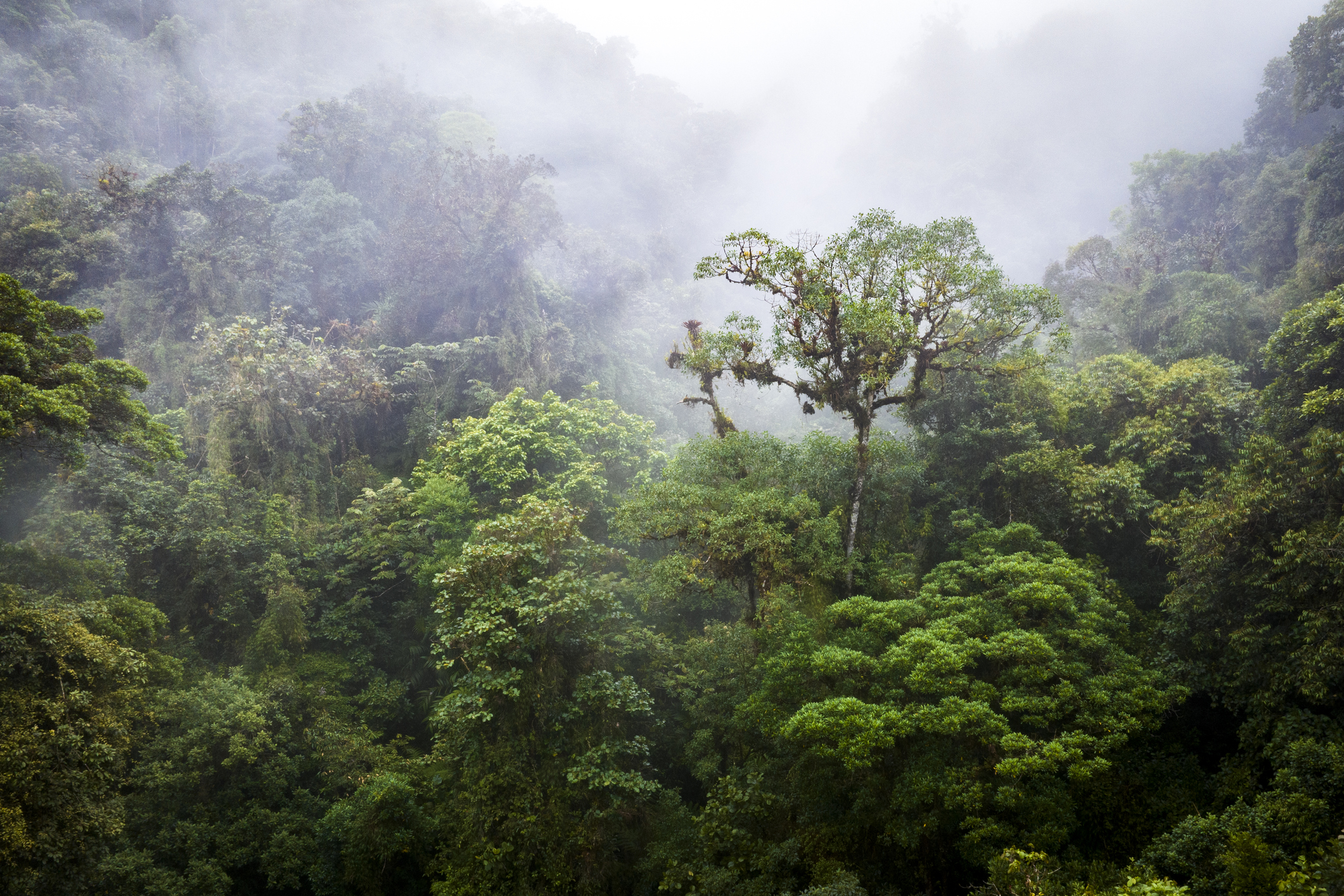
In the early morning, the cloud forest of Cusuco National Park in Honduras has an ancient, almost mystical feeling. The normally vivid colors of the flowers, lichen, and moss that thrive in this rare ecosystem seem dulled by the thick fog that pervades the forest canopy. But as the visual senses are dampened, the acoustic world seems to explode into life. The orchestra of bird calls, each perfectly adapted to fill a different frequency range in the cacophony, is punctuated by the bellows of howler monkeys reverberating through the trees. In every direction there is life, sustained by the mist that seems to flow in and out of everything you see.
After a few hours of exploring this remarkable paradise, our attention was caught by a breathtaking sight—an electric green streak darting across the path in front of me. Before I could think, the snake was in my hands, grasped gently behind the head so it couldn’t bite.
It was stunning. Adrenaline surged through my veins as I studied its dazzling colors.
One of my friends, a Honduran researcher, told me the snake was a nonvenomous species called a green racer. I released my grip so that it could move freely between my hands.
Then suddenly the snake lunged, sinking its fangs into the flesh of my left hand.
I put it down on the ground and gingerly stepped away, giving my Honduran colleague a chance to take a closer look at the animal, and I saw her eyes widen in alarm. As the snake glided into the undergrowth, she told me she had been wrong. It was not a harmless green racer. It was, in fact, a green palm pit viper: a species with highly dangerous hemotoxic venom.
The shift in my mental state from bliss into chaos was mayhem. I was two hours from town and I’d just been bitten by a deadly snake. Within moments, my hand started to go numb. If there had been any question that this snake was venomous, this symptom confirmed my worst fears—and heightened them.
As the numbness began to spread through my hand, I started beating my knuckles against a rock on the side of the path. But even after they were bloody and bruised, I felt nothing. Only the sense of numbness creeping up my arm, along with a growing sense of impending doom.
When we finally reached a village, we found a local doctor who looked at the state of my bloody hand with concern. He asked to see a photo of the snake. After a cursory look, he burst out laughing. This snake was not a pit viper. It was, indeed, just a green racer.
From this moment, the speed of the transformation in my hand was astonishing. Within a few seconds, feeling flooded back into my entire arm. Instead of numbness, my hand throbbed with agonizing pain—not from the snakebite, but from the bludgeoning I had given it on my way.
As my friends laughed, I remember thinking that relief and embarrassment are a hard combination of emotions to express on one face at the same time. I had not been injected with deadly venom. I had been injected with a powerful shot of nocebo (the opposite of placebo), so the fear that I had been envenomated was enough to trigger a physiological response that reinforced my fears. I had been trapped in a dance between my mind and body, which left me with little or no control over my entire perception of reality. The fundamental steps in that dance, the patterns that shaped my physical experience, are called feedback loops.
A positive feedback loop happens when the outcome of a process reinforces the inciting process, creating a chain of cause and effect. These loops are everywhere, occurring all the time. The more anxious I am about sleeping, the harder it gets to drift off, which only makes me more anxious. The more nervous I am about my dancing, the more embarrassing my moves become.
And loops like this do not only shape our perception of reality, but the physical structure of reality itself. After the Big Bang, it was these invisible forces that allowed areas of dense matter to congregate in space, generating more attraction on the surrounding matter, that ultimately drove the exponential forces that created stars. They allowed life to spread on an otherwise uninhabitable planet, creating more opportunities for more and more life.
Once you start noticing feedback loops like this, you can't stop seeing them everywhere. They seem to provide a deep sense of understanding, cutting through the chaos of our world to reveal lines of causality that help everything to make sense.
But the most remarkable thing about these patterns is how they can provide a sense of agency. Because we are not only subject to these immense universal forces, we are implicit in their creation and amplification.
When my body and mind had slipped into a loop that magnified a harmless snake encounter into a physical crisis, the impacts were not limited to my own body. The panic of one person became the panic of many, each reaction amplifying the next, until a single pulse of fear shapes the physical experience of reality around us.
Feedback loops do not care about scale. They can build from the smallest of sparks. Tiny oscillations alter tides; slight genetic variations reshape whole lineages; and the subtle fluctuations in the early universe determined the shape of galaxies that later formed. And exactly the same feedback loops build on our authentic beliefs and emotions to shape the future trajectory of our physical experience.
It is difficult to predict which feedback loops will grow into immense planetary-scale forces and which will fade into insignificance. But the one pattern that consistently emerges is that they amplify the qualities of the energy from which they originate.
As we face our uncertain environmental future, it will be our emotional reactions that will determine the shape of things to come. Collective panic will propagate more of the same energy, as growing levels of defensiveness and infighting distract us further from the progress we need. But exactly the same patterns can work in a regenerative direction, if we can find a way to nourish them with our attention and enthusiasm.
If eight billion people could wake up feeling authentically excited about the opportunity to engage in the countless regenerative solutions that can improve our health, wealth, fun, or fashion choices, then the loops that grow would hold an entirely different quality.
In that way, the same feedback loops that have accelerated ecological collapse can also be forces to drive runaway recovery. We may only be here for an instant in cosmic time—a brief countercurrent in an endless sea. But for that instant, the fabric of reality flows through our hands, as we shape the conditions that all future life will experience. Our moment is fleeting, but the loops we set in motion can echo long after we are gone.
Taken from Nature’s Echo by Thomas Crowther. Copyright © 2026 by Thomas Crowther. Used by permission of Harper Horizon. harpercollinsfocus.com/harper-horizon
Hence then, the article about a snake bite revealed how we can help heal the planet was published today ( ) and is available on Time ( Middle East ) The editorial team at PressBee has edited and verified it, and it may have been modified, fully republished, or quoted. You can read and follow the updates of this news or article from its original source.
Read More Details
Finally We wish PressBee provided you with enough information of ( A Snake Bite Revealed How We Can Help Heal the Planet )


Also on site :
- ‘Triangle of Sadness’ Producer Backs Park Syeyoung’s Memory-Bending Love Motel Drama ‘Satellite of Love’ at Busan Asian Project Market
- Taylor Swift Shows Up on ‘Law & Order: SVU’ Set With a Surprise—and Mariska Hargitay Can’t Stop Talking About It
- ‘Two and a Half Men’ Creator Says Charlie Sheen Made Show a ‘Nightmare’: ‘I Had No Choice But to Shut Down’