
2 min read
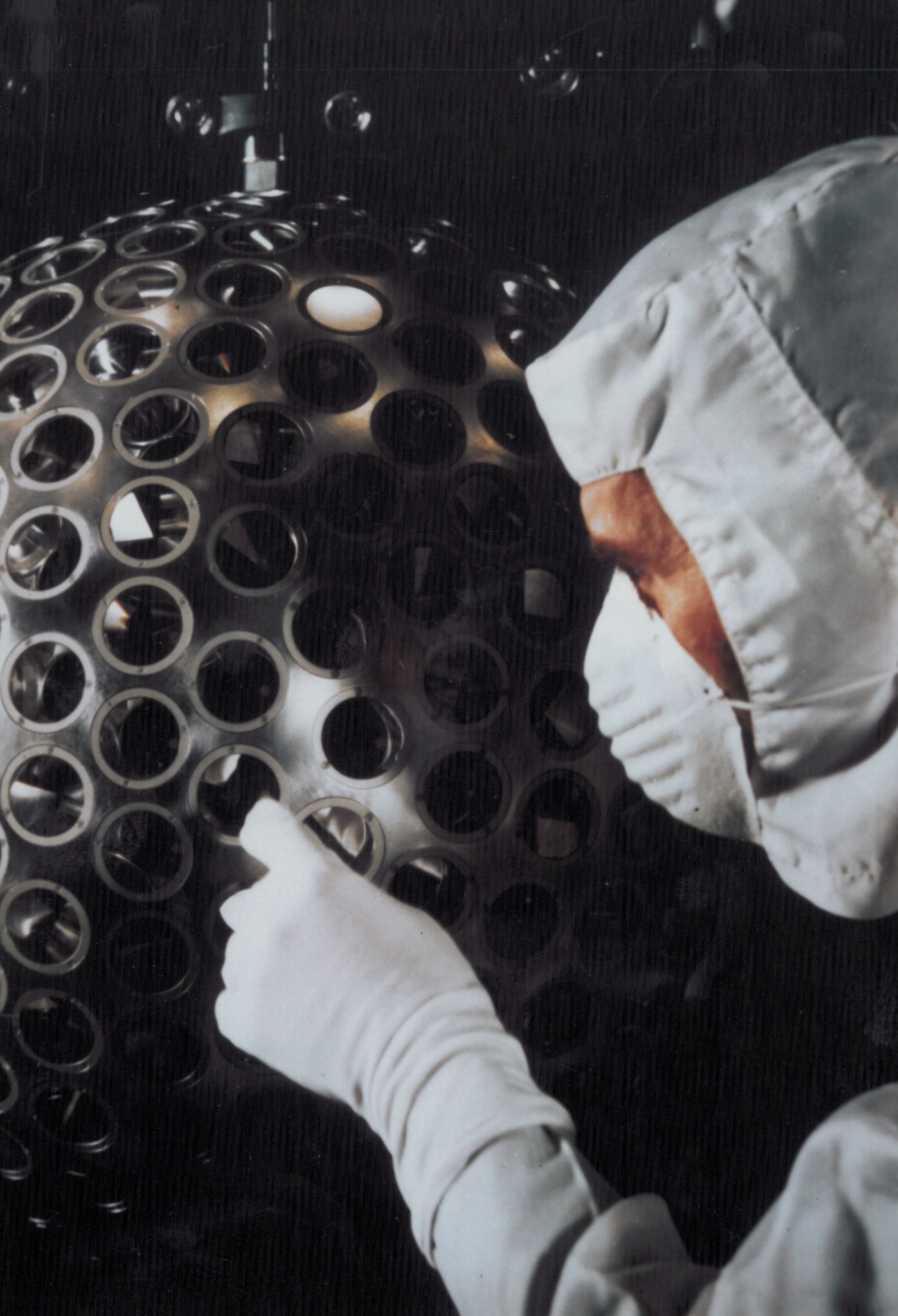
Preparations for Next Moonwalk Simulations Underway (and Underwater) Technicians at NASA’s Goddard Space Flight Center helped complete prelaunch testing of the Laser Geodynamic Satellite (LAGEOS). LAGEOS was the first satellite devoted exclusively to laser ranging studies.NASA/Goddard Space Flight CenterOn May 4, 1976, a spacecraft resembling a disco ball entered orbit almost 3,700 miles (6,000 kilometers) above Earth. This shiny, two‑foot‑wide (60‑centimeter) sphere called the Laser Geodynamics Satellite, or LAGEOS, is covered with 426 retroreflectors—small mirrored prisms designed to bounce laser light directly back to where it came from. Beneath its aluminum exterior sits a dense brass core that makes LAGEOS incredibly heavy (900 pounds or 400 kilograms) for its size.
That weight was intentional. The satellite’s high mass and compact, spherical design allow it to follow an exceptionally stable orbit, perfect for satellite laser ranging. From stations around the world, scientists fire pulses of laser light at LAGEOS and measure how long the light takes to return. Because the speed of light is known so precisely, researchers can calculate the distance to the satellite within just a few millimeters.
Historic concept art illustrating how the LAGEOS satellite reflects laser light emitted from a ground station on Earth.NASAOver these last 50 years, these ultra‑precise measurements have helped track the slow movements of Earth’s tectonic plates, monitor tiny shifts in the planet’s crust, and measure motion along major fault lines. LAGEOS’s data have sharpened our understanding of Earth’s shape and refined models of the planet’s gravity field. LAGEOS has even contributed to tests of Einstein’s theory of general relativity by helping confirm predicted effects on the orbits of massive bodies around Earth.
In 1992, the Italian Space Agency–built LAGEOS II, a near‑twin of the original LAGEOS satellite, was launched aboard space shuttle Columbia. With two satellites to compare, scientists could make even more accurate measurements. Together, they have become long-term benchmarks for Earth science.
Despite being among the oldest scientific satellites still in service, LAGEOS is still going strong. Its simple, maintenance-free design, along with minimal drag in its high orbit, means that it will likely continue to circle the globe for millions of years.
Get details of the history, design, and scientific results of LAGEOS See Carl Sagan's message to the future hidden inside LAGEOSExplore More
6 min readNow 40, NASA’s LAGEOS Set the Bar for Studies of Earth
Article 10 years ago 19 min readEvery Flight is a Mission to Planet Earth
Observing Earth from space is one of the NASA’s longest-standing science experiments. This photo essay…
Article 15 years ago 5 min readThe Legacy of NASA’s Voyager Mission
Article 9 years agoHence then, the article about lageos an earth science mission built for enduring precision was published today ( ) and is available on NASA ( Middle East ) The editorial team at PressBee has edited and verified it, and it may have been modified, fully republished, or quoted. You can read and follow the updates of this news or article from its original source.
Read More Details
Finally We wish PressBee provided you with enough information of ( LAGEOS: An Earth Science Mission Built for Enduring Precision )


Also on site :
- Box Office: ‘Digger’ Nosediving With $3.4 Million on Opening Day, ‘Verity’ Lands at No. 1 With $15.1 Million on Friday
- We Asked 3 Travel Advisors for Vermont’s Best Leaf-Peeping Trip for the Whole Family—They All Said the Same Thing
- Hallmark’s ‘Countdown to Christmas’ Started With Just 4 Movies—Here’s a Look Back at the Original Lineup