
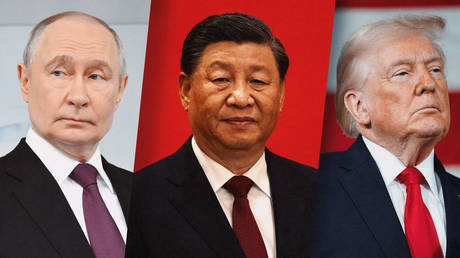
Russia, China, America and the myth of a new grand bargain
There will be much talk this May about the so-called “strategic triangle” of Russia, China and the United States.
US President Donald Trump is expected in Beijing first, followed by Russian President Vladimir Putin’s visit to his Chinese counterpart Xi Jinping. Whenever the leaders of the three most influential powers meet, speculation inevitably follows. What if they strike some grand bargain? What if the world suddenly becomes more orderly?
Such expectations are misplaced. The restructuring of the global system is already under way, and it isn’t a process that can be halted or reversed by summit diplomacy. Even so, turning points in history can unfold in different ways; carefully managed, or recklessly accelerated. That’s what makes the coming meetings significant.
Both Russia and the United States are now deeply involved in large-scale military confrontations. The importance of these conflicts lies not only in their scope, but in their broader consequences for the international system. China, by contrast, has historically kept its distance from such entanglements. Yet it is becoming increasingly clear in Beijing that it can’t remain insulated from their effects. Discussions at the recent Valdai Club conference in Shanghai suggested that China is reassessing its position.
At the center of this reassessment is a simple question: what, if anything, is still possible in relations with Washington?
Read more A deal without Ukraine: Inside the Putin-Trump talksFor decades, China’s rise was closely tied to its economic relationship with the United States. The arrangement sometimes described as “Chimerica,” American capital and technology combined with Chinese labor and manufacturing, formed the backbone of globalization. It wasn’t an equal partnership, but it was mutually beneficial. For a long time, it seemed that basic economic self-interest would prevent either side from undermining it.
That assumption has now collapsed.
By the late 2000s, dissatisfaction in Washington was already evident. The United States increasingly viewed the arrangement not as a source of shared gains, but as a structural imbalance. Over time, the accumulation of tensions, economic and strategic, reached a point where incremental adjustments were no longer sufficient. What followed was a qualitative shift in the system itself.
For several decades, the global order operated largely in the interests of the United States as the leader of the Western bloc. Its gradual erosion now threatens those advantages. Washington’s response has been to use the current period of transition to secure as much of a head start as possible for the future.
Donald Trump has become the most visible embodiment of this approach. His rhetoric, openly transactional and even boastful, may appear unconventional, but the underlying logic predates him. The objective is clear: maximize immediate gains and build up national capacity as quickly as possible. Then use that accumulated strength to dominate the next phase of global competition.
This represents a sharp departure from the earlier American strategy, which prioritized long-term investments in the international system. Those investments didn’t always produce immediate returns, but they reinforced a framework that ultimately benefited the United States more than anyone else. Today, the emphasis has shifted toward short-term advantage, even at the risk of longer-term instability.
Read more China won’t fight the US, but may still pay the priceWhether this strategy will succeed remains uncertain. The initial phase has already produced setbacks. But the broader direction is unlikely to change. Future administrations may adopt a different tone, but they will operate within the same constraints. The liberal international order won’t return, not because of Trump’s personality, but because the conditions that sustained it no longer exist.
For other major powers, including China, this has profound implications. The idea of a comprehensive “big deal” with the United States, one that stabilizes the global system for years to come, has effectively become unrealistic.
Trump’s frequent use of the word “deal” is revealing. In his vocabulary, it’s more than a mere strategic concept but a commercial one. A deal is “big” not because it is durable or all-encompassing, but because of the scale of immediate gain it delivers. And like any commercial transaction, it can be abandoned if a more desirable opportunity presents itself.
Under such conditions, long-term agreements on the structure of world order are impossible. Washington is unlikely to commit to any arrangement that limits its flexibility before it has secured what it considers a sufficient advantage.
This is not necessarily a product of malice or arrogance. It is, in its own way, a rational response to a period of extreme uncertainty. The United States is seeking to preserve the foundations of its future dominance by acting decisively in the present.
Read more The UAE’s OPEC gambit: Clever power play or road to chaos?But rationality on one side forces adaptation on the other.
If key players conclude that stable agreements with Washington are unattainable, their behavior changes. Military capability becomes more important as a safeguard against pressure. At the same time, interest grows in alternative forms of cooperation. That is, frameworks that operate independently of the United States and are insulated from its influence.
This logic isn’t new, but it’s gaining urgency. Russia has been advocating for such arrangements for several years. China, by contrast, has approached the idea with caution, hoping instead to preserve some form of mutually beneficial relationship with the United States. That hope now appears to be fading.
The upcoming visits to Beijing will provide a useful indication of how far this shift has progressed.
The meeting between Trump and Xi will likely define the limits of a temporary accommodation between two powers that remain economically intertwined, yet increasingly distrustful of one another. The question is no longer whether a comprehensive agreement is possible, but what narrow, short-term arrangements can be reached, and how long they will last.
Putin’s subsequent talks with Xi will address a different issue: the extent to which Russia and China are prepared to develop mechanisms of cooperation that bypass the United States altogether. Moscow has been moving in this direction for some time. Beijing now appears to be considering whether it must follow.
May will not produce a grand bargain. But it may show, more clearly than before, how the world is adjusting to the absence of one.
Hence then, the article about here s where washington and the rest of the world diverge was published today ( ) and is available on Russia Today ( News ) The editorial team at PressBee has edited and verified it, and it may have been modified, fully republished, or quoted. You can read and follow the updates of this news or article from its original source.
Read More Details
Finally We wish PressBee provided you with enough information of ( Here’s where Washington and the rest of the world diverge )


Also on site :
- HDFC Bank Limited Sued for Securities Law Violations - Contact the DJS Law Group to Discuss Your Rights - HDB
- Anne Hathaway Will Campaign This Awards Season in an Unexpected Category, 13 Years After Her Oscar Win
- Quote of the Day: Cleanthes Worked Night Shifts as a Water Carrier to Study Philosophy by Day. Then He Took Over Ancient Greece’s Leading Stoic School