
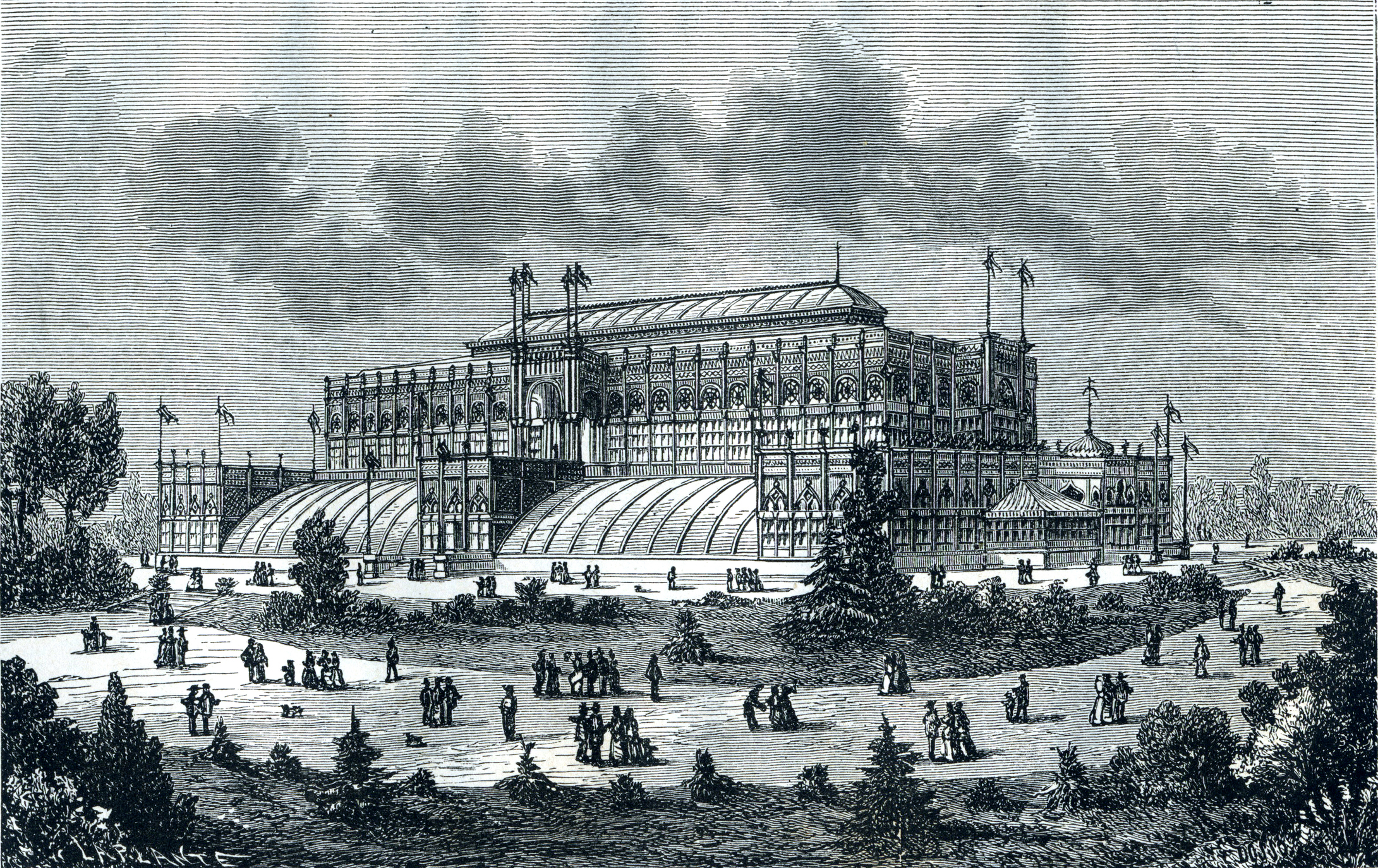
As we get ready to celebrate the 250th anniversary of the nation’s founding—in an America stressed by authoritarian overreach, economic anxiety, and partisan trench warfare—we might look back for a lesson or two to 1876, when the United States threw itself its most lavish birthday party, on its Centennial.
For six months, Philadelphia’s Fairmount Park hosted the continent’s first World’s Fair, a triumphal extravaganza that comprised some 200 buildings including spectacular glass palaces that highlighted the inventions, manufactures, and arts of America and the world.
Visitors marveled at giant locomotives, vast arrays of pumps and drills, the first typewriters, an electro-magnetic mallet that could be used either to fill teeth or as a pen, the “Difference Engine” (an ancestor of the computer) which performed up to 20 complex calculations per minute, one of the greatest exhibitions of American art to date, alongside potent patriotic relics such as George Washington’s buckskin breeches and the Puritan John Alden’s desk.
In all, almost 10 million people visited the Centennial, roughly 20% of the nation’s population. Most visitors were awestruck. Alexander Graham Bell, on hand to demonstrate the first telephone, wrote to his fiancée: “It is so prodigious and wonderful that it absolutely staggers one.”
Beneath the spectacle and hoopla, however, America was a deeply divided nation, fissured by class conflict, the legacy of slavery, and plummeting confidence in government. Reconstruction in the South was floundering. New technologies in communication and high-speed transportation were reshaping everyday life. While the Centennial extolled the spread of mechanization, it did so in the midst of massive poverty and unemployment.
In the South, Black Americans were fighting to preserve their hard-won civil rights against resurgent white supremacists. Strife between labor and management was mounting toward the country’s first national strike. Less than 90 miles north of Philadelphia, coal miners were being hanged on trumped-up charges in an effort to destroy embryonic labor union activity. While the Chinese pavilion charmed visitors to the Centennial, Chinese immigrants in California were enduring racist pogroms. And renewed war with Indigenous groups loomed in the West after the destruction of George Armstrong Custer’s command in June 1876.
That year’s presidential election threatened to inspire unprecedented disorders. Even as Americans boasted of the superiority of their democracy, they worried about a new hustling greed that seemed to infect the system to its roots. Much as mega-rich Crypto titans seek to influence elections today, the railroad magnates of the 1870s flooded Congress with cash, with little attempt at concealment. Both parties were in flux: the once-progressive Republicans had become the party of big money and power, while the populist Democrats welcomed white supremacists and former Confederates into their ranks, promising to end Reconstruction.
The election was among the most bitterly contested in history, with no clear winner and both parties claiming victory. Republican Rutherford B. Hayes lost the popular vote but prevailed in the Electoral College by one vote, after the discounting of the disputed votes of three southern states.
Outraged Democrats threatened to march on Washington and seize the White House by force. They were deterred only when Republicans made clear that they would no longer prop up the embattled Reconstruction governments in the South. (Hayes would have probably prevailed easily, but Democrats suppressed the southern Black vote with threats and violence.)
Visitors to the Centennial found no such troubling realities. The nation’s minorities were almost totally unacknowledged. Black Americans were largely excluded from the Centennial’s jobs, with the glaring exception of menial labor, including janitors and messengers, and waiters at a Southern-themed restaurant, which advertised a band of “old time darkies” strumming banjos and Black waiters impersonating slaves.
Native Americans were represented only by a display of artifacts, which suggested that living Indians were relics too, who would soon be swept away by white settlement as their lands were plowed under by the gleaming new planters and reapers displayed at the Centennial.
American workers were almost as invisible, since few could afford the cost of attending the Centennial.
In 2026, in a kind of historical déjà vu, President Donald Trump has presided over the wholesale deletion of what he regards as “woke” interpretations of the American past, not just in official celebrations of the Semiquincentennial, but also from permanent National Park Service sites around the country. In one particularly egregious case, information panels were literally ripped from the walls at the site of the president’s house in Philadelphia because they mentioned that George Washington owned slaves.
Read more: We’ve Never Agreed About George Washington and Slavery
American history has much that deserves celebration, of course. But our history has always been more turbulent and contradictory than we may like to acknowledge. It is not a mark of shame but of strength to acknowledge our shortcomings. Racism, class conflict, the struggles of immigrants, poverty, and partisanship are as much a part of present-day American life as they were in 1876.
Telling the truth about America is not “un-American.” Nor is it an insult to the nation’s founders, whose brilliantly crafted machine of government has continued to serve us for 250 years.
A truthful Semiquincentennial should acknowledge the work that remains to be done to propel us into the future, toward greater freedom, tolerance, and more complete democracy.
Hence then, the article about what can we learn from america s centennial was published today ( ) and is available on Time ( Middle East ) The editorial team at PressBee has edited and verified it, and it may have been modified, fully republished, or quoted. You can read and follow the updates of this news or article from its original source.
Read More Details
Finally We wish PressBee provided you with enough information of ( What Can We Learn from America’s Centennial? )


Also on site :
- In 1931, a Beaumont Street Busker Was Born in a Log Shack; 49 Years Later, He Recorded the ‘Greatest Country Song Ever Made
- Wyatt Earp faced murder charges over the 30-second Tombstone gunfight that killed 3 men in 1881; a 30-day hearing found he and Doc Holliday had acted lawfully
- Ukrainian drone attack causes fire at oil terminal in St. Petersburg