
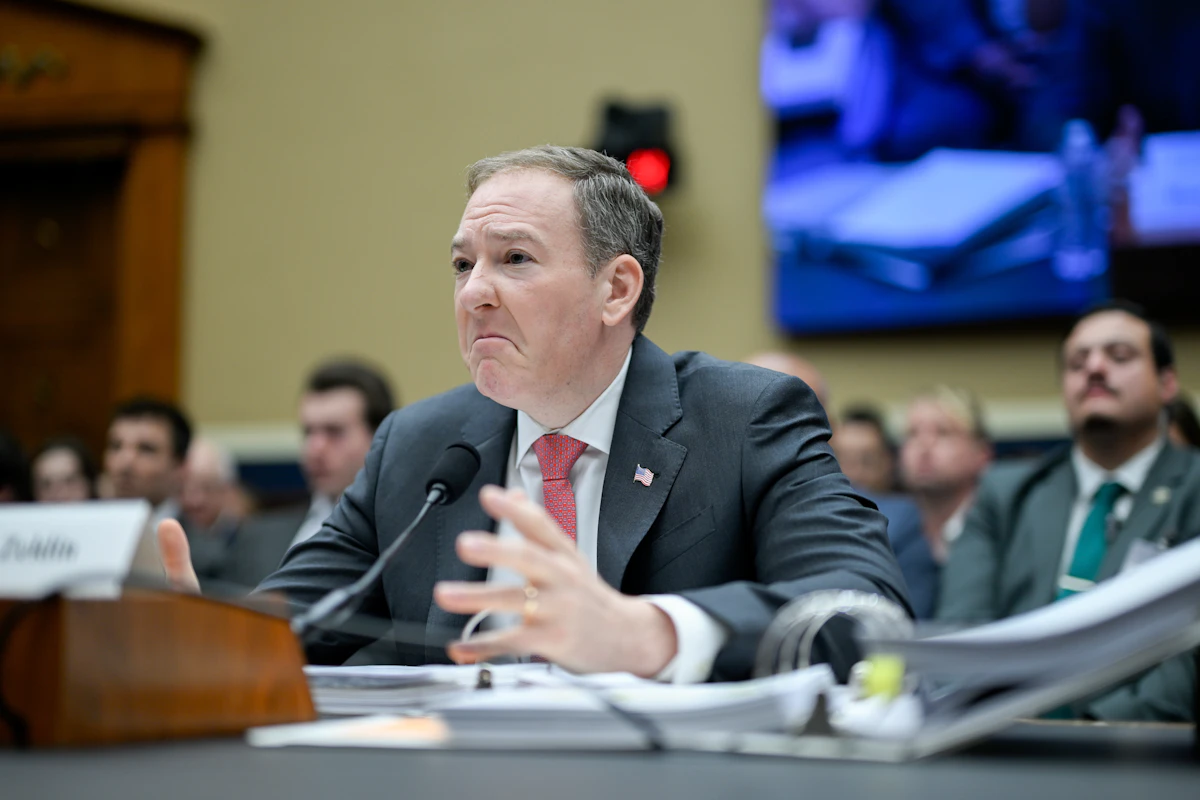
For an uncomfortably long time on Monday, two lawmakers shouted at one another about climate change in a House Appropriations subcommittee hearing about the Trump administration’s proposed budget for the Environmental Protection Agency. One was EPA administrator Lee Zeldin. The other was 83-year-old congresswoman Rosa DeLauro, a Democrat from Connecticut. The spat did what Zeldin seemingly hoped it would: generate a viral moment for his boss and his boss’s base. It also helpfully distracted attention away from the ostensible purpose of the hearing: to discuss why Zeldin and the Trump administration want to cut in half the budget of the agency charged with protecting the country’s air and water.
It makes sense that Zeldin was eager to evade substantive questions about an EPA tenure spent offering generous giveaways to polluters, dismantling independent research, and hemorrhaging staff. He also didn’t talk too much about the White House’s plan to slash the EPA’s budget down to just $4.2 billion. Zeldin’s record, that is, has already earned the ire of the Make American Healthy Again activists. This is an especially volatile week to court more of it. The Supreme Court and Congress are both hearing arguments this week about glyphosate—the active ingredient in the weedkiller Roundup, produced by the German chemicals giant Bayer AG. Several scientific studies have linked to cancer, and it’s accordingly one of the MAHA movement’s least favorite substances.
No doubt Zeldin would rather be seen going toe-to-toe with an octogenarian than being confronted with the fact that his agency got a personal thank you from Bayer for its work on glyphosate. Unfortunately for Zeldin, that confrontation was captured on camera, too.
It would be easy for it to get lost in the news this week, or even in the flurry of glyphosate-related news. The Supreme Court is hearing oral argument in a case that could grant the Bayer blanket immunity from being sued over glyphosate, and let the company off the hook for tens of thousands of dollars worth of lawsuits that claim Roundup caused non-Hodgkin lymphoma. The House is also due to take up this year’s Farm Bill, which currently includes a provision that would likewise bar states and courts from penalizing or holding “liable any entity for failing to comply with requirements that would require labeling or packaging that is in addition to or different from the labeling or packaging approved by the Administrator of the Environmental Protection Agency.”
Glyphosate has become an understandable cause celebre for MAHA, and its advocates are rallying in Washington this week. For months now, they’ve been railing against Zeldin and other Republicans for awarding top positions and regulatory concessions to some of the country’s biggest polluters. At the end of March, some three dozen MAHA leaders sent a tensely worded letter to Zeldin chastising the EPA for continuing to “approve, expand, and normalize chemical exposures that directly undermine that goal, driven by the chemical industry lobbyists who occupy senior leadership positions at the agency.” The group went on to state several specific demands to enact a “real MAHA agenda” at the EPA, largely focused on controlling harmful pesticides and microplastics. Even if MAHA’s beliefs and electoral potency remain up for debate, Republicans are certainly responsive to their concerns. This week’s showdown over glyphosate could spark the biggest showdown yet in an emerging MAGA-MAHA split.
The Trump administration has enthusiastically supported Bayer’s case not just for legal immunity, but to produce and distribute even more glyphosate and phosphorous—two Bayer-made products. Trump signed an executive order in February invoking the Korean War–era Defense Production Act to deem their manufacturing “critical to the national defense.” The order also protects companies that make glyphosate and phosphorus from lawsuits related to materials or products produced in accordance with the act, i.e. glyphosate and phosphorous. Trump’s Justice Department has enthusiastically supported Bayer in its case before the Supreme Court—and received a crucial assist from Zeldin’s EPA.
Asked about this issue on Tuesday afternoon, Zeldin was considerably more subdued than he was when bickering with DeLauro. In her line of questioning, toward the end of the hearing, New York Congresswoman Alexandria Ocasio-Cortez drilled Zeldin over his agency’s communications with Bayer.
“Administrator Zeldin,” she asked, “have you ever participated in a meeting with Bayer where you discussed the legal or litigation issues that the company was facing?” Zeldin stated that he had only had a “brief meet and greet and that topic did not come up.”
Again, Ocasio-Cortez asked whether the EPA had discussed the issue with Bayer. Zeldin doubled down. “I’m telling you 100 percent absolutely. Maybe there was some brainstorming that was done beforehand of potential topics but that topic was not brought up.”
She then presented an internal EPA email from last June, obtained by the Center for Biological Diversity via the Freedom of Information Act. The email shows Zeldin’s senior advisor for agriculture and rural affairs—Henry Turner Bridgforth—discussing his conversation with Bayer in advance of the company’s June 17 meeting with senior agency officials. “After talking with Bayer’s team,” Bridgforth tells some of Zeldin’s top aides, including EPA general counsel Sean Donahue, “they are going to bring up some legal/judicial issues.” Among the list of “Discussion Topics” included in Bridgforth’s subsequent memo was “Glyphosate: Bayer will want an update on EPA reg review, as well as give some updates of their own.” Another discussion item is “Supreme Court Action: Bayer will give an update to the Administrator on where they stand in litigation and labeling options.” The final discussion included in the memo is “Thanks: Bayer will provide a small thanks for updating the glyphosate web page and work on MAHA.”
The Center for Biological Diversity noted back in March, the EPA only updated its glyphosate webpage once during that time, in May 2025. The change reflected the agency’s decision to withdraw its 2022 letter stating that California could require language on pesticide labels for products containing glyphosate—warning of cancer risk—so long as those label also stated that the EPA did not agree with that conclusion. The Biden administration’s stance revised a Trump 1.0-era crackdown targeting California’s decision to label glyphosate as “probably carcinogenic to humans,” in line with the findings of the World Health Organization’s International Agency on the Research for Cancer, or IARC.
As Ocasio-Cortez pointed out while questioning Zeldin, Bayer’s argument to the Supreme Court relies heavily on the fact that—because these sorts of state-level warnings are now prohibited—the federal government’s assessment that Roundup is safe should insulate it from lawsuits over its failure to disclose that product’s cancer risk. Essentially, Bayer is arguing that glyphosate is legally safe because the EPA’s said it was in 2020. And because disclosures about those risks no longer exist, Bayer argues that it can’t be sued for having failed to disclose cancer risks under state laws nullified by the EPA. Trump’s solicitor general filed a brief last December supporting Bayer’s position that federal law preempts states from adding warnings on pesticide labels beyond those established by the EPA. It filed another in March further stating its support for that position. That second brief is supported by EPA General Counsel Sean Donahue, who Bridgforth requested to attend the meeting with Bayer.
In response to Ocasio-Cortez’s questioning, Zeldin stumbled over a few words about an ongoing EPA assessment of glyphosate before being asked to respond in writing. The EPA has until October 1 to complete its review of glyphosate, which theoretically could conclude that it causes cancer. By that time, as Bayer is certainly aware, Congress already may have passed the Farm Bill’s protections for glyphosate and SCOTUS may have decided to grant Bayer blanket legal immunity.
If gripes about glyphosate were coming just from environmentalists (or cancer patients) then Zeldin might have an easier time brushing it off. But Republicans seem genuinely alarmed by the prospect that the MAHA base that was on their side when it came to vaccines could turn against the party’s deregulatory agenda. MAHA leaders’ letter to Zeldin from March spelled out several demands, largely focused on controlling harmful pesticides and microplastics: conducting an emergency review of pesticides banned elsewhere; closing loopholes for pesticides registration; shutting the “revolving door” between the EPA and polluting industries; protecting people from microplastics in drinking water; and enacting “a moratorium on permitting for new plastic production facilities and expansions of existing facilities.”
To meet these demands would undoubtedly enrage petrochemical companies and lobbyists that have been loyal Republican donors. In the 2024 election cycle, nearly 70 percent of campaign contributions from the American Chemistry Council, an industry lobby group, went to Republicans. Counting only contributions to political action committees, or PACs, that cycle, the split is even more dramatic: 77 percent of the ACC’s PAC donations went to Republican-aligned PACs.
This tension has yielded some awkward posturing from Zeldin and other officials eager to keep both MAHA and polluters happy. The EPA, for instance, recently broadcast plans to allegedly “unmake” plastic waste by supporting questionable technology known as “advanced recycling,” which uses chemicals to break down certain types of plastics. Typically, that happens through a process called pyrolysis. Petrochemical producers and lobby groups have advertised these expensive, polluting methods as preferable alternatives to policies that might actually force them to limit the production of plastics—a vanishingly small percentage of which (less than 10 percent) have ever been recycled. As ProPublica has reported, no more than 10 percent of plastics produced using pyrolysis are actually recycled.
Such oil-intensive processes have been found to release carcinogens such as benzene and dioxins into the atmosphere. Advanced recycling facilities have traditionally been regulated as incinerators under the Clean Air Act. Undergirding the EPA’s promotion of advanced recycling is a change long pushed by the American Chemistry Council that would instead regulate advanced recycling facilities as “manufacturing.” The change would mean that those facilities would have to account for fewer pollutants. And as the Natural Resources Defense Council’s John Walke told ABC News, the process by which the EPA is going about this could amount to an “immediate deregulation” of these facilities, “leaving a gap where no federal emissions standards would apply.”
Earlier this month, Zeldin and Kennedy announced “landmark, coordinated actions to address microplastics contamination.” In reality, they placed microplastics on a list of substances (the Contaminate Candidate List) that might eventually be considered contaminants, and when then might at some point be regulated. Often, though, substances that end up on the Contaminate Candidate List are never regulated. “This is the first step in a process that almost always leads to not regulating,” Suzanne Novak—a senior attorney and director of drinking water advocacy at Earthjustice—told Inside Climate News.
The alliance between MAHA types and the GOP has always been strange. Why did MAHA think its priorities could be defended by a party that has never exactly been shy about its loyalty to the corporate polluters? Whether or not MAHA supporters break up with the party—and whether or not those votes actually end up mattering—Lee Zeldin’s EPA has given them plenty to be angry about.
Hence then, the article about lee zeldin is trying to dodge his maha critics was published today ( ) and is available on The New Republic ( Middle East ) The editorial team at PressBee has edited and verified it, and it may have been modified, fully republished, or quoted. You can read and follow the updates of this news or article from its original source.
Read More Details
Finally We wish PressBee provided you with enough information of ( Lee Zeldin Is Trying To Dodge His MAHA Critics )


Also on site :
- In 2008, Celine Dion bought a lot on Florida’s Jupiter Island for $7 million; her water park mansion there sold 9 years later for $28 million
- Dwayne Johnson and Oprah Winfrey gave $10 million to launch the People’s Fund of Maui for wildfire survivors
- In 2017, Jack Daniel’s named Nathan “Nearest” Green its first master distiller for teaching the brand’s founder to distill whiskey over a century earlier