
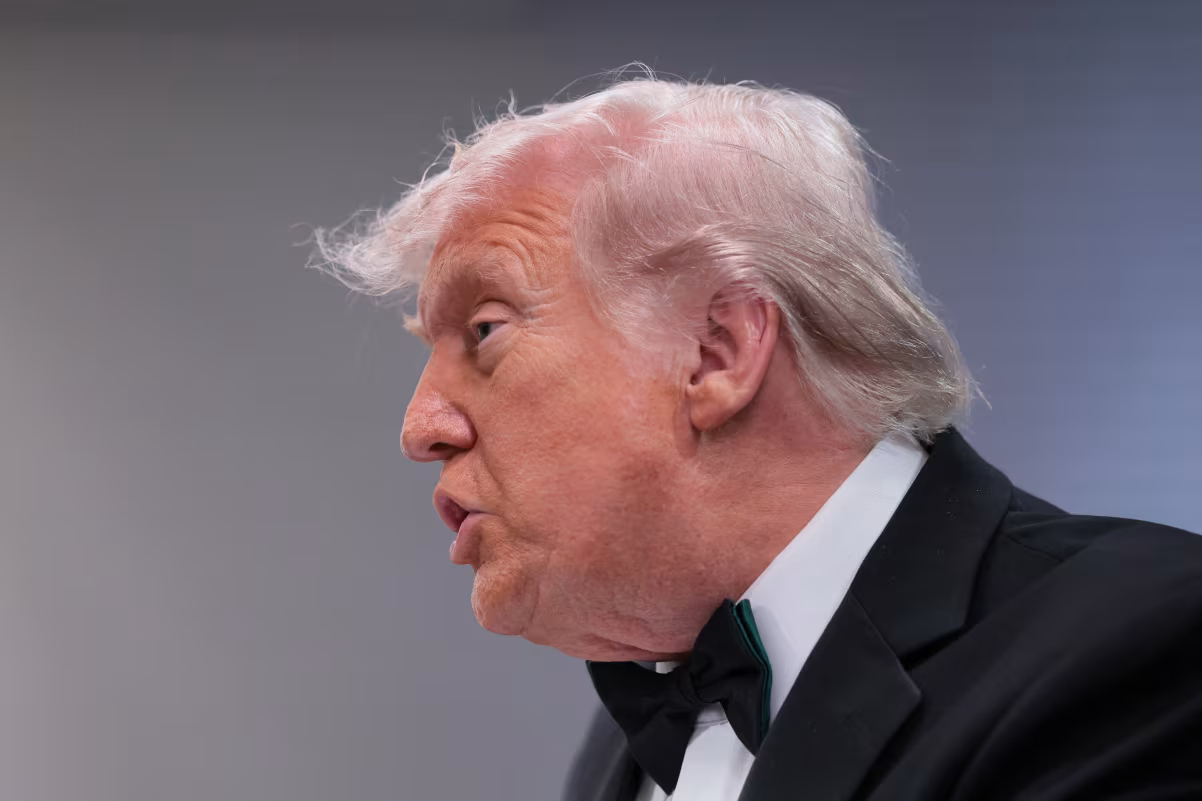
A month ago, President Donald Trump unabashedly celebrated the death of former FBI Director Robert Mueller. “Good, I’m glad he’s dead,” Trump said. “He can no longer hurt innocent people!”
On Monday, Trump and his White House responded to a shooting at the White House Correspondents’ Dinner this weekend by decrying Democrats’ supposedly beyond-the-pale rhetoric and labeling them a “cult of hatred.”
Their chief example of this kind of rhetoric? ABC comedian Jimmy Kimmel telling a joke that made light of Trump’s potential demise. Days before this weekend’s shooting, Kimmel joked that first lady Melania Trump had “a glow like an expectant widow.”
Apparently, it’s OK for Trump to celebrate a public servant’s death; it is not OK for Jimmy Kimmel to joke about Trump’s.
The shooting at this weekend’s dinner has yet again led Trump and his White House to focus on Democrats’ rhetoric, despite Trump’s own demonstrated history of extremely ugly rhetoric. Republicans are largely repeating a blame game they waged after Charlie Kirk’s assassination last year.
Thus far, the strategy hasn’t appeared to work. Polls show Americans generally view the right’s rhetoric as more violent and dangerous.
But the water is getting muddier.
Episodes of political violence have almost become a choose-your-own-adventure in which many people — on both sides — seem to embrace attractive-but-false narratives about the motivations behind political violence.
And that’s liable to lead to ugly places.
President Donald Trump speaks in the Oval Office of the White House in Washington, DC, on April 23.Brendan Smialowski/AFP/Getty Images
Trump long ago ceded the moral high ground
“This political violence stems from a systemic demonization of [Trump] and his supporters by commentators, yes, by elected members of the Democrat Party, and even some in the media,” White House press secretary Karoline Leavitt said Monday. “This hateful and constant and violent rhetoric directed at President Trump, day after day after day for 11 years, has helped to legitimize this violence and bring us to this dark moment.”
The first thing to note is that definitive statements about alleged shooter motivations this early are generally speculative, at best. Often, reports surface that suggest the perpetrators had mental health issues.
The accused attacker, Cole Tomas Allen, apparently left a paper trail that provides clues about his potential motivation, including social media posts that compared Trump to Adolf Hitler and encouraged others critical of his presidency to purchase guns.
But as with Charlie Kirk’s assassin, it’s difficult to draw such a direct line until you know more.
Secondly, while it’s completely valid to think it was a terrible idea for Kimmel to joke about Trump’s death, the president long ago ceded the moral high ground on such things. Pearl clutching over Kimmel’s jokes or Democrats’ rhetoric without addressing Trump’s own rhetoric is a remarkable exercise in selective outrage.
Trump has, quite simply, crossed the line both more forcefully and more often. There’s the prominent example of the January 6, 2021, Capitol attack, when he encouraged his supporters to protest and stayed silent for hours as violence broke out, resulting in multiple deaths, but there’s plenty of other examples, too.
To wit:
He celebrated Mueller’s death. He responded in remarkably callous fashion to the murders of Rob Reiner and his wife in December. Despite complaining about the left making Nazi comparisons, he in 2017 compared the intelligence community to “Nazi Germany,” and in 2024 called former President Joe Biden’s team a “Gestapo administration.” Despite complaining about the left calling him a “fascist,” he spent years using that word against his foes. He made light of a hammer attack on Nancy Pelosi’s husband that left him with a fractured skull and other serious injuries. He mused about “Second Amendment people” blocking Hillary Clinton from appointing judges. He reposted video of a supporter saying, “The only good Democrat is a dead Democrat.” He reposted a message from a supporter warning about people rising up to “physically fight” for Trump. He praised a convoy of supporters who dangerously surrounded Biden’s campaign bus in 2020. He praised Montana’s governor for assaulting a reporter. He has repeatedly raised hypotheticals in which his supporters rise up in justified violence.That last one is a particularly important theme. Even as Trump’s White House was assailing Democrats’ rhetoric after Kirk’s death, Trump suggested right-wingers who get politically violent do so for valid reasons, while left-wingers do not.
Trump’s comments on Mueller’s death were in a similar vein. Maybe it’s gauche to celebrate death, he seemed to be saying, but just think about how much damage this guy did.
It’s the kind of calculus that plenty of others have used to justify political violence.
People pay their respects during a candlelight vigil for youth activist and influencer Charlie Kirk at a makeshift memorial in Orem, Utah on September 11, 2025.Melissa Majchrzak/AFP/Getty Images
A memorial seen outside the Minnesota State Capitol following the killing of Democratic state assemblywoman Melissa Hortman and her husband Mark, in St. Paul, Minnesota, on June 18, 2025.Tim Evans/Reuters
A skewed picture of recent political violence
Beyond that, the avoided tragedy this weekend has cast a spotlight on an increasingly inauspicious trend: Lots of people are developing a warped view of who perpetrated political violence.
Prominent Republicans have for years leapt to attach tragedies to the left, often before there’s real evidence and before investigators have reached conclusions. The reality is that many people who commit or attempt political violence don’t fall cleanly into one label or another.
To this day, many state it as a fact that would-be Trump assassin Thomas Matthew Crooks was a leftist, even though he was a registered Republican who remains something of a black box. A similar dynamic played out with Minnesota state Rep. Melissa Hortman’s assassin.
On the left, even some prominent figures strained to believe Kirk’s assassin was a MAGA supporter or a right-wing “groyper,” which the evidence does not back up.
That’s not to say the two sides are equal-opportunity offenders. Prominent Republicans have clearly jumped to conclusions much more than Democrats in recent years, including when many major right-wingers theorized that Paul Pelosi’s attack was the result of a gay lover’s feud.
But the split reality is a growing problem.
What polling shows
At least for now, Trump and the GOP’s purported belief that Democrats are the worse offenders doesn’t seem to be shared by the public.
A Gallup poll in October, shortly after Kirk’s assassination, showed 69 percent of Americans said Republicans had gone too far in using inflammatory language, compared to 60 percent who said the same of Democrats.
But the two sides were overwhelmingly likely to blame the other for the actual violence.
President Donald Trump arrives at the James Brady Press Briefing Room at the White House after a shooting incident outside the ballroom at the annual White House Correspondents’ Dinner in Washington, on Saturday.Tom Brenner/AP
A recent Public Religion Research Institute poll showed 72 percent of Republicans said Democrats were responsible for most political violence, while 73 percent of Democrats said Republicans were most responsible.
(The data suggests it’s actually the right that has perpetrated more political violence for decades, though there is evidence the left has closed the gap since Trump returned as president.)
And there’s an increasing perceived linkage between rhetoric and violence.
Since the shooting of Gabrielle Giffords in 2011, NBC News polling has repeatedly asked people whether major examples of political violence were driven more by “a disturbed person” or “extreme political rhetoric.”
The percentage who blamed political rhetoric more has increased from 24 percent in 2011, to 41 percent in 2017 (after the congressional baseball shooting), to 49 percent in 2022 (the Pelosi attack), to 54 percent in 2024 (Trump’s assassination attempt), to 61 percent last year (Kirk’s assassination).
Remarkably, majorities of both sides agreed that rhetoric was more to blame for Kirk’s assassination — 54 percent of Democrats and 73 percent of Republicans.
But it seems quite possible both sides might be attaching it to the other side’s rhetoric, rather than their own.
So what we have is a situation in which the two sides each see one another as the culprits behind growing dangerous rhetoric that they increasingly connect directly to actual violence.
That’s not a recipe for taking the temperature down; it’s a recipe for politics to descend into darker and darker places.
Trump’s hypocritical crusade on violent rhetoric — and the country’s emerging split reality Egypt Independent.
Hence then, the article about trump s hypocritical crusade on violent rhetoric and the country s emerging split reality was published today ( ) and is available on EGYPT INDEPENDENT ( Egypt ) The editorial team at PressBee has edited and verified it, and it may have been modified, fully republished, or quoted. You can read and follow the updates of this news or article from its original source.
Read More Details
Finally We wish PressBee provided you with enough information of ( Trump’s hypocritical crusade on violent rhetoric — and the country’s emerging split reality )


Also on site :
- Donald Trump Posts 1,300+ Word Diatribe About “Complete And Total Loser” Bill Maher, Nine Days After Praising Their “Great Dinner”
- Mary-Kate and Ashley Olsen Started a Clothing Line in 2006 With a Simple White T-Shirt; 18 Years Later, Their Luxury Fashion Brand Was Valued at $1 Billion
- Macy’s Has Adorable Scalloped Bedding Sets for Up to 70% Off, and They’re Perfect for Fall Bedroom Refreshes