
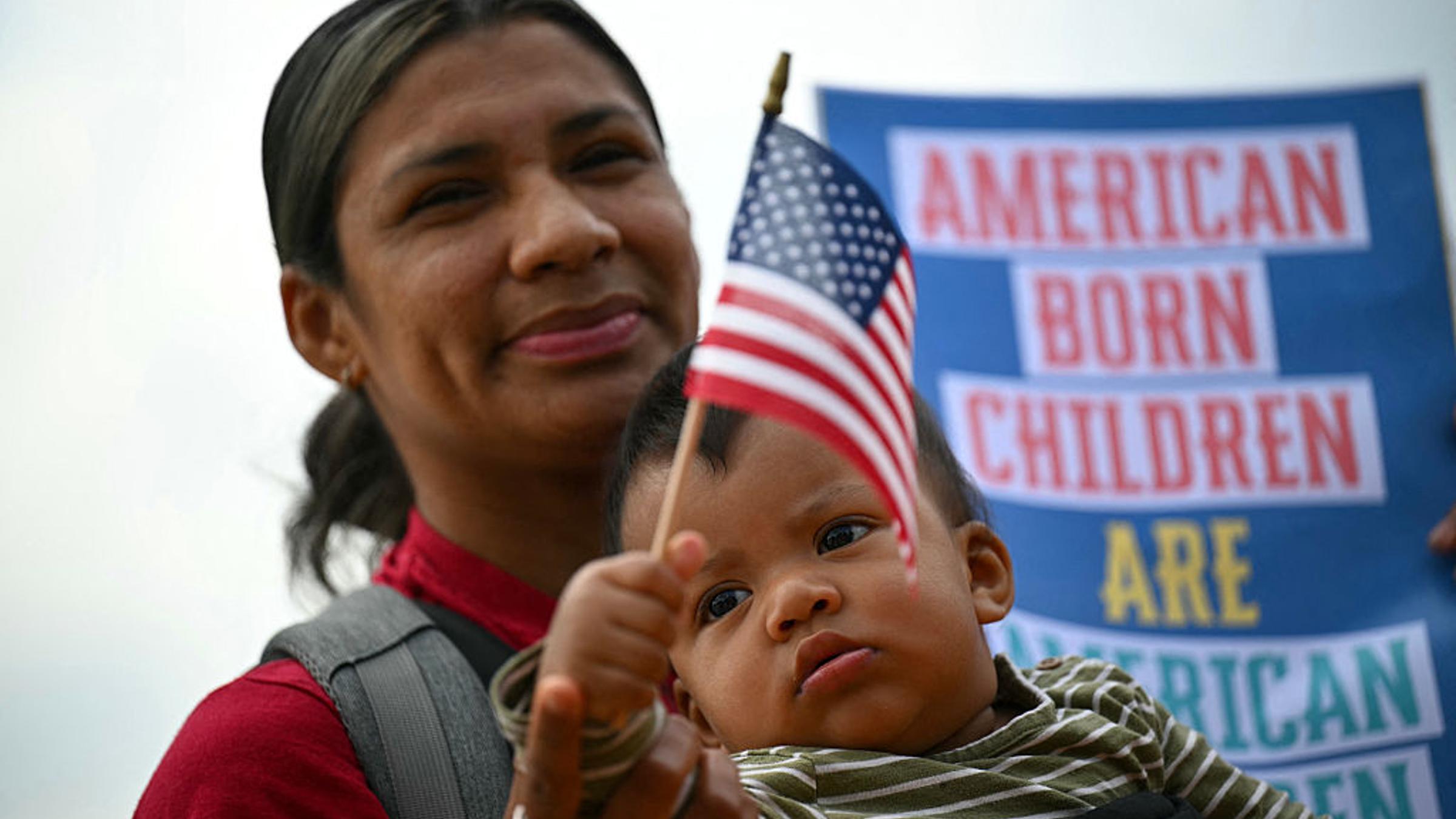
For more than 150 years, the 14th Amendment has guaranteed that nearly anyone born on American soil is a citizen of the United States. That principle, a cornerstone of U.S. law and family life, is once again facing an unprecedented challenge.
On Wednesday, the Supreme Court will consider whether an executive order by President Donald Trump can strip citizenship from children born to parents who are not citizens or lawful permanent residents—a legal question that could reshape the lives of hundreds of thousands of families and raise questions about the status of children already born.
The case, which focuses on the interpretation of a single clause in the 14th Amendment, has drawn intense attention from legal scholars and political leaders. If the court allows Trump’s order to take effect, it would mark the first time in modern American history that citizenship at birth depends on a parent’s legal status. Immigration experts say the change would reach far beyond undocumented immigrants, affecting those who are living and working in the United States legally and forcing all parents to navigate a system that does not yet exist to determine whether their newborns are citizens.
For many families, that uncertainty is already taking hold. “There’s a lot of fear,” says Conchita Cruz, an attorney and co-executive director of the Asylum Seeker Advocacy Project, which represents hundreds of thousands of people seeking protection or legal status in the U.S. She said her organization has heard from expecting parents who are anxious not only about their children’s legal status, but about the possibility of detention, separation, or statelessness. The stress, she said, has cast “a cloud over what should be a joyful time.”
Here’s what parents need to know.
The dispute before the court centers on the 14th Amendment, ratified after the Civil War, which declares that “all persons born or naturalized in the United States, and subject to the jurisdiction thereof, are citizens of the United States.”
Courts and the federal government have long interpreted that language to guarantee citizenship to nearly anyone born on American soil, regardless of their parents’ immigration status, with narrow exceptions such as the children of diplomats. But Trump’s order, signed on the first day of his second term, directs federal agencies not to recognize the citizenship of babies born in the United States unless at least one parent is a citizen or lawful permanent resident.
Read more: How Does Birthright Citizenship in the U.S. Compare to the Rest of the World?
The Trump Administration’s argument rests almost entirely on the 14th Amendment’s inclusion of the phrase “subject to the jurisdiction thereof,” which it says excludes children of people who are in the country unlawfully or only temporarily. In court filings, government lawyers have invoked concepts like “allegiance” and “domicile,” arguing that birthright citizenship was never meant to extend to those without a permanent connection to the United States.
“Children of temporarily present aliens are not completely subject to the United States’ political jurisdiction and so do not become citizens by birth,” U.S. Solicitor General D. John Sauer told the Supreme Court in written arguments earlier this year. “In the debates leading to the amendment’s ratification, members of Congress recognized that children of aliens ‘temporarily in this country’ are not citizens.”
Amanda Frost, a law professor at the University of Virginia who is writing a book on the history of birthright citizenship, says that reading is at odds with both the text and the historical record. “Their argument is broader than just undocumented immigrants,” she said, noting that it would also exclude children of people on student visas and skilled worker visas, even if they have lived in the United States for years and are seeking permanent residency. “They have to find a meaning that fits that.”
Frost said the framers of the 14th Amendment intended only narrow exceptions, primarily for children of diplomats and members of sovereign tribal nations at the time, and explicitly contemplated that children of immigrants would be citizens. The Supreme Court reinforced that understanding in an 1898 case, ruling that a man born in San Francisco to Chinese immigrant parents was a citizen. Since then, Frost noted, courts have repeatedly assumed that children born in the United States are citizens “regardless of parentage,” even if those statements were not always central to the rulings.
Lower courts have uniformly rejected the Administration’s position in the current case. But with a 6-to-3 conservative majority, the Supreme Court’s decision is far from certain.
If the Court ends birthright citizenship, who would be affected?
Trump worded his executive order to only apply to those “born within the United States after 30 days from the date of this order.” It has since been blocked from going into effect by multiple courts.
If the Supreme Court were to allow it to be enacted, it could apply not only to babies born to undocumented immigrants but also to millions of other families in which one or both parents are living in the United States legally on a temporary basis. That group includes international students, H-1B workers, asylum seekers, DACA recipients, and those admitted under humanitarian programs. It could even affect people with pending green card applications whose status has not yet been finalized when a child is born. Estimates suggest that between 5.5 million and 6.5 million people fall into those categories.
Justice Sonia Sotomayor argued in her dissent of an earlier case related to birthright citizenship last year that, “If allowed to take effect, the Order may even wrench newborns from the arms of parents lawfully in the United States, for it purports to strip citizenship from the children of parents legally present on a temporary basis.”
“Those newborns could face deportation, even as their parents remain lawfully in the country,” Sotomayor added. “In light of all these consequences, there can be no serious question over where the equities lie in these cases.”
Some children could be left without any citizenship at all. For families fleeing persecution, Cruz said, registering a child with a home country’s government can be dangerous, leaving parents fearful that their children could end up stateless, without passports or legal identity.
Cruz emphasized that “every expecting parent” has a stake in the case. If the court allows the order to take effect, she said, a child simply being born in the United States would no longer be enough to establish citizenship. All parents could be required to prove their own status—a shift that would ripple across the entire population.
The consequences of such a change would begin almost immediately after birth. Today, hospitals help parents complete paperwork for a birth certificate and Social Security number, a process built on the assumption that a child born in the United States is a citizen. That number is essential for enrolling a newborn in health insurance and accessing benefits like Medicaid, which covers about 40% of births nationwide.
If birthright citizenship were curtailed, those routines could be upended. The burden would not fall only on immigrant families, as others may lack ready access to documents like passports or birth certificates. In the days after childbirth, when families are navigating medical care and recovery, they could face new administrative hurdles simply to establish their child’s legal status.
Expecting parents and newborns in limbo for now
Even before the court has ruled, the case is already influencing behavior. Cruz said her organization has heard from pregnant women who are anxious about going to the hospital to give birth if the order were to take effect. Some have asked whether immigration authorities could target newborns—fears that, she said, underscore the level of distress in affected communities.
For families who have lived in the United States for years under temporary protections, the prospect that a child could be born without citizenship is particularly jarring. Many are in what Cruz described as the “prime having-children years” of their lives, and the policy has forced them to reconsider long-held plans.
The uncertainty also extends to children born in the past year. The executive order was originally set to take effect in February 2025 before courts blocked it. In the months since, many parents have rushed to obtain passports and other documentation for their newborns, fearing that a future ruling could put their status in question.
If the Supreme Court upholds the order, Cruz said, families are bracing for the possibility that the government could attempt to revisit the citizenship of children born during that interim period—a scenario that would almost certainly prompt further legal challenges.
For legal scholars, the implications could stretch even further. If the Supreme Court were to agree with the Administration’s reading of the Constitution, Frost said, it would not simply create a new rule going forward—it would declare that the 14th Amendment has been misunderstood for generations. “That’s how constitutional law works,” Frost says. “It’s always meant this.”
The Administration has suggested it would apply its interpretation prospectively. But Frost said there would be little, in principle, to prevent it from looking backward, raising the possibility of challenges to the citizenship of people whose status rests on the longstanding interpretation of the amendment.
“If the citizenship clause has meant that the children of temporary immigrants are not citizens, and my great-great-grandfather was a temporary immigrant…then I wouldn't be a citizen,” Frost said. “They'd have to pass a statute. Maybe Congress would do that, but it could unwind the citizenship of the nation.”
Hence then, the article about what parents need to know as birthright citizenship case reaches supreme court was published today ( ) and is available on Time ( Middle East ) The editorial team at PressBee has edited and verified it, and it may have been modified, fully republished, or quoted. You can read and follow the updates of this news or article from its original source.
Read More Details
Finally We wish PressBee provided you with enough information of ( What Parents Need to Know as Birthright Citizenship Case Reaches Supreme Court )


Also on site :
- ‘Hidden Love’ and ‘The First Frost’ Are Getting a Final Companion Romance—Meet ‘When I Meet the Moon’
- Months Before Christa Pike Survived Her Execution, Tennessee Tried—and Failed—to Execute Another Inmate in May 2026
- In 1977, a 20-Year-Old Housewife With No Business Experience Opened a Cookie Shop in Palo Alto; No One Bought a Cookie Until She Started Giving Them Away on the Street