
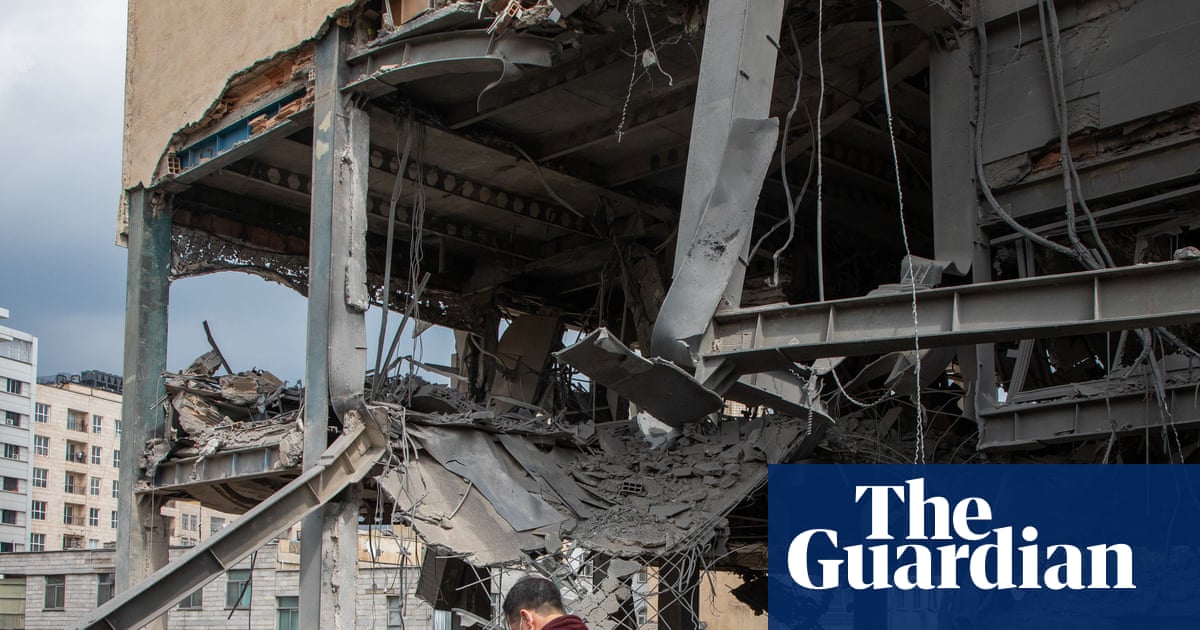
Iran has warned the US that it is prepared to confront any ground assault, accusing Washington of secretly planning a land attack while publicly seeking talks, as the war that has killed thousands of people and caused the biggest-ever disruption to global energy supplies entered its second month.
As efforts to find a negotiated conclusion to hostilities inched forward with a meeting of regional powers in Pakistan, there were signs of further escalation over the weekend as Yemen’s Iran-backed Houthis entered the conflict for the first time, and the Israeli prime minister, Benjamin Netanyahu, said his country was widening its invasion of southern Lebanon.
In a message published to mark 30 days since the start of the war, the Iranian parliament speaker, Mohammad Bagher Ghalibaf, said “the enemy signals negotiation in public, while in secret it plots a ground attack”.
“Our firing continues,” Ghalibaf said. “Our missiles are in place. Our determination and faith have increased.” Iranian forces “are waiting for the arrival of American troops on the ground to set them on fire and punish their regional partners for ever,” he added.
The Pentagon is reportedly preparing for weeks of “ground operations” in Iran, US officials have told the Washington Post, as thousands of American soldiers and marines arrive in the Middle East.
Any US ground operation would probably stop short of a full-scale invasion, instead relying on raids by special operations forces and conventional infantry, according to reports on contingency planning. But even a limited mission could expose American troops to Iranian drones, missiles, ground fire and improvised explosives.
An image from a video provided by US Central Command shows American sailors and marines onboard USS Tripoli, which has arrived in the Middle East. Photograph: APAmong the options reportedly discussed are the seizure of Kharg Island, Iran’s main oil export hub, and raids on coastal sites near the strait of Hormuz to destroy weapons threatening commercial and military shipping. Axios and the Wall Street Journal have reported that the Pentagon is also considering sending another 10,000 troops to the region, alongside a broader bombing campaign.
The White House has sent mixed signals, alternating between talk of de-escalation and threats of a wider war. Karoline Leavitt, the press secretary, said Pentagon planning was intended to give Donald Trump “maximum optionality”, not to signal a final decision.
Whether Trump would approve plans for deploying ground troops remained uncertain, the Post said.
In an apparent rebuke of the Trump administration, Pope Leo said on Sunday that God ignores the prayers of leaders who wage war and have “hands full of blood”. The pontiff made the comments days after the US defence secretary, Pete Hegseth, prayed for violence against enemies who deserved “no mercy”.
The war that began on 28 February shows no sign of de-escalation, despite renewed diplomatic efforts. Pakistan – seen as a potential mediator between Washington and Tehran – hosted a four-way meeting with Saudi Arabia, Turkey and Egypt on Sunday, a day after the prime minister, Shehbaz Sharif, spoke with the Iranian president, Masoud Pezeshkian.
Pakistan hosted a four-way meeting with Saudi Arabia, Turkey and Egypt in Islamabad on Sunday. Photograph: Pakistan foreign office/EPAPakistan’s foreign minister, Ishaq Dar, said the talks, held under tight security at his ministry but without any US, Israeli or Iranian representation, came at a “critical moment”.
Military-level contacts are also under way, with Pakistan’s army chief, Asim Munir, in regular contact with the US vice-president, JD Vance, a source familiar with the discussions told Reuters.
The US last week presented Iran with a 15-point ceasefire proposal, including reopening the strait of Hormuz and curbs on Iran’s nuclear programme, but Tehran has rejected the plan and offered alternatives. Tehran has refused to admit to holding official talks with Washington but has passed a response to the 15-point plan to end the war via Islamabad, according to an anonymous source cited by the Iranian Tasnim news agency.
The Houthis claimed two missile launches at Israel on Saturday, their first attacks on Israel since the start of the conflict. The group poses a potential new threat to global shipping if it again targets vessels in the Bab el-Mandeb strait off the Red Sea, through which about 12% of the world’s oil trade typically passes. A shutdown of the strait would amplify the already grave impact of the war on the global economy, and could also reignite a Saudi-Yemen conflict that caused huge humanitarian suffering for seven years before a 2022 truce.
Since the US-Israeli attack on Iran on 28 February, Saudi Arabia has been able to divert some of its oil exports by pipeline to the Red Sea. Saudi commentators have said that if this route was also threatened, Riyadh could also enter the war directly.
A view of missile traces launched from Yemen at Israel sighted in the sky over Hebron, West Bank, on Saturday. Photograph: Anadolu/Getty ImagesFarea Al-Muslimi, a research fellow in the Middle East and north Africa programme at the Chatham House thinktank, said: “The decision by the Houthis to join the broader Middle East conflict marks a serious and deeply concerning escalation.
“The potential impact on key commercial maritime routes, especially in the Red Sea and the Bab al-Mandab strait, cannot be overstated. At the same time, vital economic and military infrastructure across the Gulf region may become increasingly exposed.”
Israel’s military has meanwhile continued its relentless air assault on Iran, saying on Sunday its forces had targeted Tehran’s weapons manufacturing infrastructure, including dozens of storage and production sites, the day before.
Five people were killed in a strike on a pier in the southern Iranian port of Bandar-e-Khamir, which also destroyed two vessels, state media reported. In Tehran, a building housing Qatar’s Al Araby TV was hit.
People inspect a damaged cafe next to a business building including the Qatari Al Araby TV office, after an airstrike in northern Tehran on Sunday. Photograph: Abedin Taherkenareh/EPANetanyahu announced that Israel would widen its invasion of southern Lebanon, as Israeli forces continue to target the Iranian-backed Hezbollah militant group.
“In Lebanon, I have just ordered the military to further expand the existing security zone,” Netanyahu said in a video statement. “This is intended to definitively neutralise the threat of invasion [by Hezbollah militants] and to keep anti-tank missile fire away from the border.”
On the ground in Lebanon, a funeral was held on Sunday for three journalists killed in an Israeli strike the day before. Officials say more than 1,100 people have been killed in the fighting since the Iran war began.
An Iranian missile sparked a fire in the Neot Hovav industrial zone near Beersheba in Israel, with officials assessing the risk of a hazardous materials leak and urging the public to stay away. Adama, a maker of active ingredients and crop protection materials, said its Makhteshim plant was hit, probably by a missile or debris, adding that no injuries were reported and the extent of the damage remained unclear.
Reuters contributed to this report
Iran accuses US of plotting ground assault while publicly seeking talks NYT News Today.
Hence then, the article about iran accuses us of plotting ground assault while publicly seeking talks was published today ( ) and is available on NY Times News ( Middle East ) The editorial team at PressBee has edited and verified it, and it may have been modified, fully republished, or quoted. You can read and follow the updates of this news or article from its original source.
Read More Details
Finally We wish PressBee provided you with enough information of ( Iran accuses US of plotting ground assault while publicly seeking talks )


Also on site :
- KATSEYE Fans Are Lighting Up Their Wildworld Tour With Official Lightsticks — Here’s Where to Get Yours
- ’90s Alternative Metal Legends Achieve Massive Milestone With Signature Grammy-Nominated Song From ‘Toxicity’
- Stuart Fails To Save The Universe: Melissa Rauch Reveals The Story Behind Episode 7's Alternate Bernadette — And Talks Possible Season 2 Return