
A major escalation in the regional conflict occurred Saturday evening as an Iranian ballistic missile struck a building in the southern Israeli city of Dimona. The Israeli Fire and Rescue Authority confirmed the strike, reporting multiple casualties and ongoing efforts to contain a large-scale fire resulting from the impact.
Impact and casualties
According to CNN, a spokesperson for the Fire and Rescue service stated that the missile completely destroyed a single-story structure within the city.
The Moment of impact: Video footage released by emergency services on social media shows the missile descending over the city center, followed by a massive explosion.
Casualty reports: The Magen David Adom (MDA) emergency service reported treating approximately 47 individuals. Among them is a 10-year-old child in moderate condition due to shrapnel injuries; most other injuries are reported as minor.
Emergency response: “United Hatzalah” teams are currently on the ground treating victims for physical injuries and shock across various locations in the district.
Strategic target: The Dimona Nuclear Complex
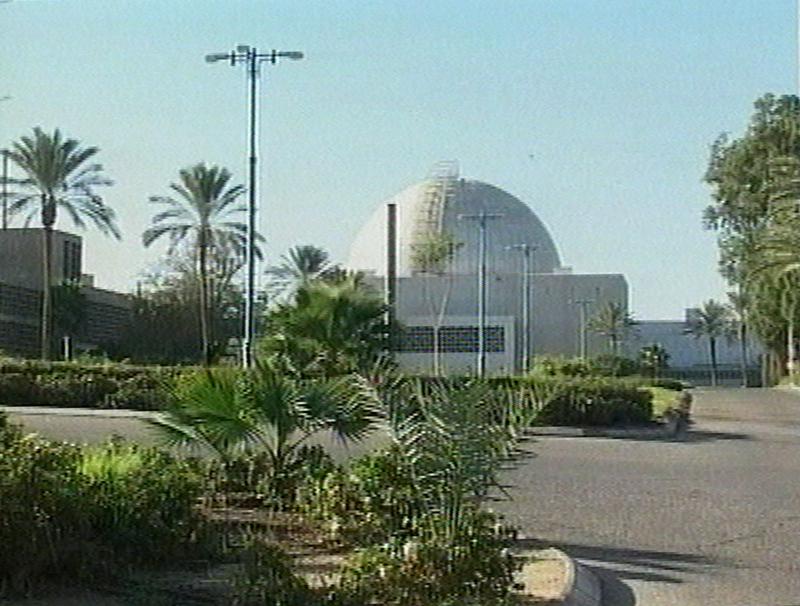
The strike is of immense strategic significance as Dimona is home to Israel’s nuclear program.
Tehran’s justification: Iranian State Media (IRIB) claimed the attack specifically targeted nuclear installations. They characterized the operation as a direct retaliation for the Israeli strike on Iran’s Natanz uranium enrichment facility earlier that same day.
Alert status: Multiple rocket sirens blared throughout the Negev desert on Saturday night as Israeli air defenses attempted to intercept incoming fire.
Geographic and historical context of Dimona
Located in the Negev Desert, approximately 30 km southeast of Be’er Sheva, Dimona is internationally recognized for the Shimon Peres Negev Nuclear Research Center, situated 13 km from the city limits.
Strategic importance: While officially an “all-purpose research center,” it is widely believed to be the primary facility for Israel’s nuclear weapons program.
History of secrecy: Built in 1958 with a heavy-water reactor becoming active in the early 1960s, the site allows for the production of plutonium. The facility’s secrets remained largely hidden until 1986, when former technician Mordechai Vanunu leaked photographic evidence of the infrastructure.
Legal status: Since Israel is not a signatory to the Non-Proliferation Treaty (NPT), the International Atomic Energy Agency (IAEA) lacks the authority to inspect the Dimona site, making it one of the most guarded and opaque locations in the Middle East.
Iranian missile strike on Dimona residential area leaves 47 Israelis injured Egypt Independent.
Hence then, the article about iranian missile strike on dimona residential area leaves 47 israelis injured was published today ( ) and is available on EGYPT INDEPENDENT ( Egypt ) The editorial team at PressBee has edited and verified it, and it may have been modified, fully republished, or quoted. You can read and follow the updates of this news or article from its original source.
Read More Details
Finally We wish PressBee provided you with enough information of ( Iranian missile strike on Dimona residential area leaves 47 Israelis injured )


Also on site :
- Absher carries out over 50 million electronic transactions in July
- JetBlue’s Mint Passengers Are Finally Getting Free Lounge Access
- Deaths of pregnant women double during fastest-growing Ebola outbreak in history in DR Congo