
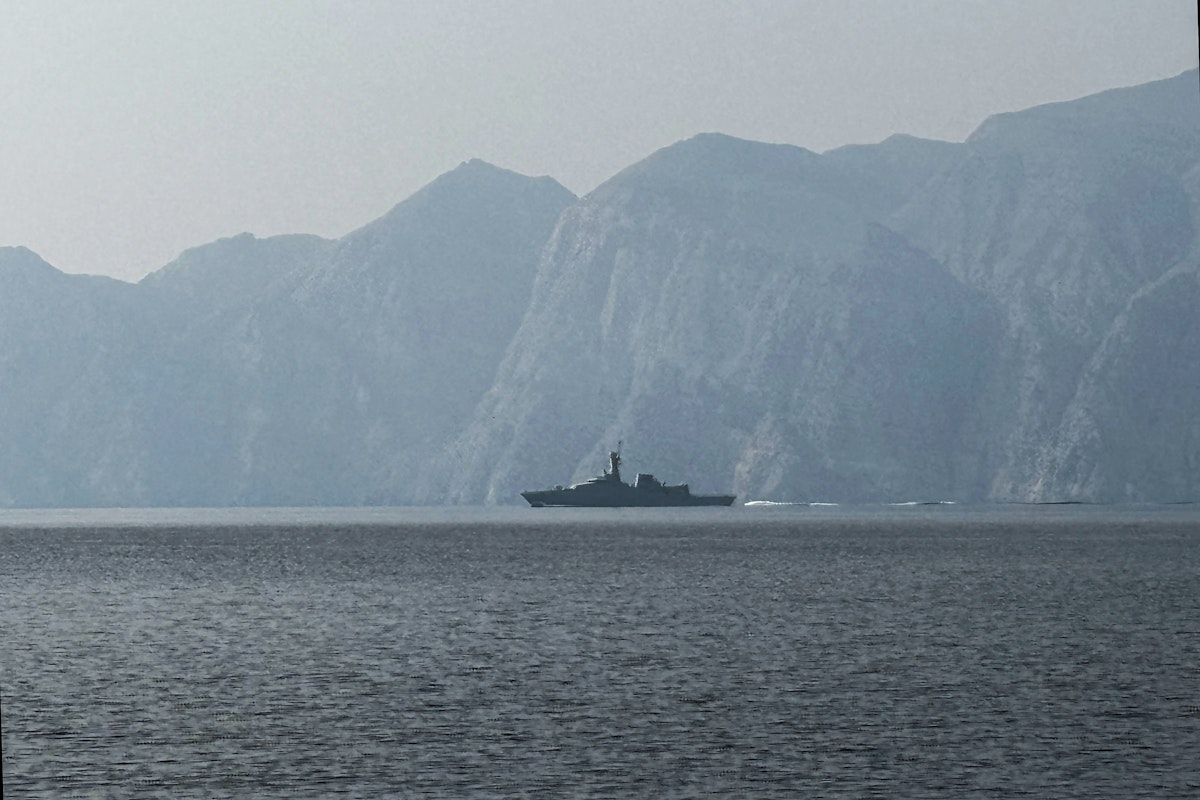
And now, Iran has begun mining the Strait of Hormuz. President Trump simultaneously denied this on Truth Social and threatened that “military consequences to Iran will be at a level never seen before” if it did happen to be true. How the United States can escalate beyond 8,000 Israeli and U.S. air strikes that have killed much of the Iranian government is an open question, but it demonstrates that the administration is genuinely afraid this will happen. They are right to be afraid. Mining the strait would mean a protracted closure of at least a month, because finding and removing them is a difficult and time-consuming process. This would create a global economic disturbance well beyond what we are already seeing.
Laying mines is comparatively easy and can be done from both modern fishing boats and dhows. In the area of the strait, both of these number in the thousands. Iran used this strategy for conducting the clandestine mining of the Persian Gulf in the 1980s as part of the “tanker wars,” the name for the series of military attacks by Iran and Iraq against merchant vessels in the Persian Gulf and Strait of Hormuz from 1981 to 1988, and later U.S. intervention to protect maritime traffic. Stopping these boats would require constant surveillance of a large area, a difficult task even with the vast array of forces in the area. Indeed, during the Persian Gulf War, Iraq managed to lay 1,300 sea mines right “under the noses” of the coalition.
Iran also has the capability to flood the zone with dozens or hundreds of civilian boats at the same time. It can be difficult or impossible for the U.S. to tell which ones have mines and which don’t. Exacerbating the problem is that the munitions used to sink these boats would likely be more expensive than the boats themselves.
The mines themselves are potentially very cheap, easy to produce, and can be deployed large numbers. Simple contact mines with a design dating back to WWI can cost as little as $1,500 each. More advanced magnetic influence mines are still remarkably cheap, as low as $25,000 apiece. The relatively shallow waters of the Persian Gulf are an ideal place for using mines against shipping, and this creates many of the same cost-imposing problems as the Iranian Shahed-136 drones that have been employed in vast numbers against U.S. and Gulf State air defenses. Mines, like Shaheds, are cheap, plentiful, relatively easy to produce, and easy to deploy. They can disable or destroy vessels worth hundreds of millions of dollars, or even a billion dollars (such as an Arleigh-Burke class guided missile destroyer). Countering them requires expensive, rare, specialized equipment, highly trained personnel, and a lot of time to carry out the mission.
Mines are effective, and they are a big problem even for warships designed to withstand hits. Of the 19 U.S. vessels sunk or disabled since WWII, 15 of them were damaged by mines. These include the Aegis cruiser USS Princeton and the Iwo Jima-class amphibious assault ship USS Tripoli on the same day during the Persian Gulf War. A WWI-era contact mine nearly sank the 4,500 ton guided missile frigate USS Samuel B. Roberts on April 14, 1988, which survived only due to exceptional damage control efforts by her crew.
Once mines are in the water, they’re very difficult to find, even with modern gear. The process of finding them is slow and painstaking, leaving the ships and aircraft conducting the search as sitting ducks in the middle of a hot war. It also requires multiple sweeps of the same area to ensure that all mines have been neutralized.
Currently, U.S. Mine Countermeasures (MCM) assets in the Gulf are likely a squadron of aging MH-53 Sea Dragon helicopters (due to be retired in 2027), and three Independence-Class Littoral Combat Ships (LCS) with the new MCM module. Both the LCS (less than affectionately called the “Little Crappy Ship”) and its MCM module have experienced extreme cost overruns and teething troubles. (e.g. failures and cancellations of key components, redesigns of the system due to weight increases, immature autonomous underwater systems, etc.) The LCS replaced the four dedicated, wooden-hulled Avenger-Class minesweepers in September 2025, which was seen as a questionable move even before this year’s air campaign.
Mine-hunting and minesweeping involve sailing at low speeds in predictable patterns, often while teams of sailors are in small boats operating underwater drones or supporting divers. This places the ship and its crew in a very vulnerable position in the strait, which is only 21 miles across at its narrowest. Thus, clearing the strait while a “hot war” is still going on would be exceptionally dangerous, and I expect the Navy would be reluctant to do so. Iran has numerous ways to cover the strait, including anti-ship missiles, armed speed boats, suicide speed boats, and artillery. If a ship tried to run from an attack by any of these, it would potentially risk running into a mine as well. The Trump administration has talked about resuming tanker escort missions through the strait, as the U.S. did in 1987 and 1988. However, given the situation described above, experts are skeptical that any transport companies would step forward. Insurers are unwilling to provide coverage to anyone sailing in the Gulf, meaning that companies would be 100 percent liable for whatever happens to those ships, their crews, the environment, the cargo, etc. Even with naval escorts, there’s no guarantee a ship won’t be attacked or run into a mine. No legitimate company is willing to run that risk.
In summary: No one will be willing to sail ships through the strait until the mines are cleared, which will take weeks to months depending how many are laid. This means the disruption to shipping will last well past the end of hostilities.
It also looks like hostilities won’t be ending any time soon. Iran has declared that it is unwilling to engage in further negotiations with the U.S., while Trump has demanded “unconditional surrender” (whatever that means to him). Iran also has the potential to escalate the conflict through terrorist attacks or assassinations. If a U.S. civilian target was blown up, or a prominent member of Trump’s Cabinet assassinated, it would likely induce the U.S. to continue a war even when it had been considering backing out.
As much as some defense experts are crowing about the damage being done to Iran’s capabilities, it is my assessment that Iran believes it will win this conflict via economic strangulation. America’s adversaries know that the way to win a war against it is to drag the conflict out and wait for public opinion to turn against it. Nothing turns the public against the incumbent party like a tanked economy and a disastrous war. The Iranians believe they’ll achieve favorable terms once the U.S. economy begins to crater and the public turns against Trump for starting a war he couldn’t finish.
Despite being a net exporter of oil, the U.S. is more vulnerable in some ways to disruptions in oil flow than its competitors are. This is because of high domestic consumption, lack of investment in renewables, and China’s reserve of as much as 1.2 billion barrels of oil (compared with 415 million for the U.S.), sufficient for a three-month reserve.
The oil market is global: think of it as one bathtub with many drains. Energy prices in the U.S. will rise dramatically regardless of its role as a net exporter. Research firm Wood Mackenzie predicted oil prices could reach $150 per barrel in the coming weeks and could go as high as $200 per barrel this year depending on the trajectory of the conflict, which could potentially lead to demand destruction: That is, oil’s price could potentially rise to the point where it becomes uneconomical to continue the production of materials like steel.
This is why I see the mining of the strait as the most important piece of news in the war so far. It signals that Iran is more than willing to “gut it out” and accept serious economic damage to its economy. It demonstrates Iran’s ultimate “theory of victory.” The U.S. has less stomach for its own economic downfall, given that it remains (nominally) a democracy where politicians care about public sentiment.
The disruption to the strait will last for weeks or months past the end of hostilities, as the U.S. frantically tries to de-mine the area to a point where insurers are willing to provide coverage again. This extended disruption locks in significantly more economic pain than most entities anticipated. In 1991, after the Gulf War, it still took the U.S. 51 days to clear 907 Iraqi mines off the coast of Kuwait.
It also makes things significantly worse for the GOP. Trump’s approval numbers are buoyed by a middling economy where a lot of people aren’t feeling the pain yet. But if they go into an election season with an economy that they actively tanked (pun intended), there will be a wipeout for Republicans. This will likely intensify their efforts to prevent a free and fair election.
Thus, when the U.S. looks back at the tipping points of 2026, it may not be the attacks on Iran that are seen as the point of no return, but rather the moment when Iran decided to do a Leeroy Jenkins on the global economy in response to an ill-considered U.S. war.
Hence then, the article about the implications of iran mining the strait of hormuz are many and ugly was published today ( ) and is available on The New Republic ( Middle East ) The editorial team at PressBee has edited and verified it, and it may have been modified, fully republished, or quoted. You can read and follow the updates of this news or article from its original source.
Read More Details
Finally We wish PressBee provided you with enough information of ( The Implications of Iran Mining the Strait of Hormuz Are Many—and Ugly )


Also on site :
- APOD: 2026 October 14 – Mars and the Beehive Under an Aurora
- Walmart’s Dainty Birthstone Leaf Necklace ‘Looks Super Expensive’ and Makes a ‘Gorgeous’ Gift, Now 88% Off
- 1951 Folk Hit, Ranked Among ‘Greatest Country Songs of All Time,’ Launched a ‘Full-On Americana Revival’ 49 Years Later