
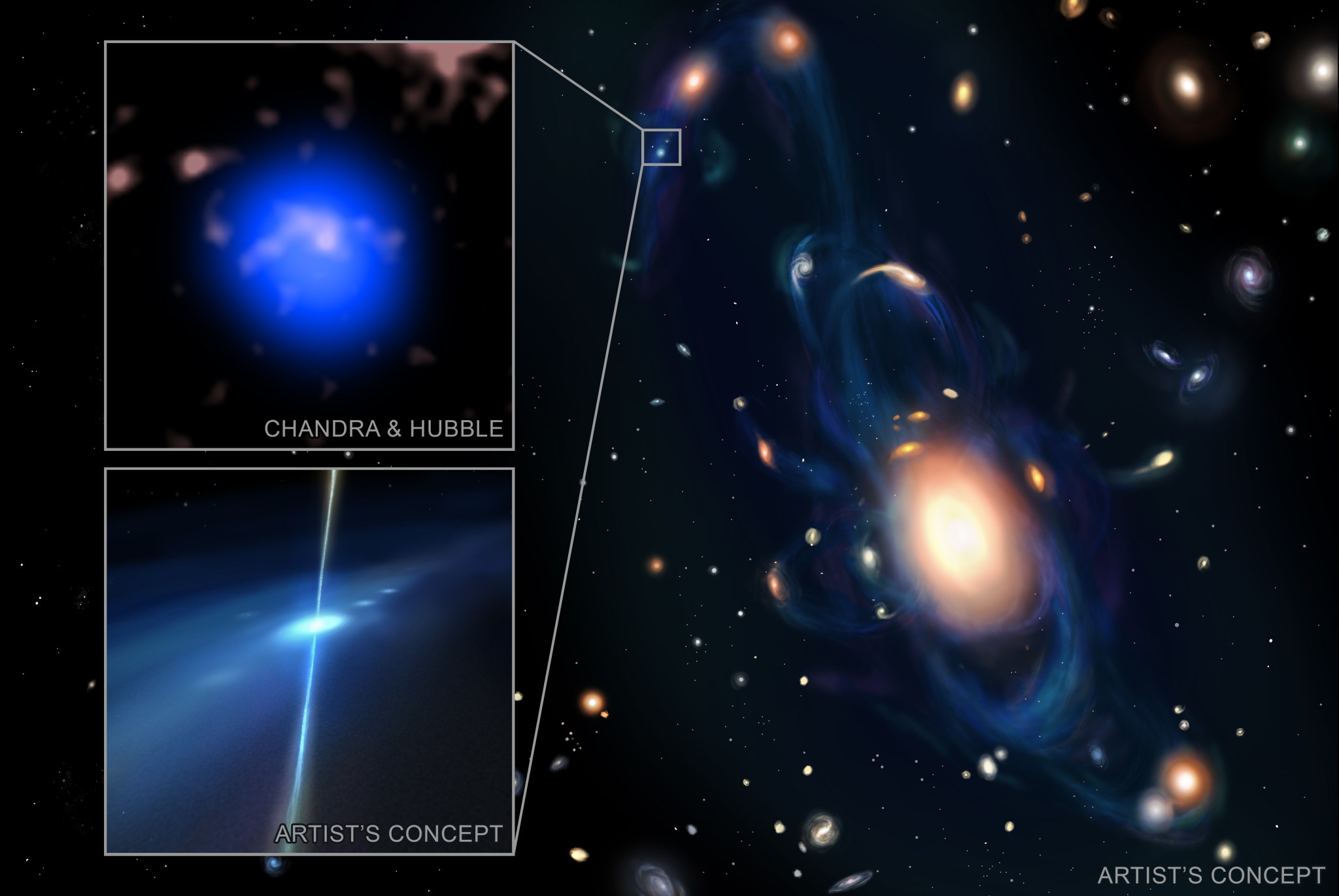
A fleet of NASA missions has likely uncovered a collision between two ultradense stars in a tiny galaxy buried in a huge stream of gas. Astronomers have never seen this type of explosive event in an environment like this before — and it may help solve two outstanding cosmic mysteries. A paper describing these results was published today in The Astrophysical Journal Letters.
Neutron stars are the cores left behind after a star much heavier than the Sun runs out of fuel, collapses on itself, and then explodes. They are small (only a dozen or so miles across) but slightly more massive than the Sun, making them amazingly dense. Astronomers consider them to be some of the most extreme objects in the universe.
In recent years, astronomers have collected data on collisions, or mergers, of two neutron stars inside of moderately sized or large galaxies. This latest discovery, however, shows that a neutron star collision may take place inside a tiny galaxy.
“Finding a neutron star collision where we did is game changing,” said Simone Dichiara of Penn State University, who led the study. “It may be the key to unlocking not one, but two important questions in astrophysics.”
The first puzzle this unprecedented location for a neutron star collision may explain may explain is the fact that gamma-ray bursts (GRBs), which can be produced by the collapse of two neutron stars, sometimes do not appear within the core of a galaxy, or any galaxy at all.The other question this result could address is how elements like gold and platinum have been found in stars located at large distances from the centers of galaxies.
This neutron star collision is unexpectedly located in a tiny galaxy, about 4.7 billion light-years away, embedded within a stream of gas that stretches some 600,000 light-years long. (For context, our Milky Way galaxy is about 100,000 light-years across.) This stream was likely created when a group of galaxies collided hundreds of millions of years ago, stripping gas and dust from the galaxies and leaving it in intergalactic space.
“We found a collision within a collision,” said co-author Eleonora Troja of the University of Rome in Italy. “The galaxy collision triggered a wave of star formation that, over hundreds of millions of years, led to the birth and eventual collision of these neutron stars.”
To discover the event dubbed GRB 230906A, which occurred on 2023 September 6th, astronomers needed several NASA telescopes including the Chandra X-ray Observatory, Fermi Gamma-ray Space Telescope, Neil Gehrels Swift Observatory, and Hubble Space Telescope.
Fermi discovered the neutron star collision by picking up the distinctive signal of a gamma-ray burst, or GRB, explosion. After using the InterPlanetary Network to derive a preliminary location for the Fermi source, astronomers then needed the sharp vision of Chandra, Swift, and Hubble to more precisely pinpoint the location of the object. NASA’s missions are part of a growing, worldwide network that watches for these changes, to solve mysteries of how the universe works.
“Chandra’s pinpoint X-ray localization made this study possible,” said co-author Brendan O’Connor, a McWilliams Postdoctoral Fellow at Carnegie Mellon University. “Without it, we couldn’t have tied the burst to any specific source. And once Chandra told us exactly where to look, Hubble’s extraordinary sensitivity revealed the tiny, extremely faint galaxy at that position. We were only able to make this discovery after we put all the pieces together.”
This finding may explain why some GRBs do not appear to have host galaxies. This result implies that some host galaxies are too small and faint to be seen in most optical light images from ground-based observatories.
The unusual location of GRB 230906A may also help explain how astronomers have spotted elements like gold and platinum in stars at relatively large distances from galaxies. Such stars are generally expected to be older and to have formed from gas that had less time to be enriched in heavy elements from supernova explosions.
Through a chain of nuclear reactions, a collision between two neutron stars can produce heavy elements like gold and platinum, which astronomers witnessed in a well-documented collision seen in 2017 . Events like GRB 230906A could generate elements like these and spread them throughout the outskirts of galaxies, eventually appearing in future generations of stars.
An alternative explanation for the explosion is that it is located in a much more distant galaxy that is behind the galaxy group. The team considers this to be a less likely explanation than the tiny galaxy idea.
NASA’s Marshall Space Flight Center in Huntsville, Alabama, manages the Chandra program. The Smithsonian Astrophysical Observatory’s Chandra X-ray Center controls science operations from Cambridge, Massachusetts, and flight operations from Burlington, Massachusetts.
To learn more about Chandra, visit:
science.nasa.gov/chandra
Read more from NASA’s Chandra X-ray Observatory
Learn more about the Chandra X-ray Observatory and its mission here:
www.nasa.gov/chandra
chandra.si.edu
Visual Description
This release features two artist’s concepts and a composite image depicting two cosmic collisions that began hundreds of millions of years ago.
At the center of the large artist’s concept is a brilliant glowing ball with a nearly white core, and golden orange outer layers. This brilliant ball represents the brightest galaxy in a collision between two groups of galaxies, which began hundreds of millions of years ago. Gas and dust from that collision were tossed into intergalactic space in long tidal streams. In the illustration, the tidal streams resemble swooping blue streaks shooting off the brilliant ball. Near the end of each swooping tidal stream is a glowing orange streak, or ellipse. These glowing shapes are smaller individual galaxies, some of which are revealed to have spiraling arms when examined closely.
One of the tidal streams shoots toward our upper left, then begins to hook back down, passing two glowing orange galaxies along its path. Near the end of this tidal stream is a tiny galaxy and an X-ray source presented in the middle of a close-up insert. In the center of the composite insert, Hubble observations in orange reveal the tiny, faint galaxy buried in the tidal stream. A pool of neon blue haze shows X-rays detected by Chandra from the collision of two ultra-dense neutron stars.
Astronomers believe that the tiny galaxy was born from gas and dust along the 600,000 light-year-long tidal stream, created by the initial collision of the galaxy groups. Over hundreds of millions of years, that material contributed to the birth of many stars within the tiny galaxy. Two of those stars collapsed into neutron stars, and ultimately collided, producing important elements like gold and platinum, and gravitational waves that rippled across space.
The artist’s concept in the other insert shows a close-up view from the side of what the aftermath of a neutron star collision might look like. A burst of gamma rays was originally detected by viewing it down the barrel of the jet, which triggered follow-up X-ray observations with Chandra and other X-ray telescopes.
News Media Contact
Megan WatzkeChandra X-ray CenterCambridge, [email protected]
Joel WallaceMarshall Space Flight Center, Huntsville, [email protected]
Share
Details
Last Updated Mar 10, 2026 EditorLee MohonContactJoel [email protected] Space Flight CenterRelated Terms
Chandra X-Ray ObservatoryAstrophysicsFermi Gamma-Ray Space TelescopeGamma-Ray BurstsHubble Space TelescopeMarshall AstrophysicsMarshall Space Flight CenterNeil Gehrels Swift ObservatoryNeutron StarsThe UniverseExplore More
4 min readNASA Strengthens Artemis: Adds Mission, Refines Overall Architecture
Article 7 days ago 3 min readTwo Observatories, One Cosmic Eye: Hubble and Euclid View Cat’s Eye Nebula
This new NASA/ESA Hubble Space Telescope image features one of the most visually intricate remnants of…
Article 1 week ago 6 min readListen to This Month’s ‘Planetary Parade’ With NASA’s Chandra
Article 2 weeks ago Keep ExploringDiscover More Topics From NASA
Chandra X-ray Observatory
The Chandra X-ray Observatory is the world’s most powerful X-ray telescope.
Hubble Space Telescope
Since its 1990 launch, the Hubble Space Telescope has changed our fundamental understanding of the universe.
Fermi Gamma-ray Large Area Space Telescope
The Fermi Gamma-ray Space Telescope (FGST), formerly called the Gamma-ray Large Area Space Telescope (GLAST), is a space observatory being…
The Swift Spacecraft
Swift launched into orbit on Nov. 20, 2004, as NASA’s Swift Gamma-ray Observatory. In 2018, NASA renamed the spacecraft in…
Hence then, the article about nasa discovers crash of extreme stars in unexpected site was published today ( ) and is available on NASA ( Middle East ) The editorial team at PressBee has edited and verified it, and it may have been modified, fully republished, or quoted. You can read and follow the updates of this news or article from its original source.
Read More Details
Finally We wish PressBee provided you with enough information of ( NASA Discovers Crash of Extreme Stars in Unexpected Site )


Also on site :
- ‘Harry Potter’ Producer David Barron Backs AI Adaptation Of ‘The Call Of The Wild’
- Oil prices surge after Trump rejects Iran’s plan to reopen Strait of Hormuz
- Walmart Sells a Beautiful Toi Et Moi Birthstone Necklace That Instantly Upgrades Your Jewelry Collection