
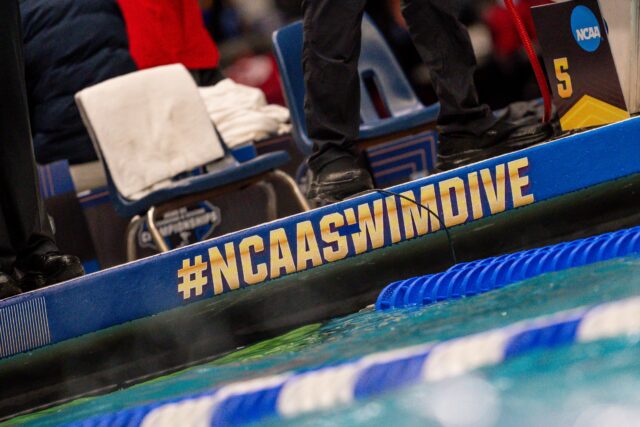
By Madeline Folsom on SwimSwam
With the CSCAA approving the addition of automatic qualifiers via conference titles to the NCAA Championships this year, there have been a lot of questions about qualifying for the meet this year.
The individual procedure is not entirely different than it has been in the past. A total of 322 women are invited to the meet, 41 divers and 281 swimmers. On the men’s side, 270 men earn invites, 35 of which are reserved for divers while 235 are for swimmers.
New Step-by-Step Qualifying Procedure Swimming
35 of the men’s spots and 41 of the women’s spots are set aside for divers, who qualify for the meet at zone competitions closer the NCAA Championships. That leaves 235 men’s spots and 281 for the women. Every automatic qualifier is added into the events they earned an automatic qualification in from fastest to slowest. Athletes are only counted once regardless of how many events they earn an AQ in. In order to be an ‘AQ’ athletes must swim the NCAA qualifying standard to win the conference championships. The next fastest swimmers in each event are added until every event has the same number of entries. For example, if the 50 free has the most AQs of any event with 10, every event would add swimmers until there were 10 in each event. Once the events are equal, one entry is added per event to keep them even. This process is repeated until all the swimming spots are filled (235 for men and 281 for women). It is important to remember that all athletes only count as one individual, and as rows are added swimmers will begin to double and triple up. The #1 seed in the 200 back might be the #15 seed in the 100 back – as the 15th row of swimmers is added to each event, she’ll be added to the 100 back list, but won’t take up another one of the 281 invite spots, as she already has her official invite. The final row of swimmers added won’t come out exactly even. In the final row, the swimmers will be ranked based on their percentage of the NCAA standard in the event and added in order, and when the 235th man or 281st woman is added, the process stops. So the 100 fly could have 38 women and the 200 fly 39 women – that would mean the 39th 200 flyer had a higher percentage ranking than the 39th 100 flyer and therefore won the ‘tie-breaker’ for the final spot.Steps for Relay Qualification
The relay qualification process hasn’t really changed. There are still ‘A’ and ‘B’ cuts, the only difference is that more schools have the opportunity to send a relay to NCAAs, providing they have an invited athlete.
A school that has a relay ‘A’ cut can swim any relays in which they have the ‘A’ cut and can bring up to four uninvited relay swimmers. A school that has at least one invited swimmer and has at least one relay ‘A’ cut can swim any relays in which they have ‘A’ or ‘B’ cuts and can bring up to four uninvited relay swimmers. A school that has at least four invited swimmers, but only relay ‘B’ cuts can swim relays where they have earned a ‘B’ cut and can bring up to four uninvited relay swimmers.Diving Qualification
The NCAA allocates 35 men’s spots and 41 women’s spots for divers before selecting swimmers. Divers are selected via the five diving zone championships, which occur after the final conference meets are over and before the NCAA championships. Divers must qualify for the championships by earning the qualifying score at an official competition. Each zone is allocated a different number of qualifying spots per diving event. The top five female divers and top four male divers from ever zone earn an invite. The rest of the spots are awarded based on the number of divers who finished in the top 16 in each event at the previous year’s NCAA Championships. Once invited, divers are eligible to compete in any other events at the championships, as long as they have achieved at least the zone qualifying score.2026 Qualifying Spots per Zone
Women 1m 3m Platform Men 1m 3m Platform Zone A 6 5 6 Zone A 4 5 4 Zone B 11 9 7 Zone B 8 6 7 Zone C 7 10 10 Zone C 8 10 9 Zone D 11 10 11 Zone D 7 7 10 Zone E 6 7 7 Zone E 9 8 6Frequently Asked Questions:
How have auto qualifiers changed the process?
The Auto Qualifiers are the first swimmers added, similar to the old NCAA ‘A’ standard. Events will still have the same number of qualifiers, but if the 100 breaststroke has 10 AQs, the 35th fastest swimmer might miss the meet, whereas if the 100 back has only 5 AQs, the 40th fastest swimmer could earn an invite. Both events will still have 40 athletes invited.Are relay swimmers counted?
Relay only invited athletes are not eligible to compete in individual events at the NCAA Championships, and do not count against the roster limit.What if two swimmers have the same percentage of the NCAA standard?
The athletes will then go to a tiebreak based on their 2nd best event, and the individual with the higher percentage will earn the invite. If their 2nd event is tied as well, the tiebreak goes to their 3rd individual event.If a relay wins the conference championship in a ‘B’ time, are they invited?
No. There are no AQs via conference championship for relays. If the relay earns an ‘A’ cut they can swim. If they have at least one swimmer qualified and a separate ‘A’ cut, they can swim, and if they have at least four invited swimmers, they can swim.Read the full story on SwimSwam: New NCAA Qualifying Procedure: How Swimmers/Divers/and Relays Qualify
Hence then, the article about new ncaa qualifying procedure how swimmers divers and relays qualify was published today ( ) and is available on swimswam ( Middle East ) The editorial team at PressBee has edited and verified it, and it may have been modified, fully republished, or quoted. You can read and follow the updates of this news or article from its original source.
Read More Details
Finally We wish PressBee provided you with enough information of ( New NCAA Qualifying Procedure: How Swimmers/Divers/and Relays Qualify )


Also on site :
- Adam Peaty on Zero-Gold Summer: “We Pushed a Little Bit Too Far on the Load in the Pool, Especially in the Gym”
- Catholics in Ecuador Mourn Death of Priest Struck by Falling Crucifix During Mass
- The questions and stats looming over Giants’ Jameis Winston-J.J. McCarthy decision