
Downloads
PIA26706 Figure A
JPEG (82.95 KB)
PIA26706 Animation
MOV (3.33 MB)
Description
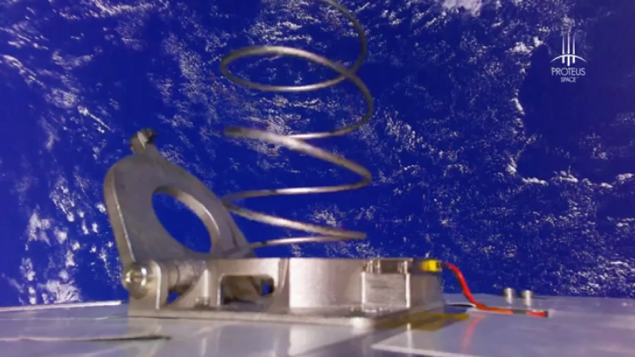
With a simple motion, a jack-in-the-box-like spring designed at NASA’s Jet Propulsion Laboratory showed the potential of additive manufacturing, also known as 3D printing, to cut costs and complexity for futuristic space antennas. Called JPL Additive Compliant Canister (JACC), the spring deployed on the small commercial spacecraft Proteus Space’s Mercury One on Feb. 3, 2026. An onboard camera captured this video of the spring popping out of its container as the spacecraft passed over the Pacific Ocean in low Earth orbit.
Figure AFigure A is a still image of JACC after deployment, taken above Antarctica.
JACC is one of two JPL payloads on the spacecraft that are demonstrating new technologies designed to take up reduced volume while precisely deploying antennas on future orbiters. JACC’s success demonstrates that 3D-printed mechanisms can be built faster, cheaper, and with less complexity than traditionally fabricated space hardware.
Printed out of titanium, JACC uses three times fewer parts than similar structures: Combined into a single part is a hinge, panel, compression spring, and two torsion springs. Weighing just over 1 pound (498 grams), it is about 4 inches (10 centimeters) on each side. The spring, which extends from a packed height of just over 1 inch to about 6 inches (3 centimeters to 15 centimeters), is modeled after communication antennas commonly used on satellites.
The second demonstration payload aboard Mercury One is the Solid Underconstrained Multi-Frequency (SUM) Deployable Antenna for Earth Science. Together with JACC, the two payloads go by the name Prototype Actuated Nonlinear Deployables Offering Repeatable Accuracy Stowed on a Box (PANDORASBox). They were both conceived, built, tested, and delivered for flight by JPL in less than one year on minimal budgets.
Mercury One launched from Vandenberg Space Force Base in California on Nov. 28, 2025, as part of SpaceX’s Transporter-15 mission.
JPL internal research development funds supported JACC, as did NASA’s Earth Science Technology Office (ESTO).
Keep ExploringDiscover More Topics From Photojournal
Photojournal
Search Photojournal
Photojournal’s Latest Content
Feedback
Hence then, the article about jpl 3d printed part springs forward was published today ( ) and is available on NASA ( Middle East ) The editorial team at PressBee has edited and verified it, and it may have been modified, fully republished, or quoted. You can read and follow the updates of this news or article from its original source.
Read More Details
Finally We wish PressBee provided you with enough information of ( JPL 3D-Printed Part Springs Forward )


Also on site :
- New Avatar Animated Series About Teen Kuruk Ordered At Paramount+, Seven Havens Scores Double Renewal
- Accident-Only vs. Accident-and-Illness Pet Insurance: What’s the Difference?
- ’80s Rock Band With Six Lead Singers Is Approaching Its Farewell Tour—and Fans Have a Major Date to Know