
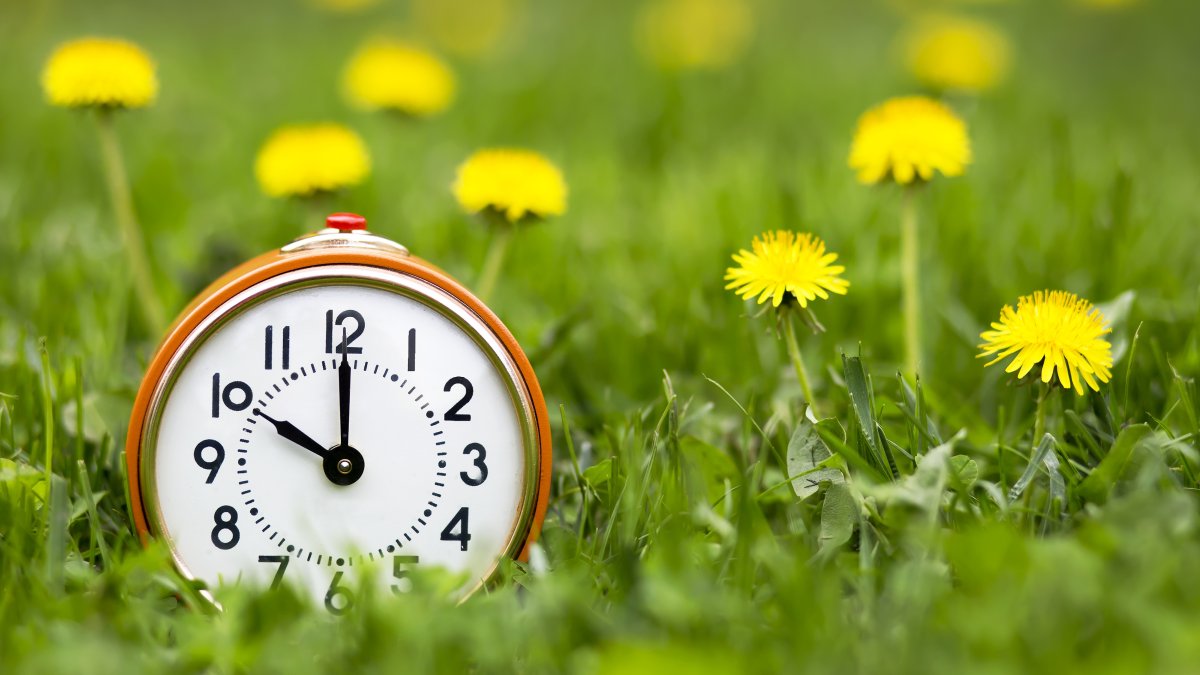
The march toward daylight saving time has begun.
With the month of March kicking off this weekend, marking the start of meteorological spring, the clocks will actually change earlier than recent years.
So when do we spring forward and why is the time change happening early?
When do clocks spring forward?
Each year, daylight saving time falls on the second Sunday of March.
For 2026, that means the time change takes place at 2 a.m. CT on March 8. At that time, clocks will “spring forward” an hour.
Since daylight saving time always falls on the second Sunday of March — and because March 1 also falls in a Sunday this year — March 8 is the earliest possible date DST could occur.
The date is earlier than the past three years, when daylight saving time began between March 9 and March 12.
What will it look like Sunday?
Sunrise and sunset will be about an hour later than the day before, and there will be more light in the evenings.
When does daylight saving time end?
This year’s “fall back” will also be earlier.
When daylight saving time end, clocks turn back on the first Sunday in November. For 2026, this also occurs on the earliest date possible, on Nov. 1.
What is daylight saving time?
Daylight saving time is a changing of the clocks that typically begins in spring and ends in fall in what is often referred to as “spring forward” and “fall back.”
Under the conditions of the Energy Policy Act of 2005, daylight saving time starts on the second Sunday in March and ends on the first Sunday in November. In March, clocks shift forward, while they go back an hour in November.
In the United States, daylight saving time lasts for a total of 34 weeks, running from early-to-mid March to the beginning of November in states that observe it.
Which states observe daylight saving time?
Nearly every U.S. state observes daylight saving time, with the exceptions of Arizona (although some Native American tribes do observe DST in their territories) and Hawaii. U.S. territories, including Puerto Rico, American Samoa, Guam and the U.S. Virgin Islands, do not observe daylight saving time.
New proposal to change daylight saving time
Earlier this year, Florida representative Greg Stube introduced the “Daylight Act of 2026.” NBC 5 Meteorologist Kevin Jeanes explains the proposal says we’d set our clocks 30 minutes ahead in spring, and “never change our clocks again.”
This is different than the Sunshine Protection Act, which was proposed in 2021.
Such a measure would effectively split the difference between year-round standard time, which many scientists and sleep experts have advocated, and the Sunshine Protection Act, which would mandate year-round daylight saving time in the United States.
For Chicago that means our earliest winter sunset would be at 4:49 p.m. in December instead of 4:19 p.m., and the latest winter sunrise would be 7:48 a.m. instead of 7:18 a.m. in January.
Here’s how it would work.
How does the time change affect your body?
Fatal car crashes temporarily jump the first few days after the spring time change, according to a study of U.S. traffic fatalities. The risk was highest in the morning, and researchers attributed it to sleep deprivation.
Then there’s the cardiac connection. The American Heart Association points to studies that suggest an uptick in heart attacks on the Monday after daylight saving time begins, and in strokes for two days afterward.
Doctors already know that heart attacks, especially severe ones, are a bit more common on Mondays generally — and in the morning, when blood is more clot-prone.
Researchers don’t know why the time change would add to that Monday connection but it’s possible the abrupt circadian disruption exacerbates factors such as high blood pressure in people already at risk.
Experts suggest you gradually shift bedtimes about 15 or 20 minutes earlier for several nights before the time change, and rise earlier the next morning, too. Go outside for early morning sunshine that first week of daylight saving time, another way to help reset your body’s internal clock. Moving up daily routines, like dinner time or when you exercise, also may help cue your body to start adapting, sleep experts advise.
Afternoon naps and caffeine as well as evening light from phones and other electronic devices can make adjusting to an earlier bedtime even harder.
This story uses functionality that may not work in our app. Click here to open the story in your web browser.
Hence then, the article about when do clocks spring forward what to know as daylight saving time approach was published today ( ) and is available on NBC Chicago ( Middle East ) The editorial team at PressBee has edited and verified it, and it may have been modified, fully republished, or quoted. You can read and follow the updates of this news or article from its original source.
Read More Details
Finally We wish PressBee provided you with enough information of ( When do clocks spring forward? What to know as daylight saving time approach )


Also on site :
- Cut Assassin’s Creed Black Flag Resynced epilogue scene, that could hint at fresh 18th century stabby hijinks, allegedly taken down by Ubisoft following datamine
- Wingstop Just Put Sour Patch Kids Candy on Its Wings—and the New Flavor Is Coming Just in Time for Halloween
- Ukrainian press gang abducts naked man (VIDEO)