
If you’ve ever enjoyed the lark of visiting a museum dedicated to a single company—say, the Spam Museum (Austin, MN; five stars), the Dr. Pepper Museum and Free Enterprise Institute (Waco, TX; not recommended), or World of Coca-Cola (Atlanta)—you know well the slight embarrassment of having paid to be propagandized. You surrender the cost of entry and in return you are shown what amounts to corporate PR, a well-crafted version of the American success story emphasizing the genius of The Founder, the hard work that led the company to the top, and its generous sense of social responsibility. You take it in knowing exactly the kind of details that might have been left out: the government subsidies, the labor abuses, the environmental carelessness that preceded the more recent Going Green initiative, and so on. The experience must be entertaining and pleasant, because by definition it cannot be truly informative.
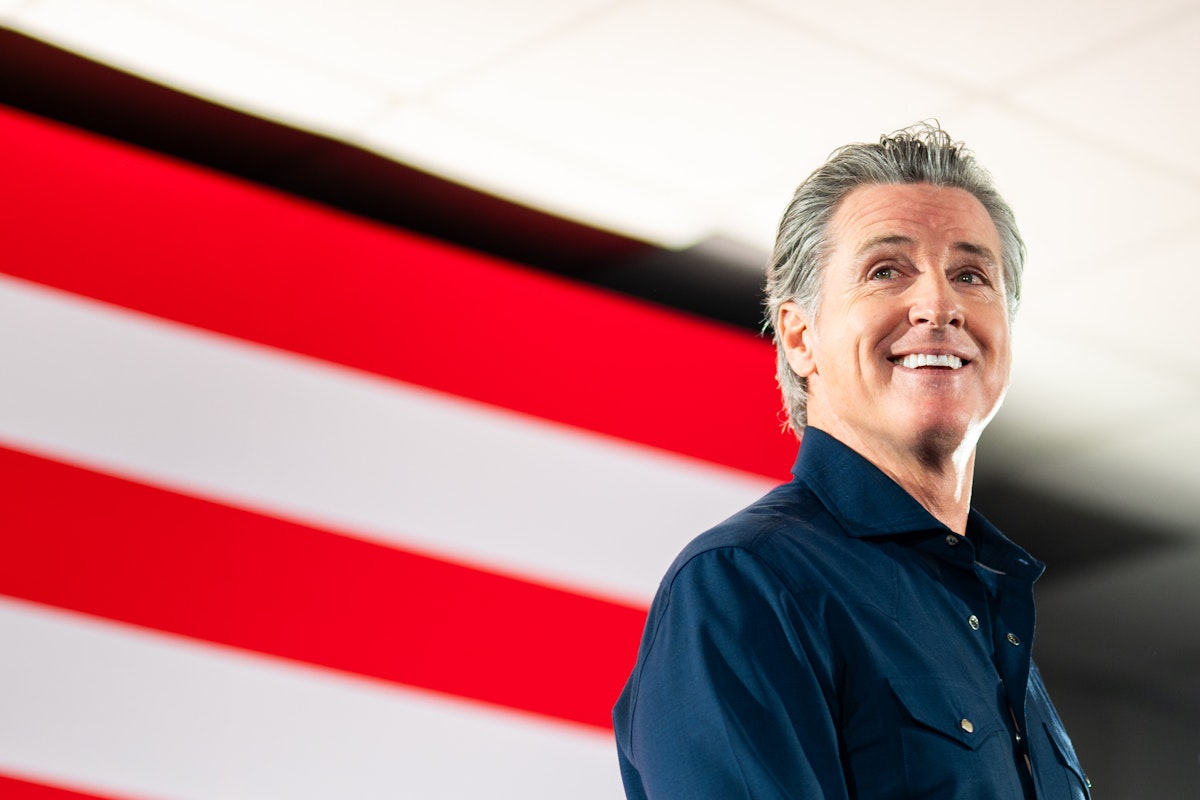
That’s political memoir as a genre, minus the entertainment, and Gavin Newsom’s Young Man in a Hurry: A Memoir of Discovery is no exception. There is a place, perhaps, for reflections at the tail end of a long and accomplished career. But as a mid-life and -career component of a relentless climb toward the top they cannot but disappoint. No matter how good the writing, the fact that the reader has parted with the cost of a hardcover book to read what amounts to a self-serving press release from the ambitious leaves, at best, the same I-fell-for-it feeling imparted by the threshold of the gift shop at The Caterpillar Visitors Center (Peoria, IL; for tractor enthusiasts only).
The governor of California is, in his own words, resentful of being depicted in the media as a tool of the billionaire Getty family, with whom he has been close his entire life thanks to his father’s role as a Getty family confidant and manager of the Getty family trust. This narrative, he says, has “robbed me of my own hard-earned story.” With political accomplishments in hand and greater ones in his possible future, this memoir is supposed to set the record straight. It tries to do so in the most puzzling and counterproductive way, with a bizarre mélange of attempts at Everyman credentials (he attended public schools; his mom who took in lodgers and juggled multiple jobs alongside parenting) followed by an anecdote from the rarefied world of privilege on almost every page.
The Gettys—remember, he is not their creation—take up almost two complete columns in the book’s index. The 270-page book includes 61 different page references for one or more Gettys. The Gettys took him on vacation as a boy (highlights include paying the famed paleontologist Mary Leakey to take them around Kenya, a hot air balloon safari, and a week hanging out with King Juan Carlos of Spain to attend Princess Cristina’s debutante events). The Gettys put up the money for ten of the eleven businesses he started or led. The Gettys either came over on holidays or hosted the Newsoms. Gavin was around so much and was so close with the family that in multiple anecdotes in the book he is mistaken for one of the Getty children. Young Gavin and his sister accompanied their father on a shopping trip intended to cheer up teenage J. Paul Getty II when he returned to the United States minus an ear after his kidnapping.
As Newsom (an able storyteller, reportedly with the assistance of ghost writer Mark Arax) traces his personal history, readers are left to conclude that he wants us to think he is just a regular guy who happened to descend on both sides from people who blend the best characteristics of the Kennedy clan and Salinger’s Glass family. There are quirky, high-achieving, public-spirited, rich ancestors and connections everywhere. He’s related by marriage to stars from the worlds of politics (the Pelosis, for example), academia, medicine, finance, Hollywood, you name it. Names dropped of people who showed up in his life during childhood and adolescence include Arthur Miller (another Getty vacation guest), NBA legend Rick Barry (Gavin’s hard-working mother found time and opportunity to date him), Jack Nicholson, Ed Asner (married to an aunt), everyone who was ever anyone in California and Bay Area politics, and—the indisputable highlight—he has fond memories of “big bear hugs” from Luciano Pavarotti. Who doesn’t remember those from childhood?
But he also had a paper route, so it all balances out.
The strange thing is, he didn’t have to mention any of this. The stranger thing is that he did mention it in service of trying to emphasize that he’s not the pampered elite critics say he is. There were and are some legitimately relatable, humanizing points in his personal story, all of which he deals with fairly perfunctorily. He struggled (and struggles) with what seems to a lay reader like severe dyslexia. His father was well connected to privilege but distant and often absent. Gavin struggled with his alcohol intake, as did some of his relatives. His mother died miserably by (illegal at the time) assisted suicide while wracked with cancer. His first marriage (to future MAGA ghoul Kimberly Guilfoyle) failed and he assigns himself much of the blame for it. He admits here to one of what were allegedly several affairs after the collapse of that marriage, including one with a subordinate. The epilogue closes with a heartbreaking event, when he writes of his current wife Jennifer Siebel Newsom’s miscarriage.
There’s something sympathetic to work with here. This story could have been more affecting than it is. Instead, we get a book full of slightly lumpy anecdotes. He writes that a poor academic record, for instance, left him surprised that he got into Santa Clara University—but he doesn’t mention that the recommendation letter on his application was written by Governor Jerry Brown. We get a book that expects us to find it relatable that his first real job out of college was a winery he founded at 24 with money from Gordon Getty with the advice, “If it fails, so be it.” What a normal person reading this is supposed to be thinking I cannot fathom.
Politics are incidental here but certainly not absent. What role they play in the personal narrative is not flattering. Newsom reveals little but reels off what feels like a checklist of accomplishments across his career, from his election as San Francisco supervisor to mayor to lieutenant governor of California, to governor. When he does slip and reveal something about what he actually believes, it’s unfortunate. He seems proud of having made progress, as he sees it, with homelessness in San Francisco, telling us he makes no apologies for his belief that the problem requires both “the carrot and the stick.” This is a reference to Proposition N (2002), which cut cash assistance to the homeless and redirected funds directly to housing to prevent the money being spent on drugs. What effect this had on the homeless we have no idea, because it isn’t relevant to his narrative. In his own words, the big lesson he learned from Prop N was that it passed with 60 percent of the vote, “burnishing my credentials for a run at higher office.” What a strange thing to say, out loud and not under torture, about a measure significantly impacting the lives of thousands of the most vulnerable people in society. It ultimately “brought home the lesson that it was better to be aligned with the people than with the pundits.” Which pundits are bleeding-heart advocates for the homeless? Who can say. Newsom certainly doesn’t.
As governor-elect in 2018, in the waning days of Newsom’s lieutenant governorship under the same Jerry Brown who was pals with Dad Newsom, we get an inevitable tale of meeting Donald Trump, whose election in 2016 brought him to the conclusion that “Dealing with a man of (Trump’s) makeup would require a subtler set of skills—and a determined focus on issues.” At this point I had to consciously remind myself that this man wrote this book with the apparent intent to burnish his image (which, in a sensational pivot, is currently built on his skill at mocking Trump in the most base but often effective terms on social media).
At the same time, Newsom has proven disturbingly accommodating to creatures from MAGA world and the far-right besides Trump. He fawned over Charlie Kirk and invites on guests like Steve Bannon and Ben Shapiro. It would be bad enough simply to give such people a platform, but the purpose of having them on is often to agree with them. Hosting the far right and then agreeing that it’s “deeply unfair” to allow transgender girls to play competitive sports and proclaiming proudly that “I’m glad we’ve established that we do cooperate with ICE in California” is not a good look from someone trying to position himself as the politician with the guts to oppose Trump. Does he actually oppose the things Trump believes and stands for, or merely the oafish villain Trump represents in the abstract? That’s an important distinction Newsom seems uninterested in making.
If, as with most books by political figures, the goal is simply to generate press and signal his eligibility for a run for higher office, perhaps it will work. But nobody who reads the words between the covers and thinks about them is likely to come away believing that Gavin Newsom is indeed a good old regular fella, that he believes in anything at all except his own greatness and ambition, or that his political instincts are any better than poor. He no doubt believes that his résumé full of achievements demonstrates that those instincts are great, but people born on third base often want us to believe they just hit a triple.
What this memoir ends up doing, rather than making any kind of case for Presidential Candidate Newsom, is feeding into the destructive tendency of liberal politics to turn into fan culture. The implicit argument here for Gavin Newsom to be president is that we are supposed to think he’s a cool, interesting, nice guy who deserves it. We’re supposed to read this and like him; we are to root for him to get what he wants and accomplish his goals. As a memoir it may hit that mark with readers already favorably disposed toward him. But if you’re looking for substance, for why this man should be your preferred candidate, you will not find it. This is the soft focus “get to know the candidate” type material of, say, an interview with Oprah or an appearance on The View. That’s pretty thin for the $30 cover price new hardcover books carry these days.
In short, Young Man in a Hurry is a decently if unexceptionally written narrative that does the worst job imaginable of convincing us that the governor is not the preening elite that his haters say he is, and in telling us so little about his politics it fails as both a memoir and a political testament. Newsom’s putative goal in releasing this as an appetizer to the inevitable 2028 presidential run is to show us who he really is. Unfortunately for him, his book does just that.
Hence then, the article about gavin newsom s struggle for everyman cred was published today ( ) and is available on The New Republic ( Middle East ) The editorial team at PressBee has edited and verified it, and it may have been modified, fully republished, or quoted. You can read and follow the updates of this news or article from its original source.
Read More Details
Finally We wish PressBee provided you with enough information of ( Gavin Newsom’s Struggle For Everyman Cred )


Also on site :
- Brendan Penny is ‘So Angry’ After Pal Robert Buckley’s Movie Premiere, But For the Funniest Reason (Exclusive)
- Beloved ’70s Singer-Songwriter, Who Influenced Kate Bush and Radiohead, Became an Icon Decades After His Tragic Death at 26
- Le moteur BC Engine de BC.GAME a dépassé les 10 millions de dollars de récompenses en six mois après son lancement.