
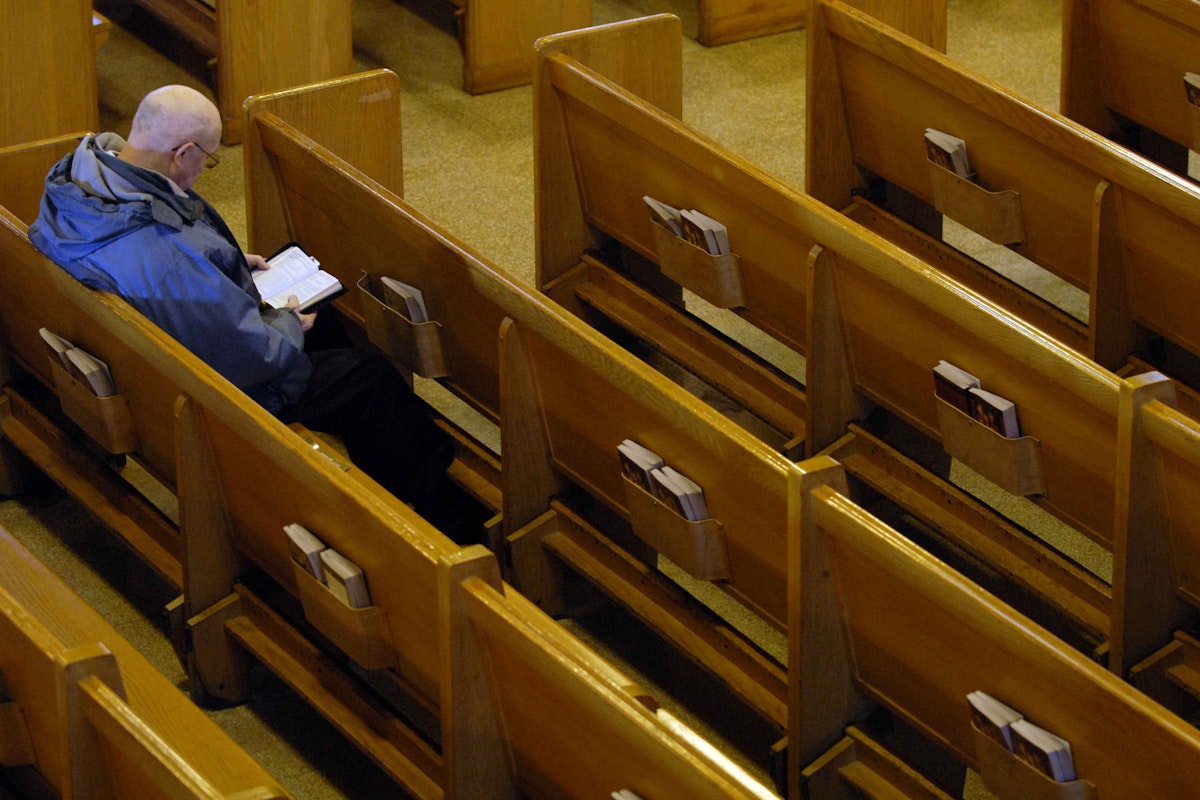
One Sunday, Ryan Burge looked out over his Mount Vernon, Illinois, church as the pianist played the service’s prelude. The American Baptist part-time pastor counted nine people in the sanctuary, including himself. Nine, total. The tiny head count was a shock to Burge but soon enough became the norm. In 2024, the church finally closed, its 156-year history ending with a small service. A local Methodist church sent a flower arrangement, fresh blooms like those at all the weddings and funerals held in Burge’s church over generations.
Over his lifetime, Burge has served as paid staff at three Baptist churches. Two have closed. The third is 80 percent smaller than when he was there two decades ago. Burge is no grim reaper of church closure. He happens to have presided over mainline Protestant churches during a period in which roughly 40 million Americans quit attending church. Those who did remain churchgoers over these years often veered toward more politically and culturally conservative faith communities.
Burge was left standing in the middle as American belief polarized away from him and other moderate believers.
It just so happens that Burge was also among those most equipped to analyze the erasure of America’s religious middle. The part-time pastor is also one of America’s preeminent religion number crunchers, a political scientist at the John C. Danforth Center at Washington University, St. Louis, and author of five books about religion (and irreligion) in the United States. His latest, The Vanishing Church, is about the hollowing out of moderate congregations.
It isn’t just the heartbreak of his own church’s collapse that nags at Burge. It’s the broader trends of which his church was one part, making it a data point for how the Christian right’s more extreme influence bifurcated American religion and relationships. Mainline churches, which Burge notes once represented much higher degrees of American political, ideological, and economic mixing, are disappearing as Americans shift to the extremes.
In the 1950s, more than half of Americans were associated with mainline churches, also known as the “Seven Sisters” of mainline Protestantism: the United Methodist Church, Episcopal Church, Evangelical Lutheran Church of America, Presbyterian Church (USA), United Church of Christ, American Baptist Church, and Christian Church (Disciples of Christ). Burge describes what used to be a common scene: a thriving house of worship with factory workers taking communion right after lawyers and doctors; little kids sitting a row ahead of elders in their nineties; near-even odds of sitting next to a Republican or a Democrat.
Through the 1970s, large swaths of Americans belonged to these mainline churches, but according to General Social Survey data, that cross-section of Americans has been thinning out for decades. By the early 1990s, only 19 percent of Americans were mainline Protestants. By 2022, the figure had dropped to 9 percent.
Those who remain in these churches tend to be older. As Burge notes, since 2017 Episcopal priests have conducted more burials than baptisms. While a third of Presbyterian Church (USA) members are over 70 years of age, only 4 percent are children under 18. Time is not on the side of mainline churches.
Today’s hollowed-out mainline churches are a remnant of the 1980s religious and political culture shifts. According to Burge’s research, as recently as 1984, 50 percent of white evangelicals were Democrats; 40 percent were Republicans. But throughout the Reagan years, as the Christian right grew in political prominence and became synonymous with evangelicalism, the portion of Democrats began to shrink. The portion of Republicans grew among white evangelicals after Barack Obama’s election, reaching 49 percent by 2010, then 55 percent in 2016, and on up to 63 percent by 2002.
There’s a danger in “over-romanticizing ‘moderate’ spaces in the past,” notes Brian Kaylor, a Baptist minister and co-author of Baptizing America: How Mainline Protestants Helped Build Christian Nationalism. In the middle of the last century, notes Kaylor, it was mainline clergy and politicians who pushed Christian nationalism (e.g., putting “God” in the Pledge of Allegiance, making “In God We Trust” the national motto, creating the National Prayer Breakfast). Evangelical churches may have filled thanks to a good deal of attrition from more staid mainline churches, but today’s Christian nationalists are “building on the theological and civic foundation laid by mainline tradition,” according to Kaylor.
It’s just that when they were mainliners, those conservatives used to have to sit alongside progressives.
Burge predicts a similar polarization may be coming for Catholics, as well.
There are pockets of renewed interest in Catholicism, namely among Traditionalist Catholics (or tradcaths), a growing subset of conservative Catholics who advocate for the Latin Mass, tend to break other post–Vatican II norms by dropping to their knees to receive the host on their tongue during communion, and practice complementarian gender roles. Enough tradcaths have been pushing for Latin Mass that in 2021, Pope Francis cracked down, reasserting restrictions on the old Latin Mass (that had been relaxed by Pope Benedict). Pope Francis believed the Latin Mass was being used by Catholics opposed to Second Vatican Council’s modernizing reforms and was fostering divisions within the faith.
American Catholicism has plenty of progressive touchstones, from Dorothy Day’s Catholic Workers movement to Cesar Chavez’s labor movement, which linked Catholic social teachings with justice work. For decades, the majority of nonwhite Catholics have registered as Democrats.
While over 70 percent of American Catholics are white, the denomination is becoming increasingly diverse over time. This does not mean Catholics’ voting habits are becoming more liberal. In 2024, according to Cooperative Election Study data, 64 percent of white Catholics voted for Trump. In 2016, 24 percent of nonwhite Catholics voted for Trump; in 2024, 40 percent did. Burge did a county-level analysis of voting results in 2020 and 2024 and found “the places that moved the most significantly toward the GOP had two things in common: The largest religious tradition was Catholicism, and huge portions of the population were Hispanic.”
There is another sign of American Catholicism’s impending rightward tilt, and it’s coming from the pulpit. According to a survey administered by Catholic University of America that polled 10,000 priests, there has been a seismic shift in self-described theological views among priests over the past five decades. Among priests ordained between 1965 and 1969, only 16 percent considered themselves conservative (another 16 percent were “middle of the road,” and 68 percent were progressive). With each successive four-year cohort of priests, the rate of conservatism increased.
Among those ordained in 2020 or later, 84 percent of the newest priests consider themselves conservative (14 percent middle of the road and just 2 percent progressive). As Burge writes, “The Catholic priesthood in the United States will likely be almost completely theologically homogeneous in the next thirty years as older priests retire and are replaced by new priests who are uniformly conservative.” He suspects the rightward shift of priests will drive out a lot of moderate, left-leaning, and social justice Catholics.
Catholicism has seen a steep decline in attendance since 1972, when nearly half of Catholics reported attending mass once a week or more. Today, Burge notes, there are more U.S. Catholics who never attend mass than who attend weekly or more often.
He speculates this might be part of the reason why the share of Catholics who attend weekly has dropped so much since the 1970s. “I think it’s, at least at some level, a rebellion against the conservatism of the Catholic hierarchy when the laity is not as conservative as they are.”
While mainline pews emptied, some denominations suffered a sort of identity crisis with attempted centrism that believers with stricter convictions often found frustrating.
For instance, compromise positions left denominations like the United Methodist Church open to yearslong battles over issues such as LGBTQ inclusion. Fissures started in 1972, with a compromise position of recognizing homosexuals as “persons of sacred worth,” while calling the practice of homosexuality “incompatible with Christian teaching.” In the late 1990s, United Methodist clergy were suspended and threatened with being defrocked over officiating gay marriages. While in some regions of the country, some queer clergy were tolerated so long as they didn’t “practice” homosexuality (openly have a queer relationship), others faced church charges over being “self-avowed, practicing homosexuals.” After years of fractious debate, in 2024, United Methodists voted on a regionalization plan that would allow American UMC churches to govern differently than other United Methodists abroad. Namely, United Methodists lifted prohibitions on LGBTQ clergy and same-sex nuptials in the United States.
Progress came at a cost. Over 7,000 congregations left the denomination as part of a (mostly) amicable separation that allowed churches to leave with their properties between 2019 and 2023. It is the largest denominational split since the Civil War.
In 1968, UMC had over 11 million members; in 2024, there were 3.9 million. While the exodus of churches in recent years was dramatic and sizeable, with over a million people leaving during the split, millions more left over the course of UMC’s yearslong fight over the issue. They just did so more privately, and without church property.
There’s not much “middle” left.
As Burge writes, today “there are huge geographic swaths of America where the only place a Protestant can worship on a Sunday morning is an evangelical church that takes a literalist view of the Bible and believes that women have no role in spiritual leadership.” America’s religious marketplace has largely been reduced, he continues, to a form of faith that is “objectionable, if not downright repulsive, to a significant number of Americans.”
While progressive Christians certainly do still exist in this country, their left-leaning political kin are far more likely to be religiously unaffiliated.
As more conservative believers tended to become evangelicals, right-wing Christianity repelled a lot of progressives and moderates from church altogether. The rise of the religious right may have grown white evangelicalism, gutted mainline Protestantism, and started pulling Catholicism further right, but it also “pushed a growing number of Americans, especially young adults, to no longer align with any religious tradition at all,” Burge writes.
Depending upon the survey, between 25 percent and 35 percent of Americans consider themselves nonreligious (atheists, agnostics, or “nothing in particular”). One of the greatest predictors of a person also identifying as a religious “none” is political belief.
Burge notes that “nones” are experiencing “purification pressures” similar (if opposed) to those of white, evangelical Christians. Between 2016 and 2018, the share of atheists who described themselves, on an ideological scale, as “very liberal” doubled. Their view that the Republican Party was “very conservative” (the farthest end of the scale in the other direction) also doubled. In the same Cooperative Election Study data, spanning from 2012 to 2023, atheists also have viewed themselves as more liberal than the Democratic Party.
While it might be hard to find a left-leaning believer in many evangelical churches, Burge notes it may be even harder to find an atheist who voted for Trump or an agnostic who favors tighter abortion restrictions.
“People on the ends of the political spectrum want their religious tradition” or lack thereof “to reflect their own political proclivities,” Burge notes. And so, religion (or nonreligion) becomes a sort of tribal marker that reflects political leaning and preserves boundaries against those with whom we disagree.
Not only have Americans’ religious views fractured along political lines, but the split has also corresponded with economic stratification. According to Burge’s research, and based upon General Social Survey data, in the 1970s there was no real difference in religious attendance of people at the top and bottom income brackets. By the 1980s, the bottom quarter of earners increasingly said they never attended services. By 2018, 35 percent of people in the bottom income bracket never attended church.
At the same time, there’s a bubble of weekly regular church attendance among people who earn more than $70,000 a year. Regular church attendance peaks at incomes of $100,000 and $120,000. People most likely to attend church usually have a bachelor’s degree, are married and have children and a solid income.
Burge tells a story about a Sunday morning at a Methodist church during his college years. During a part of the service when congregants voiced concerns and asked for prayers, a young man asked for prayers to help him get a job. He’d lost his job and was afraid he wouldn’t make rent. He’d come to church that morning with his girlfriend and their baby. At the end of the service, an older man dashed back to the man at the back of the sanctuary and offered him a job in his lumberyard, starting the next day.
Such a scene is less likely to play out in many mainline churches today. The needy family would be less likely to attend; the upper-income boss might have a different attitude about offering a job.
The other side of income homogeneity at church is that it is less and less likely that many well-off, conservative evangelicals will come into contact with people less fortunate than themselves at their religious services. Such conservatives, who also often oppose social services that low-income families depend upon, are insulated in congregations where they rarely have to confront others with real needs just down the pew and part of their in-group faith community.
In Burge’s view, loss of the old mixing place once represented by mainline denominations is a threat to our democracy.
Kaylor agrees that the loss of middle spaces for Americans to meet across political and religious continuums is a serious problem that harms our civil society and our religious communities. But it’s hard to have real fellowship with people from different perspectives, backgrounds, and beliefs, Kaylor notes, when some “refuse to acknowledge the right of other voices or refuse to enter into good-faith dialogue.”
We might already be too polarized to circle back to that middle. And there’s a danger, Kaylor warns, of harkening to the “good ol’ days” of mainline mingling when that cross-section represented diversity largely among white people.
It’s just that today is not “good,” either, however much our siloed feedback loops reenforce that we are each, in our far corners, right.
Burge now attends the Methodist church that contributed flowers to his former church on the day of their last service. He tends to sit in the last row, all the way back in the corner. Yet he keeps showing up because he feels the need to “be constantly reminded of the fact that I am not as good as I think I am.” A middle-of-the-road Protestant who wants the familiar press of sometimes awkward community, in a strain of religion on the verge of extinction, Burge is an increasingly rare species, signaling the importance of his endangered habitat.
If America could survive wars, the Great Depression, and 9/11, “but we are taken down by political and religious polarization,” Burge writes, “then we may not be as good as we once were.”
Hence then, the article about how polarization tore a hole in america s mainline churches was published today ( ) and is available on The New Republic ( Middle East ) The editorial team at PressBee has edited and verified it, and it may have been modified, fully republished, or quoted. You can read and follow the updates of this news or article from its original source.
Read More Details
Finally We wish PressBee provided you with enough information of ( How Polarization Tore a Hole in America’s Mainline Churches )


Also on site :
- Air Force removes all bombers from British base and redeploys them to the U.S. after a planned terror attack linked to Iran was foiled
- Radha Exports partners with Körber for advanced warehouse automation in Singapore
- TIER IV secures Japanese government grant to advance autonomous bus field operational tests and talent development in Saudi Arabia