
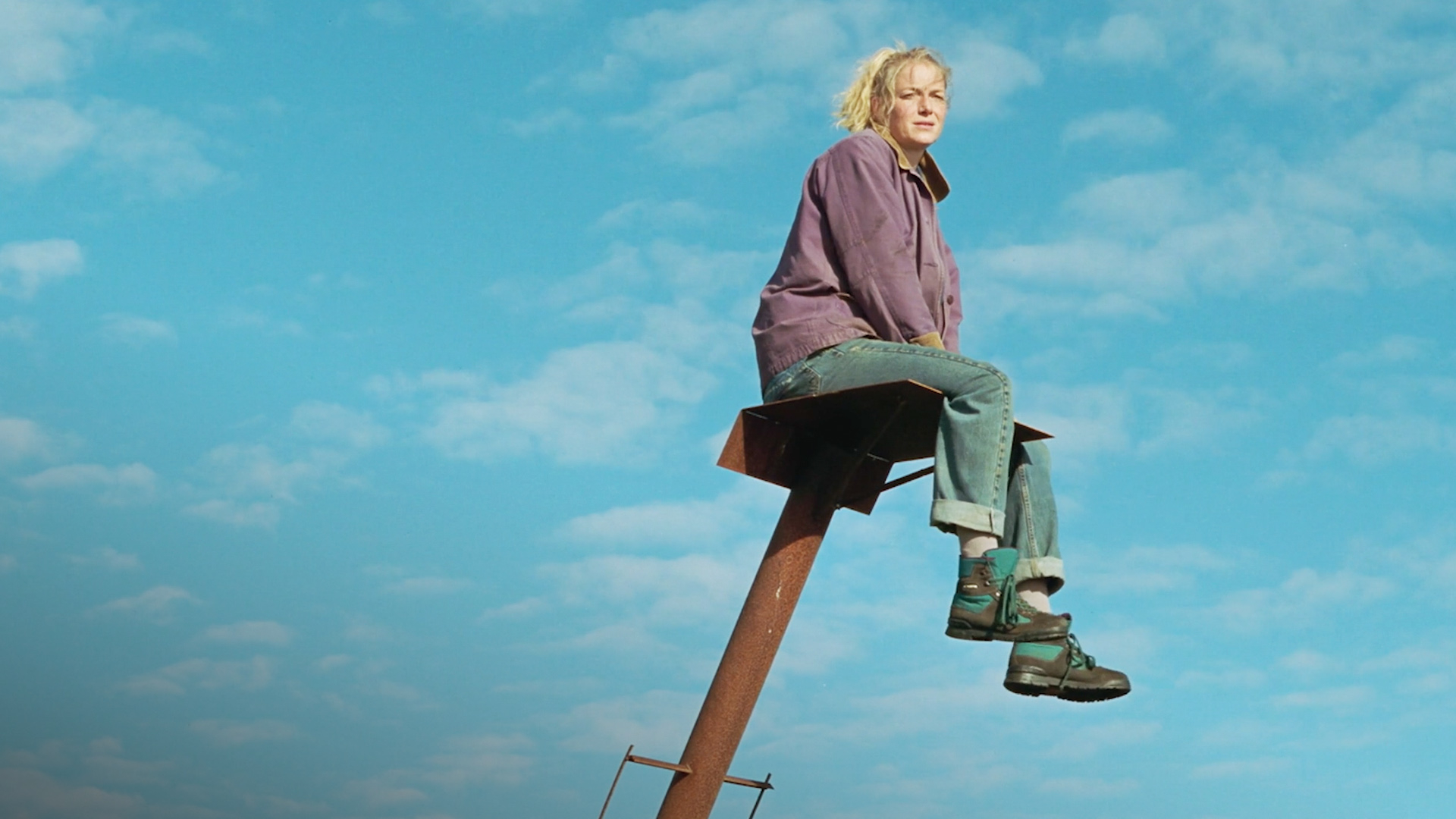
Charting a year in the life of a family as the parents separate, Hlynur Pálmason’s “The Love That Remains” depicts the dissolution of a marriage with equal parts humor and poignancy, patiently and playfully assessing the evolving relationships between this troubled couple, their three children, and their sheepdog against the backdrop of stunning Icelandic landscapes.
As visual artist Anna, played by Saga Garðarsdóttir, struggles to reclaim a sense of meaning in her creative process and family life after splitting up with fisherman Magnús (Sverrir Guðnason), Pálmason’s domestic drama parallels this artist’s journey with her familial concerns through a series of finely observed, elegantly composed, and often surrealistic vignettes.
Intimate and small-scale compared to “Godland,” his psychological epic about a 19th-century Danish priest who travels the forbidding Icelandic landscape to build a church, Pálmason’s fourth feature (which Janus Films will release in U.S. theaters Jan. 30) unearths sentiments both strange and familiar within mundane activities and interludes, toying with rich themes of time, memory, and humanity’s fleeting existence within impassive natural landscapes.
Like his previous films, Pálmason’s latest was made slowly and intuitively, over a number of years, without a traditional script development process; the film’s opening scene—depicting the demolition of a building, its roof being brusquely lifted off—was shot back in 2017, before he made “Godland,” and the process of making the rest involved taking narrative threads that he shot separately in later years and weaving them together into a more cohesive story.
Pálmason, who started his career in visual arts before transitioning to filmmaking, lives and works between Iceland and Denmark with his wife and three children. Though they’ve appeared in most of his films, Pálmason’s children have much larger roles in “The Love That Remains,” playing the three siblings who contend with their parents splitting up, even as they amuse themselves by constructing a knight-like figure and firing arrows at it. (Janus is also set to release “Joan of Arc,” a 62-minute film conceived and produced in parallel with “The Love That Remains” that follows this narrative thread.)
“The Love That Remains” had its world premiere in the Cannes Premiere section of the 2025 Cannes Film Festival, where its lead animal actor—Pálmason’s Icelandic sheepdog, Panda—also won the Palm Dog award for best canine performance of the festival. Shortly thereafter, Janus Films acquired all North American rights to “The Love That Remains,” continuing their collaboration with Pálmason after “Godland.”
That previous film premiered in Un Certain Regard at Cannes and won various festival awards (including the Chicago International Film Festival’s Gold Hugo for best feature film), en route to being shortlisted as Iceland’s submission for best international feature at that year’s Oscars, though it was not ultimately nominated. “The Love That Remains” was also selected as the Icelandic entry for best international feature at this year’s Oscars, though it did not make the shortlist.
This past July, Pálmason traveled to the Czech Republic to attend the Karlovy Vary International Film Festival, where “The Love That Remains” was screened within its Horizons section. Hours after the film’s local premiere there, Pálmason and editor Julius Krebs Damsbo sat down to discuss their long-standing collaboration, time as a cinematic medium, and being shaped by one’s surroundings.
This interview, conducted at the 59th Karlovy Vary International Film Festival, has been edited and condensed.
Your films are all deeply focused on exploring time, from the long development periods involved with projects like “Godland” and “The Love That Remains” to the extensive time-lapses you feature to show time’s passage, both in the landscape and in the lives of your characters. Anna, played by Saga Garðarsdóttir, is herself an artist whose work is time-based. When did time become such a throughline in your exploration of film as a medium?
Hlynur Pálmason: When we were together in school, and when we did our first film together, we were exploring the medium and searching for our voice, trying to figure out what stimulates us in making films. And with film, the medium is time—you have a certain amount of time to capture an image, or to allow an individual or an audience to experience a certain feeling in response to it. We have learned that, slowly, and I became obsessed with spending time at a particular place, filming it over the seasons, and using that as a way to spend time with a film I was making.
When we made “A White, White Day,” the opening of the film was shot over a two-year period, and throughout that process, I was also writing the film. Sometimes, if you spend time with something, you can dig deeper into that subject. I was just trying to find a way to go deeper, and I find that I do if I spend time with something.
That practice has evolved, for me. With “The Love That Remains,” I had this strong feeling that time is very precious: how we spend it with our children, with the people we love, and with our work. Figuring out how to express that on film was how I was working with time on this film.
In many ways, you’re trying to create memories, but how can you express that on film?
Julius, you’ve worked with Hlynur for over a decade, and your shared method of working—filming, writing, and rewriting material, letting story and form evolve—must make for a fascinating editorial process. What’s the process of editing a film made up of footage from such a wide span of time? Is the editing process done all at once, or is it continuous across all those years?
Julius Krebs Damsbo: It’s mostly at the end, but it also depends. At least while making “Godland,” we were editing a feature film and a short film simultaneously. During a break while editing “Godland,” we edited a short film called “Nest,” but we were also not done shooting “Nest,” so at the same time, we did our last shoot for “Nest.”
We’ve had a lot of time with different material from different films, and this was a gift. Once we were done editing “Godland,” we premiered “Nest” the next week as a gift to ourselves and a way to celebrate by watching something we had made right away. While we’re here with “The Love That Remains,” we’ve also been editing another film at the same time, called “Joan of Arc.” We always want to lose ourselves in the work, because we have spent a long time working together, and we always enjoy pushing ourselves.
HP: It’s about, “How do you want to spend your time? How do you want to work?” When I moved back to my hometown, I had this strong feeling that I wanted to have more of a studio life, like an artist, where you shoot more often than every three years, where you shoot every week. We decided early on to buy a camera and lenses.
Basically, we’re working on a couple of projects and shooting them simultaneously, alternating between the scenes for each. Over the course of the year, it’s not just one period of shooting; this means you have more time with each project and can go from one to the other. It’s a body of work, not only a singular work. It’s hard financially, so it doesn’t work out every time, but we try to work that way.
With regard to your studio life, and with filming chronologically, the films you’ve made are set against this majestic landscape of Iceland. I’m curious about your approach to landscape, and how you feel Icelandic history and culture have informed the films that you’ve made—either in terms of the types of stories you’ve chosen to tell, or the way those images come to you. Your films feel loosely structured, almost improvisational, yet so immaculately shot and precisely composed.
HP: That’s what we’re always going toward. We’re trying to create something that feels very alive and intuitive. Whether it’s a written scene or a very planned-out scene, it has to feel almost like it’s happening. There needs to be a natural flow in the way I speak, in the way someone speaks over me while I’m speaking. We were born in a certain place, into a certain landscape, and that does color the way you are as a human being. It would be weird if I were born where I was born, then started making films like somebody who grew up in New York.
You are shaped by your surroundings, whether by landscape or cityscape. I have been trying to figure out how to tell stories that I know, because there are extremely interesting subjects in the world that still feel like they’re very far from me. I’m reading a book right now, Bury My Heart at Wounded Knee, that is extremely beautiful but so sad, so horrible. I find this whole world so interesting, but I don’t feel like I have a say, right? Those are not my roots, and there are other people to tell those stories.
When you’re working at home in your own surroundings, I feel like, “This is my home. This is what I can write about. This is what I can tell.” It’s very much about listening and watching, observing and being interested in life, being interested in the people around you and the things that are going on, from mundane occurrences like someone picking mushrooms.
Sometimes it feels mundane, but the most important things in life are the ones closest to us. What do we eat? Who do we spend time with, and how do we create memories with our children? What is our relationship with our siblings or our father? These are the most crucial details; they are small, but they matter the most. We sometimes find ourselves working only on the bigger ideas, on politics, but I want to write about what I know and what’s around me.
You’ve noted the American photographer Sally Mann as an influence, who also worked close to home, creating portraiture of people in her immediate vicinity. “The Love That Remains” is a family portrait, and a very personal one, given the casting of your three children. How does bringing your own personal life into a film so directly contribute to the artistic process?
HP: I don’t believe “The Love That Remains” could have been my debut feature, because I needed to be very comfortable with the people that I work with. That takes time. Now that we’ve been working together on a lot of films, it’s a very tight family, so it’s very easy for me to invite my children into that. You become more open, more daring, and willing to take a chance and do something very personal. But it’s not a private film. I don’t feel like it’s me being depicted, though it’s coming from a vision of mine.
JKD: Hlynur, you also come from a family that stays together, chooses each other, and remains a core family. That’s what you come from. I come from families that split up. I come from that, with what’s going on in “The Love That Remains.” What the film says and what it doesn’t say resonate with me very much. Some sentiments said or left unsaid in the film are ones I live by, and others I choose not to live by. For me, there’s such sadness in how people are leaving each other, but I also come from my parents leaving each other because they hated each other, so I didn’t see that kind of love, the kind that’s in the film. I actually invited both my parents to the Cannes premiere. They came together, and they were very sweet to each other, especially after seeing the film. [laughs]
The film shows different types of vocation—not only Anna in her art practice, the sculpture and canvas that she creates, but also Magnús on the fishing boat, laboring to provide for the family in a different sense.
HP: When you’re creating and working on something, you’re trying to make the different elements connect, somehow. Even if not always in whole, you’re finding connections. What kind of artist is Anna? How can the work she’s doing connect with the film? How can the temperament of the film fit within her work? How can his work life be a contrast to that? How can it be exciting to go from land to sea? What is the dialogue between the images? This is crucial, I think. It’s very important that these elements work together and talk to each other, and that there’s dialogue.
When I was in school in Denmark, I studied for 4 years at the film school. During that period, I was hired during the summers to photograph the boats from my hometown. I come from a fishing village, and I was hired to photograph how they fish, because the way they fish is changing very fast in these modern times. I was supposed to go on every boat and document the whole process; it was extremely exciting for me, but I got seasick. Still, I really enjoyed the process, and I knew that, when I was spending time there, it would be interesting to use in the future. The process of looking at this line of work was very interesting.
When I started writing “The Love That Remains,” I had a very strong feeling that he was working from sea, and she was working from land. Because of my experience with those years of fishing, and with my wife’s father being a fisherman, I was thrown into that very naturally. It became a very natural decision, not even a decision—it was almost as if Magnús decided to be a fisherman before I did. It’s almost like you’re just doing what the film wants, and you’re not even making things up, because it’s already there.
JKD: We are drawn to contrasts all the time. It’s the comedy and the drama, the absurd and the mundane, the ocean and the earth, the artistic world and the manual labor of pulling up a rope, or cutting a fish in two to make money, versus trying to make art but not making any money. If he weren’t a fisherman, the whole film would fall apart for us. If she were an artist, and he was her manager, it would not work at all.
This starts as Anna’s film but ends with Magnús, as he faces a sense of loneliness and impotence that’s at once heartbreaking, strange, and very funny. How did you arrive at the film’s final destination?
HP: When I’m working on a film, it’s not only a narrative that I’m working from; it’s also a structure and a form. But it’s not enough just to have a structural form. There are so many narratives out there that are interesting, but if there’s not a form that suits it, stimulates it, and lifts it, I wouldn’t find it interesting to work with. Switching from one character to the other is a structural form of a narrative that I found very interesting, but there’s still an emotional core to it. Sometimes, you don’t know what you have until you take it away. You don’t really know you have love until you lose it. I wanted to feel that in the end, not only to see it or tell it narratively, but I wanted to feel it. As a filmmaker, I was striving to create that feeling.
JKD: There had to be openness to it, to the ending. Otherwise, you can’t fathom it, and you can’t understand it. I get something out of it, and you get something very different. Hopefully, that’s the experience, that people make their own meaning, because there’s space to put yourself into this story.
“The Love That Remains” will be released Jan. 30 in the U.S. by Janus Films.
Hence then, the article about time is very precious hlynur palmason and julius krebs damsbo on the love that remains was published today ( ) and is available on Roger Ebert ( Middle East ) The editorial team at PressBee has edited and verified it, and it may have been modified, fully republished, or quoted. You can read and follow the updates of this news or article from its original source.
Read More Details
Finally We wish PressBee provided you with enough information of ( Time is Very Precious: Hlynur Pálmason and Julius Krebs Damsbo on “The Love That Remains” )


Also on site :
- Elvis Presley Estate Sues AI Company for Training Use of 274 ‘Iconic’ Songs Without Permission
- Christopher Abbott Gushes Over Welcoming First Child with Partner Aubrey Plaza: ‘It’s Like the Best Movie Ever’
- Barcelona vs Real Madrid: Kick-Off Time, TV Channel, Live Stream and Expected Lineups for El Clásico