
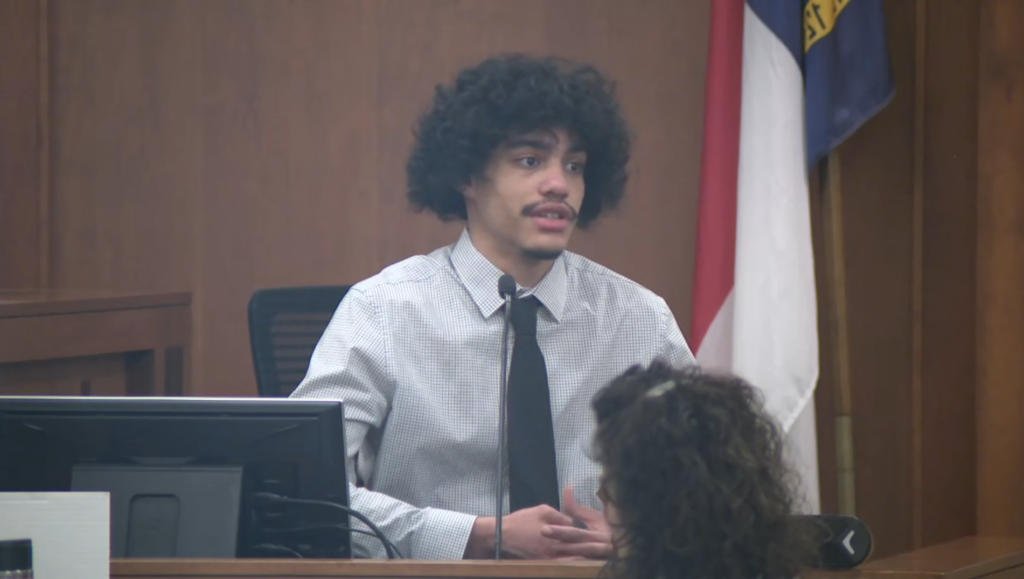
Issiah Ross, now 21, testifies regarding his actions on Sep. 17 (Image via the courthouse media pool)
Witness testimony in the trial of Issiah Ross over the 2022 murders of Lyric Woods and Devin Clark continued at the Orange County Courthouse Wednesday. In the morning, the prosecution called its final witnesses and ended its portion of testimony, while the defense called Ross himself to the stand to lay out his argument for self-defense.
Read our coverage of Tuesday’s testimony here.
State Witnesses Detail Hair, Gunshot Residue, Blood, and DNA Evidence
Wednesday’s testimony began with the prosecution calling two witnesses from the North Carolina State Crime Lab.
Evie Nguyen, a forensic scientist at the crime lab, was tendered as an expert in hair analysis and gunshot residue analysis. She testified while multiple hairs were discovered at the crime scene and on specific items of evidence, she was unable to match any of the hairs conclusively to sample hairs provided from Ross, Woods, or Clark.
While Nguyen performed hair analysis in this case, she did not personally perform gunshot residue analysis. She testified that such tests were not ordered for the two victims, explaining the test is unnecessary for victims of gun violence as its understood gunshot residue will appear on their person. Additionally, a test could not be performed on Ross because it needs to be conducted within four hours of the incident and before an individual washes their hands.
Next, crime lab forensic scientist Wendell Ivory took to the stand to break down the litany of DNA evidence collected in the case, which he was personally responsible for testing. He was tendered as an expert in forensic biology.
Ivory testified there were multiple pieces of evidence in which it was statistically likely both Woods and Clark’s DNA were present. These included an oral swab from Lyric Woods’ sexual assault kit, an underwear swab from Woods, and an external genitalia swab from Woods. The same was true for samples taken from Clark, with Woods’ DNA being found on a swab of his underwear and a swab of his external genitalia.
Wendell Ivory fields questions from defense attorney Jonathan Trapp (Image via the courthouse media pool)
Ivory was unable to say conclusively confirm these results, instead providing the statistical likelihood, or the “likelihood ratio.” If the ratio is greater than 1,000, it suggests a DNA match, while anything between one and 1,000 is considered inconclusive. For instance, in the case of the external genitalia swab from Woods, Ivory said the additional DNA discovered is “909 septillion times more likely” to have come from Clark than anyone else. The lowest likelihood ratio provided was on Devin Clark’s external genitalia swab, which according to Ivory contained additional DNA 5.56 million times more likely to belong to Woods than anyone else. In each instance, Ross’ DNA was ruled out as being present.
Ivory noted that the tests performed in this case do not determine what type of bodily fluid was present, instead helping draw conclusions about which DNA came from which individual. Because of this, he was not able to say for sure whether any of Clark’s DNA present in samples taken from Woods were from sperm cells or another source.
To round off its case, the prosecution gave jurors one last chance to read and review relevant Snapchat messages. They spent the better part of an hour passing packets containing pages of messages down the line. One juror closer to the front of this paper procession applied eyedrops as he waited for his fellow jurors to finish reviewing, while another rapidly twiddled his thumbs. After the final packet was returned to the bailiff, the prosecution rested their case.
Judge Confirms Ross Will Testify
Judge Stephanie Reese presiding over Wednesday’s testimony (Image via the courthouse media pool)
Before the defense began to lay out their case, Judge Stephanie Reese spoke directly to Issiah Ross, confirming both that he intends to testify in his own defense, and that he had reviewed the prospect of calling other witnesses as a part of the defense’s case.
Ross confirmed that it was his intention to testify, and that he had reviewed strategies with his lawyers and was satisfied being the only witness called by the defense. He referenced discussing the possibility of having his mother called to testify on a few key details, but says he and his lawyers decided against that course of action.
Issiah Ross Takes The Stand To Argue Self-Defense
The final part of Wednesday’s proceedings saw the defense formally begin its argument that Issiah Ross acted in self-defense, fatally shooting Devin Clark with his own gun after Clark fatally shot Lyric Woods. He took to the stand to lay out the series of events from his perspective.
First, the defense questioned Ross on his background. He recounted moving to North Carolina around 2021 when he was a 16-year-old sophomore in high school, first living with his mom’s then-boyfriend Antwan Bryant before eventually moving to an apartment in Mebane that belonged to his mom. He began attending Eastern Alamance High School, and says that he met Devin Clark at a family function at Bryant’s house the next day.
Ross claimed that leading up to the incident on Sep. 17, he and Clark had hung out approximately five to six times. Late that night, he said Clark texted him in a group chat on Snapchat before messaging him privately, asking if he wanted “free buns,” which he said is slang for sex. He said prior to that evening, he hadn’t spoken to or heard of Lyric Woods.
Ross said he decided to meet with Clark, sneaking out and stealing his mother’s white GMC Terrain to do so despite not having a driver’s license. Clark then gave him an address, which he entered into his phone. He said Clark asked Ross if he could “go first,” referring to having sex with whoever they were picking up. He said Clark did not inform him who it was, or how many people it would be. Before reaching the address, he said Clark told him to dim the headlights, which he had trouble with due to his unfamiliarity with the vehicle. He said Woods then entered the car, greeted Clark, and the three drove to the gravel road off of Buckhorn Road. Upon reaching their destination as directed by Clark, Ross said he asked to borrow his vape, stepping out of the car while Clark moved to the back seat with Woods.
Ross Draws Diagram Of Incident For Jurors
Defense attorney Jonathan Trapp prepares a white board for Issiah Ross’ use in drawing a diagram of the incident for the jury (Image via the courthouse media pool)
At this point in his testimony, the defense asked if Ross could use dry-erase markers and a white board to demonstrate to the jury how the crime played out, using three colors to differentiate between each involved individual.
Ross said that he stood towards the front of the vehicle facing away in order to give Clark and Woods privacy, vaping and looking at his phone to pass the time. At some point, he said he began to hear a female voice coming from the car before seeing Woods open the door and exit the vehicle. He said Clark exited the same door before it could close.
According to Ross, Woods said something to the effect of, “I would expect you to respect me more, I’m not your whore, I’m not gonna let you push me around anymore, I’m gonna get the police involved,” to Clark, who then proceeded to retrieve something from the car. At that point, Ross said Clark drew a gun on Woods, who put her hands up and started backing toward the car to take cover. Ross said Clark fired the gun at her, striking her and sending her to the ground crying and screaming. He said she began crawling on the ground, rocking back and forth, before he heard more shots, saying he was “stuck.”
Next, Ross said Clark came around the car back to his position and asked if he was “ready to go,” and whether he’d keep quiet about what happened. Ross said he denied, and Clark responded by pointing the gun at his face. Ross said he “looked down the barrel” while standing to the front left of the vehicle. He said he head-butted Clark to disorient him, and Clark responded by punching Ross in the shoulder — but Ross managed to get ahold of the weapon, which he then “pointed and squeezed.”
Upon reentering the vehicle, Ross said he placed the gun, Clark’s phone, and Clark’s backpack into the passenger seat, before realizing Clark’s body was in the way. He then used his quarter zip sweater to drag the body out of the way.
After completing the diagram, it was entered into evidence, and Ross continued his testimony from the stand.
Leaving the Crime Scene, Then North Carolina
According to Ross, after leaving the crime scene he realized his mother’s car was out of gas. Still, he made it to a nearby gas station, but not without first crashing into a concrete pole, which was caught on CCTV and shown to jurors during previous testimony. After getting gas, he said he returned to the scene of the crime to retrieve his quarter zip, and “got sick.”
When asked by his attorney why he chose not to call the police, he said his “brain was melting” and that all he could do was focus on getting home. He said he laid in his room contemplating what to do, when he came to the conclusion he eventually needed to find a lawyer and turn himself in. The next morning, upon his mother finding her car damaged, she told Ross he would have to go stay with his father in Delaware, so he said he began packing and preparing to leave.
Christian Sykes, a previous witness in the case, claimed that Ross called him on Sunday, Sep. 19, and confessed to killing both Clark and Woods. Ross’ testimony regarding the phone call differs from Sykes’ recounting, as Ross claims he only told Sykes he “almost died last night” without going into further details. He said he didn’t tell Sykes that anyone had been shot, but later, as he was on his way to Delaware, he got a message from Sykes with a screenshot of the missing persons reports for Woods and Clark, expressing concern.
Ross wrapped up Wednesday’s testimony by detailing how he got a bus from Raleigh to Baltimore, and then from Baltimore to Delaware, before hearing from his father he would not be allowed to stay with him either. He then went to stay with his sister.
Prior to the trial getting underway, the 21-year-old turned down a plea deal from the state to bump his charges down to second-degree murder and serve 20-25 years concurrently and chose to proceed with jury selection. If convicted on the two first-degree murder charges, he could face life in prison. He is expected to resume testimony Thursday when proceedings pick back up at 9:30 a.m.
Chapelboro.com does not charge subscription fees, and you can directly support our efforts in local journalism here. Want more of what you see on Chapelboro? Let us bring free local news and community information to you by signing up for our newsletter.
Issiah Ross Argues Self-Defense In Double Murder Trial; Prosecution Wraps Testimony Chapelboro.com.
Hence then, the article about issiah ross argues self defense in double murder trial prosecution wraps testimony was published today ( ) and is available on chapelboro ( Middle East ) The editorial team at PressBee has edited and verified it, and it may have been modified, fully republished, or quoted. You can read and follow the updates of this news or article from its original source.
Read More Details
Finally We wish PressBee provided you with enough information of ( Issiah Ross Argues Self-Defense In Double Murder Trial; Prosecution Wraps Testimony )


Also on site :
- This Airline Just Upgraded Premium Economy With Full Privacy Screens, Electric Recline, and Wireless Charging
- France Launches Global Initiatives to Support Independent Cinema and Establish Framework for Alliance of State Film Commissions: Lumiere Summit
- Nuclear-capable warship that capsized when launched finally joins North Korea’s fleet