
The Mississippi Legislature took steps early this week to change how elected officials spend tens of millions of opioid settlement dollars, money that state leaders have said can be spent on any public purpose.
Attorney General Lynn Fitch and state lawmakers created plans over the past four years to allow for roughly a third of Mississippi’s opioid funds to be spent on non-addiction expenses. That portion of the settlements, money won in lawsuits against companies that contributed to thousands of Mississippi overdose deaths, is split evenly between the Legislature and 147 local governments. Most states do not allow any opioid settlement money to be spent on anything unrelated to addiction.
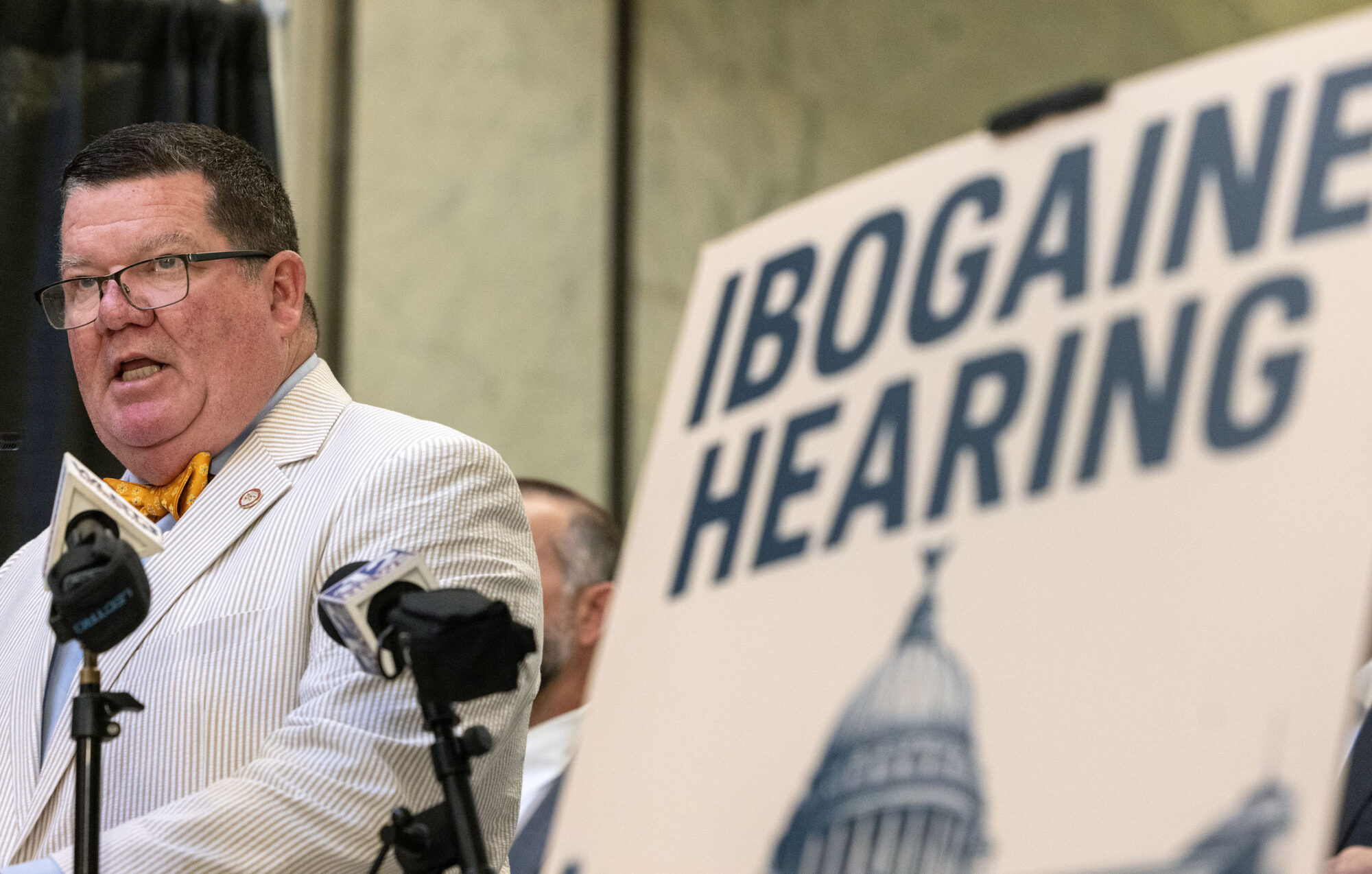
Over three years since Fitch’s office received the first check, the Legislature hasn’t spent the money it deemed discretionary yet. But at Tuesday’s meeting held by the House Public Health and Human Services Committee, lawmakers approved a bill to create a pathway to fund mental health clinical trials related to a drug called ibogaine.
Republican Committee Chair Sam Creekmore of New Albany said he expects the state to appropriate $5 million of this money to fund the trials with Mississippi residents. Creekmore, the bill’s lead sponsor, has been encouraging his fellow lawmakers for months to use state dollars to study the psychedelic drug’s mental health treatment potential.
In August, he invited speakers from across the country to encourage Mississippi to invest in the trials that examine how the drug could address opioid use disorder, traumatic brain injuries, post traumatic stress disorder and other mental health conditions.
While some preliminary studies have indicated ibogaine could be helpful for treating these ailments, a review of available evidence says past ibogaine trials related to opioid addiction had “high risk of bias.” The drug has also been linked with severe side effects, such as cardiac arrhythmias. Some scientists say that risk can be mitigated by taking magnesium simultaneously.
At Tuesday’s meeting, Department of Mental Health Medical Director Dr. Thomas Recore said he didn’t think ibogaine would be a “miracle drug” for all mental disorders.
“I’m in support of this proposal, that we continue to investigate this medicine as a potential for several of these options,” he said.
Clinical trials are usually funded by private groups or federal organizations under the National Institutes of Health. But Arizona and Texas have passed bills to use public dollars for ibogaine studies, and Creekmore said Mississippi’s potential investment may help make the studies stronger.
“If we can work together, that’s a really good start for this potentially world-changing drug,” he told his fellow committee members.
The bill does not explicitly call for using opioid settlement funds. Instead, it says funds will be “specifically appropriated by the Legislature to the department for the purpose of this act.” After the meeting, Creekmore said he thinks the settlement dollars that can be used for anything would be the best funding source for the trials.
John Read, the Republican House Appropriations A Chair, did not respond to multiple calls and a voicemail asking whether his committee would look to use opioid settlement dollars for Creekmore’s bill.
Creekmore’s ibogaine bill tasks the Mississippi State Department of Health with creating a state partnership with a university, a pharmaceutical company and a hospital. If the trial makes a profit, it says the state will get 20% of the profits.
The bill also instructs the partnership to apply for two special designations from the Food and Drug Administration. One is a process that expedites drug development for treatments that have a “clear advantage over available therapy,” and the other allows people to transport Schedule 1 drugs, like ibogaine, legally across state lines.
State lawmakers may soon be making changes around how the local opioid settlement money gets spent as well. In September, a Mississippi Today investigation found that much more of this money had been used for routine government expenses than addressing addiction.
Some cities and counties shifted their spending to address addiction after the investigation, but others are still looking to use money for unrelated purposes. In October, Creekmore said he would propose a bill to encourage local government leaders to use money to prevent and treat opioid addiction in the 2026 regular legislative session.
After Tuesday’s committee meeting, Creekmore said he submitted that legislation before the deadline to file bills. He said it should be available for the public to see shortly.
The opioid settlements require roughly two-thirds of Mississippi’s money to be spent on addressing addiction, and those funds have also been unspent over the past three years. A state advisory council solicited and made recommendations on funding for opioid-related grants last fall, and the Legislature will decide which of those applications to approve later this session.
Hence then, the article about public health lawmakers take steps to spend mississippi opioid settlement money to study ibogaine was published today ( ) and is available on Mississippi Today ( Middle East ) The editorial team at PressBee has edited and verified it, and it may have been modified, fully republished, or quoted. You can read and follow the updates of this news or article from its original source.
Read More Details
Finally We wish PressBee provided you with enough information of ( Public health lawmakers take steps to spend Mississippi opioid settlement money to study ibogaine )


Also on site :
- Ice-T on ‘Law & Order: SVU’s’ Longevity and Cultural Impact: ‘I’m on a Good Treadmill, and I Want to Stay on It’
- Newport Beach Film Fest: ‘Social Reckoning’ Filmmaker Aaron Sorkin Set for Maverick Award, Live Episode of ‘Awards Chatter’ Podcast
- Steven R. McQueen Sends Direct Message in First Social Media Selfie in 5 Years After Rare Public Return Sparks Buzz Over His Changed Appearance