
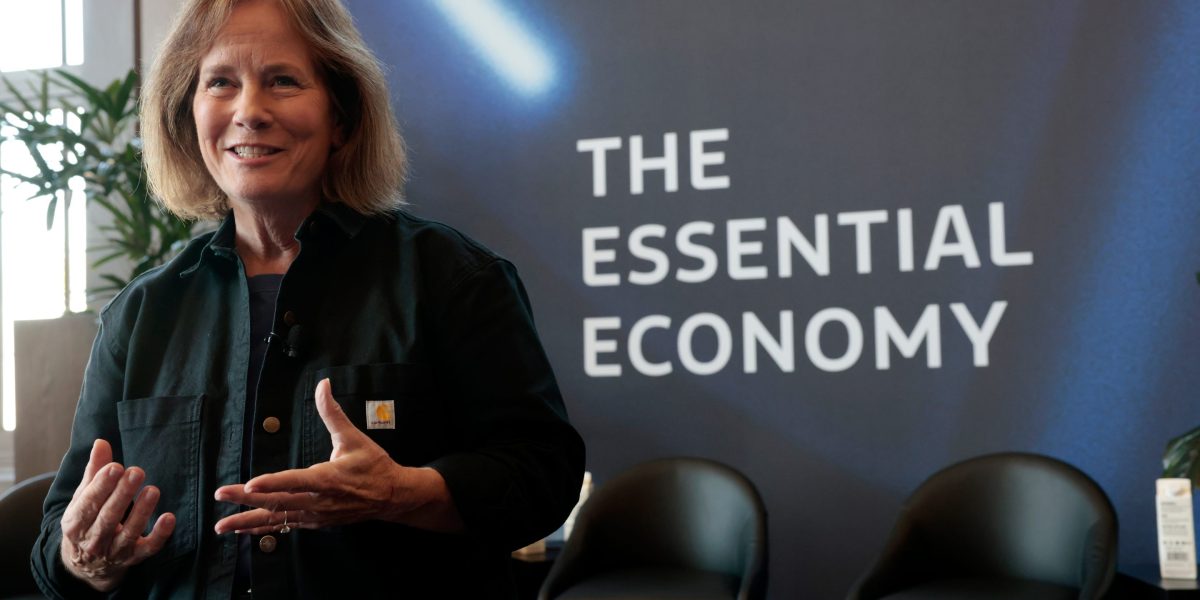
In an era where fashion brands frequently pivot to chase the latest influencer trends, Carhartt remains an outlier by standing perfectly still. Despite the brand’s explosion in popularity among urban “hipsters” from Brooklyn to Berlin, CEO Linda Hubbard insists the company’s compass remains fixed on the job site.
“We’ve really been about the worker … we don’t try to be everything to everybody,” Hubbard told Fortune in a joint interview with Ford Philanthropy President Mary Culler, as the two Detroit-area brands join forces in a multi‑year partnership to power what Ford CEO Jim Farley calls “the essential economy.”
Farley estimated the essential worker shortage at more than 1 million factory, construction, and auto workers in June. “Today’s essential economy faces a critical crossroads,” Farley said in a statement to Fortune: “Stagnant productivity and an outdated belief that a four-year college degree is the only path to success. Given these 95 million jobs are the backbone of our country, we need to change that narrative. To help do that, Ford and Carhartt are joining forces in three critical areas: workforce development, community building, and the tools required by the men and women who keep the American Dream alive. It’s time we all reinvest in the people who make our world work with their hands.”
“We’re not going to change it overnight,” Culler told Fortune, but Ford “looked at ourselves” and decided there are barriers that they can work to break down. “The tools are expensive. Transportation is a barrier. And so we have to really start to tackle those things.”
Ford and Carhartt share Detroit DNA
Ford and Carhartt partnering has been “so seamless,” she added, thanks to sharing so many of the same values, and literally being neighbors in the same city of Detroit. Culler said the partnership personally resonates with her, having two kids who are graduating from college: “And you see how tight the job market is.” But of course, when her kids come back from college, she added, there’s always a stop they request: “[They] always love to go to the Carhartt store in Detroit when they come into town from school. That’s always a stop.”
The Ford and Carhartt camps know each other well from local volunteer efforts and a long history of collaboration, Culler said, but the cool factor is always undeniably on one side. This past summer, she recalled, she joined the Carhartt team for a volunteer project with Tool Bank USA, building benches for a big park.
“And the only reason I knew who the Carhartt people were was because they were outfitted in the coolest overalls ever,” she said. “And I wanted [to buy] them right away. And then the Ford people, of course, had their Ford blue volunteer shirts.”
Culler described the partnership as a logical union, saying she sees Ford trucks and Carhartt gear on most job sites she visits. The two companies are using their combined scale to move beyond “awareness building” into actual “tactics” to solve the problem facing the essential economy.
This “ethos” of giving back to the community and providing economic opportunity is what Hubbard believes makes the partnership so seamless. Whether it’s redeveloping the Michigan Central innovation hub or building park benches for southwest Detroit, the two teams have found immediate “synergy” in their shared values.
Hubbard smiled knowingly as she was informed of Carhartt’s hipster cache (GQ wrote the “always popular” brand was “having a moment” in 2023), but she waved it away, attributing the brand’s crossover appeal to its unwavering authenticity, noting many consumers are drawn to the “Carhartt DNA,” often passed down through generations of blue-collar families. Form is temporary, she seemed to say, but class is permanent. To her point, the Detroit Regional Chamber of Commerce reported in 2020 Carhartt had produced more than 10 million pieces of workwear in the U.S., making it the largest maker of workwear in the country.
“Everything that we make is work-worthy and we welcome anyone into the brand that wants to celebrate hard work,” she said. “So the fact that people want to wear it and maybe they’re not, you know, core workers is okay with us if they want to celebrate the people that work hard and celebrate a brand that tries to showcase that.”
Carhartt’s CEO added she never set out to run one of America’s coolest brands, but her winding path from public accounting to leading a 137-year-old Detroit label now sits at the center of a new push to help young people launch careers in the skilled trades—with Ford as her ally. “We are a workwear brand and we don’t try to be anything else.”
An unlikely path to Carhartt’s top job
Hubbard started her career in public accounting, far from the world of rugged jackets and hoodies now beloved by both job-site crews and Brooklyn twenty‑somethings. “If you told me I was going to be selling T‑shirts and hoodies at the end of my career, I’d have been like, huh, what?” she recalls, underscoring how unplanned her trajectory has been. She credited a series of opportunities, rather than a rigid master plan, with carrying her from spreadsheets to steering one of America’s most storied workwear companies.
“The other thing in public accounting,” Hubbard said, pointing to her teal-green Carhartt work jacket. “You can’t dress like this.”
Culler seconded this, adding whenever she sees Linda around Detroit, “she’s always in a cool Carhartt jacket, even on her own. I always wear her. It’s so cool.”
Hubbard shrugged off the compliment, making clear her decades of accounting experience enable her to be a good CEO. (She joined Carhartt as CFO in 2002, after 20 years as an audit partner at Plante Moran, a stint that included a decade and counting on the board of the Federal Reserve Bank of Chicago. After 10 years as CFO, she served 10 years as president and COO before getting the top job at Carhartt in 2024.)
“We’ve really been about the worker and focused on their core worker,” she said. “And I think that the authenticity of that is maybe what attracts people to the brand—that we’ve stayed true to who we are.”
That improvisational career path shapes how she talks to young people about their own choices. Asked whether she plotted out her rise, she was blunt: “Absolutely not,” she said, emphasizing one opportunity simply led to another and the real goal is to stay open to evolving paths. The advice she offered to young job seekers is to “keep an open mind and think about, you know, just listen to the facts about what the opportunities are out there.”
But Ford and Carhartt are offering more tools to young job seekers through their partnership.
Concrete tools for starting a career
For a teenager unsure about college or a college student staring down debt, Hubbard and Culler said the key is both inspiration and practical support. Hubbard points young people to their “Join the Trades” portal, built with the National Center for Construction Education and Research, which helps users map their interests to specific trades, find training programs, and see which employers are hiring right now. Ford, meanwhile, works through partners like TechForce Foundation to provide scholarships, wraparound support, and even basics like tools and transportation—often the hidden costs that keep students from finishing technical programs.
Both executives stress skilled trades roles often pay 25% to 50% more than the median wage and can serve as launchpads into management or even the C‑suite. Hubbard said she engaged with many manufacturing leaders at Farley’s Ford Pro Accelerate conference in September, even hearing some stories of CEOs who began as electricians and worked their way up.
“I met a couple of folks who started in the skilled trades, but then wanted to start their own business and they realized they needed a business degree to really run their business,” Culler said. “But that didn’t come till like 10 years later, after they had been, you know, a plumber and electrician. And I thought that was really amazing, because now they’ve they’ve sort of evolved.”
Hubbard smiled when informed of this editor’s New York-area connection to Carhartt: his father’s favorite store, the dadwear specialty shop in lower Manhattan known as Dave’s. (Just like Carhartt, the unpretentious workwear shop has acquired a hipster cache, for example partnering with the sneaker blog turned fashion magazine Highsnobiety in 2023.)
“I know Dave’s,” Hubbard said, displaying the instant recall of an executive in close touch with her footprint. “I was just there, not about a month ago, visiting with the owners. They are a great customer of ours.” She said the name is misleading, because “the owners of Dave’s are actually Bob and Adam, but it was originally founded by a Dave, and it’s just really great. It is a great Carhartt experience and just a New York experience for sure.”
This story was originally featured on Fortune.com
Hence then, the article about carhartt ceo says they always focused on blue collar workers but hipsters came anyway we welcome anyone that wants to celebrate hard work was published today ( ) and is available on Fortune ( Middle East ) The editorial team at PressBee has edited and verified it, and it may have been modified, fully republished, or quoted. You can read and follow the updates of this news or article from its original source.
Read More Details
Finally We wish PressBee provided you with enough information of ( Carhartt CEO says they always focused on blue-collar workers—but hipsters came anyway: ‘We welcome anyone … that wants to celebrate hard work’ )


Also on site :
- Bravo Fans Are Losing It Over Rumors ‘Summer House’s Lindsay Hubbard and ‘Below Deck’s Joe Bradley Kissed
- Steven R. McQueen Sends Direct Message in First Social Media Selfie in 5 Years After Rare Public Return Sparks Buzz Over His Changed Appearance
- What were Trump operatives doing for pro-Russian politician Dodik in Bosnia?