
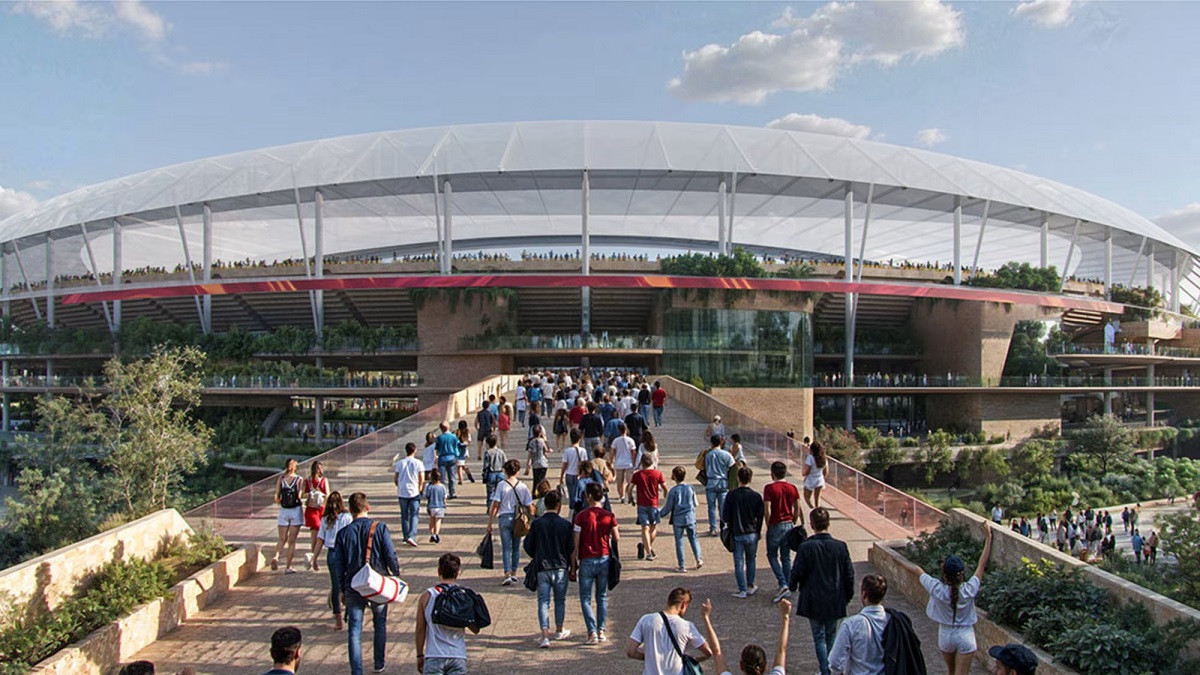
Officials in Brisbane, Australia, have revealed plans for 2032’s Olympic stadium: a $2.3 billion venue inspired by the state’s typical suburban homes, known as “Queenslanders” — residential architecture that may be familiar to fans of Brisbane-based cartoon, “Bluey.”
Digital images of the proposed stadium — encircled by a walkable platform evoking the Queenslander’s distinctive wraparound veranda — were unveiled Monday, as the Queensland state government announced the winners of an international design competition.
Set to host the Olympic and Paralympic athletics, as well as the opening and closing ceremonies, the stadium is due to be built in the 158-acre Victoria Park, just north of central Brisbane. But with authorities previously ruling out a brand-new venue in favor of upgrading an existing one, the plans to construct a 63,000-seat arena in a heritage-listed park have met backlash from conservationists.
Local campaigners have also expressed concern about potential damage to a culturally and historically significant site inhabited and used by Australia’s Indigenous communities for thousands of years.
Following Monday’s announcement, campaign group Save Victoria Park described the renderings as “greenwashed computer imagery.” Its statement added that the proposal will cause “catastrophic loss of heritage parkland.”
Queensland authorities say the venue will be used for cricket and Australian rules football after the 2032 Games.Cox Architecture/Hassell
Although the venue’s exact location within Victoria Park is yet to be finalized, early studies by an an independent panel suggested that the stadium would occupy between 12 percent and 13 percent of its land. A report by sustainable development researcher Dr. Neil Peach, however, claims that as much as two-thirds of the park may be “destroyed,” estimating that more than 1,200 trees will be felled during construction.
“There’s a marketing ploy to try and convince people that only a small part of the park will be impacted, and it’ll be covered in mature greenery,” the spokesperson for advocacy group Save Victoria Park, Andrea Lunt, said over the phone, adding: “These images are basically selling a fantasy. And the reality of Victoria Park is much more wonderful. The reality is that we have this beautiful, central park full of history.”
At a press conference on Monday, Stephen Conry, chair of the Games Independent Infrastructure and Coordination Authority (GIICA), the organization responsible for Brisbane’s Olympic venues, argued the project would, in fact, “maximize the use of the parkland and of green space.” He added that the winning proposal, by Australian firms Cox Architecture and Hassell, would allow “hundreds of thousands of people” to “enjoy Victoria Park and utilize it.”
At the same press conference, Queensland’s deputy premier, Jarrod Bleijie, was more forthright, dismissing the Save Victora Park group as “loopy” and its members as “a bunch of nimbys who don’t want anything to happen.”
He also referenced the recent history of the site, which housed a golf course for most of the last century, only being converted into a public park in 2021. “They believe this park has been activated for years. It wasn’t. It was a golf course. Before it was a golf course, it was a dump, for goodness sake,” he told reporters.
Controversial site
Brisbane was awarded Olympic hosting rights in 2021, more than 11 years before the Games — the longest preparation time ever given to a winning host. Officials originally proposed upgrading the city’s largest cricket stadium, The Gabba, to accommodate the Games, though the project’s price tag was heavily criticized.
That plan was effectively scrapped in 2023 after an independent government review recommended a different, and even more expensive, proposal: building a new stadium in Victoria Park, at a cost of 3.4 billion Australian dollars ($2.3 billion).
Spanning 158 acres just north of central Brisbane, Victoria Park was converted form a golf course into a public park in 2021.Hollie Adams/Reuters
A campaign poster uses the park’s Indigenous name, Barrambin, which means “the windy place” in the Turrbal peoples’ traditional language.Nick Mulvenney/Reuters
But Queensland’s then-Premier, Steven Miles, rejected the Victoria Park plan. So, too, did the current Premier — and then-opposition leader — David Crisafulli who, during his election campaign, said no new stadium would be built. Crisafulli has since distanced himself from the pledge, backing the plan to build in the park after his new government’s own review also recommended the proposal.
In August, an Indigenous non-profit group, Yagara Magandjin Aboriginal Corporation, lodged an application for the park’s permanent legal protection with the Federal Government. In a statement at the time, spokesperson and Yagarabul elder Gaja Kerry Charlton described the land as a “place of great significance and history” where Aboriginal communities gathered for thousands of years before they were ultimately displaced by British colonists, sometimes in violent circumstances.
“We are very concerned there are ancient trees, artifacts and very important eco-systems existing there,” he added. “There may be ancestral remains. We stand resolute in our responsibility to protect it.”
In a press release, the winning architects said they had hired an Indigenous-owned consultancy, Backlash, to “guide meaningful and ongoing First Nations engagement throughout the project.” In a video call with CNN, Cox Architecture’s director Richard Coulson said he looked forward to engaging with the park’s traditional owners.
“Now that we have been appointed, it gives us that opportunity to have that stakeholder consultation,” he added.
Walkable links and platforms were informed by the verandas of Queensland’s traditional suburban houses.Cox Architecture/Hassell
Keeping cool in the subtropics
Cox Architecture and Hassell have both designed major sporting venues in Australia, previously collaborating on Perth’s Optus Stadium and the redeveloped Adelaide Oval. For Brisbane Stadium, the firms will work alongside Azusa Sekkei, a Japanese architecture practice that has helped deliver over 100 sporting venues, including the Japan National Stadium used at the 2020 Tokyo Olympics.
Hassell’s managing principal, Lucy O’Driscoll, said the architects wanted their design to capture “the climate and culture” of Queensland. This is why they turned to the traditional Queenslander houses — semi-elevated wooden homes like the one occupied by the Heeler Family, in “Bluey,” who enjoy an expansive view of downtown Brisbane — for inspiration. In particular, she looked to their verandas, which she described as being “neither inside nor outside.”
“People really enjoy occupying these spaces,” she told CNN over Zoom. “So, we really wanted to interpret this at the stadium … by peeling away the facade, building a lot less and allowing a venue that breathes.”
While recognizing the stadium would constitute a “significant change” to the park, Coulson hopes that parts of the complex will be permanently open to the public, encouraging foot traffic around the site. “The park is well loved, but it’s not largely occupied because it’s not as well connected to other parts of the city as it could be,” he said, adding: “I think the stadium is a catalyst to allow more people to engage with the park, facilitating connections to and within the park.”
Work on the Brisbane Stadium is expected to begin this year, with a view to completing 2031.Cox Architecture/Hassell
As with all recent Games, legacy planning also looms large. The forthcoming Olympics in Los Angeles will only use existing or temporary stadiums, in the hope of minimizing the environmental impact of new construction. Elsewhere in the world, former main stadiums are often considered “white elephants” that lie unused or, given the construction and upkeep costs, significantly underused.
As well as being used for entertainment events, the Brisbane venue will serve as a new home for the city’s Australian rules football team, the Brisbane Lions, as well as two cricket teams. The fact that both these sports use rounded playing fields that are similar in size to an athletics track makes the transition easier, Coulson said.
In Brisbane, “we have nothing like those challenges that we’ve seen for London and other Olympics,” he added, referencing the British capital’s need to convert an oval athletics field into a rectangular soccer one, adding: “We can actually quite quickly pivot from the Games mode into the legacy mode.”
The Brisbane Stadium is expected to break ground this year, with a target completion date of 2031. Save Victoria Park retains hope that the decision can be reversed, saying that applications for the park’s permanent legal protection are still being evaluated. The group is planning a public protest later this month.
“We’re going to continue fighting,” Lunt said, “because we’re really committed to protecting this park as a park, not a sporting entertainment precinct.”
Plans for $2.3 billion stadium ignite debate in 2032 Olympics host city Egypt Independent.
Hence then, the article about plans for 2 3 billion stadium ignite debate in 2032 olympics host city was published today ( ) and is available on EGYPT INDEPENDENT ( Egypt ) The editorial team at PressBee has edited and verified it, and it may have been modified, fully republished, or quoted. You can read and follow the updates of this news or article from its original source.
Read More Details
Finally We wish PressBee provided you with enough information of ( Plans for $2.3 billion stadium ignite debate in 2032 Olympics host city )


Also on site :
- 01F Group Announces Investment in DANA, Indonesia's Leading Digital Financial Company, Reinforcing Long-Term Confidence in Asia's Fintech Opportunity
- ‘A huge problem’: Trump has traded more stocks than all of Congress combined. A Bush-era ethics lawyer explains why you should worry
- William Shatner, 95, Walked Onstage With a Band Nobody Expected Him to Front; the ‘Star Trek’ Legend Covered Ozzy Osbourne and Metallica in Chicago