
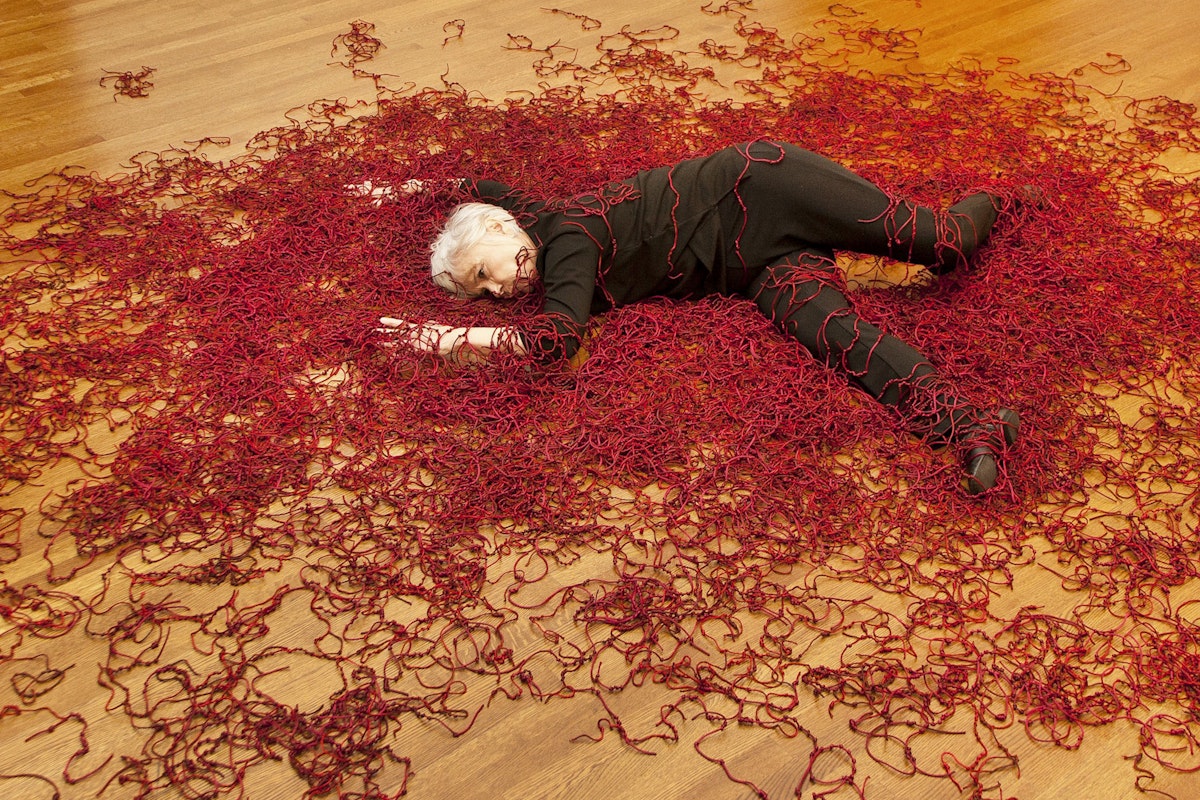
While interviewing sexual assault survivors for her study Girls Play Dead: Acts of Self-Preservation, Jen Percy began by asking: What did you do immediately after your rape? One woman Percy spoke to prepared chicken soup for her assailant; another “had a bath and watched television with [her] family”; still others comforted or cuddled their violators, fell asleep in the beds where the rapes took place, or pretended, for the sake of their rapists, that the rapists themselves were the proper victims of these events. “I told him I couldn’t wait to do it again,” one confessed. Tidying and accommodating, soothing and self-abnegating—the disquieting scenes of horror’s aftermath.
In the margins of my review copy, I scrawled recollections of my own post-traumatic behavior, likewise bizarre: In the summer of 2012, I waited for my rapist’s footsteps to recede and then stood up, cleaned the blood from my forehead, and staggered down the middle of the street more than a mile until a cab stopped. Just before Valentine’s Day of the following year, I asked my next rapist for a ride home. When he dropped me several blocks from my apartment (I assiduously avoided disclosing my exact address), I thanked him for the lift, closed his car door quietly, and went to bed for three days. Two years later, and in a different city, I walked into a police precinct, not to report the gang rape that had just happened, but to ask if the men turned in the pocketbook they’d stolen from my purse. My driver’s license, it occurred to me, was about to expire; how else would I replace it? A group of policemen laughed at me when I entered. I promptly left.
These weren’t, perhaps, “normal” reactions, but what is normal about being raped—except that it is horrifyingly and statistically commonplace? In the United States, someone is sexually assaulted every 74 seconds; a rape is reported every 4.1 minutes. That some communities and demographics are disproportionately affected by this violence is inarguable, but the notion that rape itself is an exceptional or anomalous injury is a myth. These experiences are, Percy writes, a kind of asphyxiating “accumulation” in the lives of countless girls and women. Rape may come to annihilate the body or fracture the psyche; certainly it disarticulates narrative. Yet the demand on survivors is that we react coherently to violence so shattering it’s often said to be “unspeakable.” To render ourselves credible witnesses, our stories must be lucid; our brokenness must appear in some way familiar.
The demand on survivors is that we react coherently to violence so shattering it’s often said to be “unspeakable.”
It’s easy to believe we’ll know how to act in a disaster, that we have an affinity for survival. Survival, however, wears many faces, and there is much we don’t yet comprehend about women’s responses to sexual violence. As Percy points out, the psychological study of rape trauma is a field “no one in America bothered to study” until the early 1970s. Women’s lib and the consciousness-raising groups of that decade brought many of the hitherto private wounds and pleasures of women’s lives into the light, making the case that our experiences could and should be proper objects of inquiry, and we the subjects staging them. Still, progress has been slow and backsliding frequent. Marital rape, for instance, was largely outlawed in the United States by the 1990s, though legal loopholes exist in several states.
To release a rape book in our moment of escalating anti-feminist backlash is a daring act. With its chorus of voices, Percy’s book is distinctively anchored in #MeToo—joining together women of disparate circumstance in recognition of shared, systemic subordination. But while some of the most prominent memoirs of the #MeToo era—Chanel Miller’s Know My Name, Christine Blasey Ford’s One Way Back, E. Jean Carroll’s Not My Type—gave a loud, clear voice to the victims of high-profile abuses, Percy is attempting to excavate the aftereffects and reactions that remain quietly hidden or catastrophically misconstrued, and to unravel society’s misreadings of them. Girls Play Dead is, by turns, a memoir, a matrilineage, a survey of sex trauma, an analysis of inculcated female docility, and an assemblage of intimate, individual stories of rape’s most discordant and irreconcilable aftershocks.
Girls Play Dead opens meditatively on Percy’s girlhood in rural Oregon, where she spent wilderness hikes “mapping the world” and its attendant flora and fauna with her mother, a naturalist. “We made time to practice surviving,” she remembers, lessons that often took the form of noticing—that the horned lizard “spurted blood from its eyes to scare predators,” that trees could speak to one another through fungal networks, that predators lost interest in prey they believed to be dead, as dead meat harbors disease.
Though there are no grizzlies in Oregon, Percy’s mother trains her to play dead—a widely known survival strategy in the event of an attack. “I hated playing dead,” Percy recalls. “I preferred to fight,” to “compete for wildness.” But her mother insisted on perfecting the practice. Her mother’s own girlhood had been defined by painstakingly feminized domesticity: In a house where her brothers “did nothing and were asked to do nothing,” Percy’s mother cooked dinner each night and was expected to scrub the floors until “the pads of her fingers turned smooth.” For a time, Percy’s grandmother left the family to join a cult led by New Age guru Elizabeth Prophet, who told followers that the apocalypse (likely via annihilation by Russian nukes) would happen in March 1990. Percy’s mother fled toward marriage and work in the logging industry, which nearly killed her.
In the office, the walls “were covered in crotch shots” from porno magazines; in the field, it was “all men, all around.” Percy’s mother was the interloper, the “distraction,” the female impediment in a male-dominated field. While taking regrowth measurements on a precarious scree, she fell but refused to go to the hospital: “She didn’t want her supervisor to get in trouble,” Percy relays. “It was all she thought about.” Like her mother, Percy, too, labored “to keep wounds a secret under my clothes and let them heal in the dark. I learned not to seek help for pain or to give a voice to wounds.”
Survival, for women, rarely manifests as unambiguous victory; often it’s little more than a painful negotiation with circumstance. In later encounters with men, Percy finds herself reacting with disorienting non-reactions: She courteously fields pervy phone calls and, while abroad, stumbles into a brief assignation with an ambiguously cruel Spanish man. At a party, as a stranger crushes her into the carpeted floor, she remembers feeling “light, floating, no longer afraid. I heard the sound of the ocean.” A girl who happens on the scene makes a snide remark to Percy; “It was too difficult to explain, I told her. I shrugged and left.” The trouble of women’s passivity in facing imminent or transpiring violence—and the shame that subsequently affixes itself to this enervation—are the fulcrum of Girls Play Dead, which is preoccupied with the mystifying expanse between anticipated and actual responses.
Percy’s previous book, Demon Camp, was likewise an interrogation of trauma, though her persons of interest there were American combat veterans, who’d returned from Iraq and Afghanistan haunted by what they’d perpetrated and witnessed abroad. “I was interested,” Percy told Bookforum in 2014, “in how traumatic memory can destroy our ability to communicate effectively, how you might need another kind of narrative” when the conventional one fails.
When storytelling breaks down or we are otherwise silenced, how do women’s bodies speak? The middle sequence of Girls Play Dead is divided into a kind of taxonomy of these accounts, sorted by an array of post-traumatic responses: agoraphobia, tonic immobility (freezing in the event), psychosomatic seizures, dissociation and feelings of unreality, and dysregulated models of intimacy, including hypersexuality and love addiction.
These responses are more complex than their labels might suggest: Freezing during a rape may not, for example, always appear as paralysis. An NYU law professor, Erin Murphy, tells Percy of cases where women in moments of duress have removed their clothes themselves, not wanting, say, to ruin an expensive skirt. “I hear it all the time,” Murphy continues, women asking themselves why they’d lifted their hips during a rape in which they were otherwise prostrate. Clinical psychologist Jim Hopper tells Percy it’s statistically uncommon for victims to fight back during an assault, and, as Murphy notes, many juries still can’t “recognize rape unless there was physical resistance.” Verbal dissent, Hopper adds, happens more often, but is still less common than you might think.
In other stories, women recall having sex with men simply because there was a “possibility of violence.” A college freshman told sociologist Jessie Ford that she understood these encounters as “consensualish … consensual but unwanted.” Sex meant to please or appease; uncomfortable sex that seemed able to prevent further harm. Percy suggests that the language we have for sexual violence is too circumscribed and determinative, that we need to develop a more complex vocabulary for the feelings of sexual dysphoria that can arise during “embarrassing, disgusting, painful, or creepy sex.”
The women and girls Percy speaks to are not those who typically surface in a post-Weinstein news cycle: an agoraphobic sex worker, a personal masseuse, a 10-year-old in a refugee camp, a special-ed teacher living in Delaware. Their assailants, meanwhile, are not titans of industry but church acquaintances, family friends, office drones, and landlords. A number of the women have never spoken of or been asked to speak of these histories before. That Percy’s representation of sexual violence is so wide-ranging underscores how pervasive rape is, the way it harms so many—victim-survivors and the countless others we encounter, love, work with, join to or create in friendship and kinship.
Mostly successful is Percy’s decision to let the stories breathe, allowing these women to present themselves as entirely, complicatedly human and living expansive lives. We are not, after all, reducible to or ruined by the violence committed against us. At the same time, the book’s tendency toward broad evaluation is also its occasional undoing. That somatic responses are each separated into discrete categories suggests little overlap between them—not taking into account that, say, a survivor of assault might journey from a period of incapacitating antisociality toward one in which they amass frequent and/or novel sexual experiences. Are women who freeze during a rape more likely to suffer seizures in its wake? How does dissociation engineer or reconstruct the routes by which we build physical, sexual, and emotional intimacy with others?
By presenting the women’s stories in fixed groupings, Girls Play Dead leaves little room to explore connections between seemingly oppositional “types,” or to acknowledge that post-traumatic experiences are commonly contradictory, or that they can evolve through a sequence of affects and behaviors. In Percy’s taxonomy, you’re one sort of victim, or else the other.
Percy writes that the agoraphobes she interviewed self-induce pain, pinching skin, for example, or snapping rubber bands against their wrists. A defining feature of the phobia is a confusion of bodily borders, between what is in and what is outside of oneself. For them to remain present in their bodies, “it helped to remind themselves that they had one,” Percy writes. Yet I couldn’t help but hear in these descriptions an echo of Percy’s so-called hypersexuals, who have sex sometimes as a way of seeking punishment (“I thought I deserved to be treated like a piece of trash”), but who also, crucially, have sex in order to rewrite the story of their victimization. Some of the women Percy spoke to told her that post-rape sex concerned establishing that “this time it was my choice” or that now “I’m going to decide who gets to touch me.” Three days after an assault, one woman called a friend and asked to be intimate with him “because [she] didn’t want the only experience [she] had of sex to be rape.”
These brief accounts of women choosing their own paths, however, are overshadowed in Girls Play Dead by exhaustive testimonies of women who have sex we might describe in the manner of “self-harm.” Certainly, both possibilities exist, but the narrative weight that Percy gives to the latter suggests a broad incapacity among rape survivors to make smart sexual decisions, which may even include choosing promiscuity or supposedly problematic sex.
What feels urgent in Percy’s work is her attention to the ways bodies process violence, as well as to the alien, inconsistent nature of many of these responses. Yet Percy is an often distant and disorienting guide through some of the most difficult cases. Her tendency toward disinterested observation and journalistic self-effacement not infrequently registers as evasiveness. Of her approach in Demon Camp, Percy remarked in the Bookforum interview, “I’m a subtle writer when it comes to reflection, and I wish I’d been a little more direct.” At times, this indirectness in Girls Play Dead makes it difficult to see what the stakes are for Percy, or how she’s interpreting the testimonies she collects. The book, in effect, directs the reader toward other sources of authority, citing statistics, police accounts, or psychological professionals over and against some of the women’s own accounts.
This conflict between a removed authorial voice and stories of people in their most intimate and vulnerable moments plays out most perplexingly in the last third of Girls Play Dead. Percy interviews three incarcerated women at the Logan and Decatur Correctional Centers in Illinois: Debraca, Angel, and Laconda, all jailed for having murdered their rapists. Their stories are as relentless as you’d expect, and Percy almost entirely steps away from editorializing in these chapters. She takes these women seriously, and if her reporter’s predilection to disappear from the story at other moments in the book fails to serve her, here her spectral positioning demonstrates a deep respect for the suffering that led Debraca, Angel, and Laconda to actions that derailed the course of their lives and their freedom forever. That these women will spend decades behind bars, separated from their children and other loved ones, for refusing to let their abusers continue defiling them exposes the tragic failure of a world that can’t imagine rehabilitation or repair.
Percy’s interviews lead her, also, to a white woman named Chelsea Godfrey, whose rapist—Dajuan Kirksey, who is Black—was convicted and imprisoned for the rape in 2014. In the course of their conversations in late 2022, according to Percy, Godfrey admitted to having lied on the stand: She tells Percy that, though the rape definitively happened, she’d never said “no” during it. She felt she wouldn’t be believed by the jury. (In a December 16, 2024, opinion denying Kirksey’s request to have his conviction vacated, Virginia Circuit Court Judge Brian H. Turpin found that it was “undisputed” that Godfrey had lied about saying “no” and “stop.”) What follows drastically recalibrates Percy’s role in the book, as she shifts from reportorial observation to intervention. A few months later, Percy approached a prosecutor familiar with Godfrey and the case to disclose what Godfrey confessed to her. The Innocence Project subsequently took on Kirksey’s case and in 2024 sought to overturn Kirksey’s conviction on the grounds that Godfrey had lied. That motion was denied, but Kirksey’s appeal is ongoing. At the time of writing, he is still in prison.
Percy wrestles with what she’s set in motion, ceding that “to report her felt like I was going against everything I had been working toward.” Her husband reminds her that she’s not adjudicating the case, merely relaying what she’s been told. The remainder of the chapter finds Percy reckoning with the institutionalized racism in sex crime litigation, with references to Confederate statues, the way the justice system is stacked against Black men like Kirksey, and statistics about false accusations.
It’s true that Kirksey and countless others, particularly people of color, are abused by the justice system. It’s also possible that Godfrey can have said racist things (and did at the time of her testimony: that she would “never have sex with a Black man,” for example) and still have been raped by the man she claimed to have been raped by. Prejudiced people are not immune to sexual violence, and Godfrey—so far as Percy presents this account—is steadfast in her sense that what she experienced was a rape.
What strikes me about Percy’s inclusion of this story is that the case and her treatment of it work against the book’s major theme. For nearly 300 pages, Percy makes or seems to make the argument that rape victims mostly do not react in expected ways, both during and after assaults. She has foregrounded statistics that reveal the infrequency of verbal and physical expressions of nonconsent during assaults, while the question of physical evidence in rape trials is often profoundly muddied—how many rape kits are left untested every year? In the first half of the book, much is made of tonic immobility—a reaction to rape where a victim is functionally paralyzed and often entirely silent, responses that mirror Godfrey’s account of the event, in which she claims to have been crying and staring at a television screen. Percy even acknowledges that she can understand why a woman in Godfrey’s situation might lie about having said “no” because perhaps “she didn’t think her response to rape was good enough,” and Percy writes that if a friend had confided in her about the same sort of lie, she would have thought “that sounds perfectly normal.” Yet she makes the lie that Godfrey told on the stand the central fact in the chapter, and it is a detail that ushers in the variety of doubts that so often surround rape stories—even though false accusations are vanishingly rare.
While Percy’s husband is right that it was up to the courts to decide what to make of the new evidence Percy found, she gives the reader only a hazy sense of what happened as a result. She describes the subsequent legal maneuverings in confusing and opaque ways; on the emotional fallout, she offers even less. What did all this mean for Godfrey, who believed the case was settled? Or for the man in prison? Who can say? And while Percy highlights Godfrey’s changing story, her reflections on the case omit an important piece of information. She never mentions that Dajuan Kirksey testified at his trial in 2014 that Godfrey did in fact tell him to “stop”; as Judge Turpin noted in his December 2024 opinion, Kirksey told the court that “Ms. Godfrey did tell me to stop and I did stop.”
The episode seems to illustrate, if inadvertently, how easy it is to snap back to typical expectations of rape stories, and how challenging, even for the most informed and well-intentioned observers, to take seriously the possibility that a woman who told a serious lie might also still be telling the truth about her rape. Like Percy, I’m left haunted by the words of a social worker she speaks to at the end of the Godfrey saga: “We think we know these stories because we hear about them in the news.... We don’t know anything.”
Hence then, the article about the perplexing twist in jen percy s girls play dead was published today ( ) and is available on The New Republic ( Middle East ) The editorial team at PressBee has edited and verified it, and it may have been modified, fully republished, or quoted. You can read and follow the updates of this news or article from its original source.
Read More Details
Finally We wish PressBee provided you with enough information of ( The Perplexing Twist in Jen Percy’s Girls Play Dead )


Also on site :
- Walmart's Vintage-Inspired Sideboard Has 'Plenty of Storage' and Looks Like a 'Beautiful' Antique
- 1956 Rock Hits, Recorded on the Same Day, Began Record 11-Week Run at No. 1 for Elvis 70 Years Ago Today
- 1974 Novel, Written by Best-Selling Author Richard Price, Ranked Among 'Best Coming-of-Age Books' of All Time