
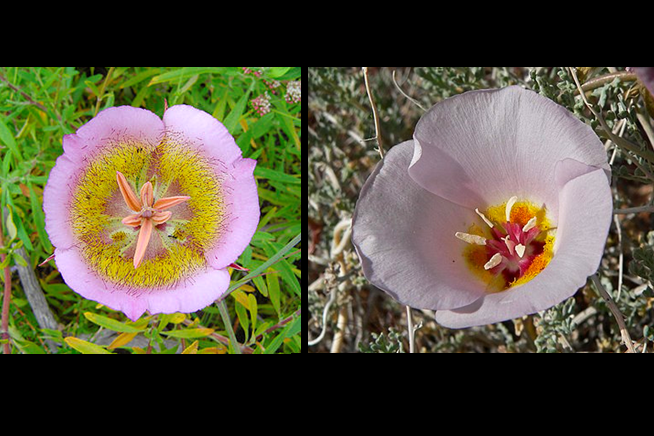
In an earlier story, we discussed the characteristics of monocots and talked about some of the beautiful native monocot flowers that grow locally from bulbs and corms. Some of my favorites include Mariposa lilies, fairy lanterns, brodiaeas and Ithuriel’s spear. I’m also partial to the alliums, such as crinkled onion and cascade onion.
If you see a few of these flowers on your property, the best way to have more is to remove grass seedlings (pull or burn) shortly after they emerge. You may have a lot of monocot corms present in the soil, but they do not compete well with non-native grasses. Because the corm may be several inches underground, foliage does not emerge as early as grasses that germinate from seed. If you remove the grass early in an area that had a few of these plants, you may be amazed at how many will emerge somewhat later.
Many monocots have leaves that look a lot like grass so be careful what you remove later. Monocot leaves do not tend to branch like a lot of non-native grasses, so that’s one thing to look for. You may only get a few extra blooms the first year that you remove competing grass, but it will give the corms already there an advantage and the number of flowers should keep increasing. Look at the leaves of the few that originally bloomed to help you identify the smaller plants. Some monocot seedlings have blunter tips than grass; others have slightly wider leaves.
To grow more of these flowers from seed, use a potting mix or 3 parts potting mix and 1 part perlite or sand in a deep one-gallon pot. Sprinkle seed on the soil and cover with a quarter inch of very small (3/16”) rock or coarse builder’s sand. Do not use chicken grit because it’s chemically bad for the seeds. Place the pot in partial sun in October. Water once a week if it doesn’t rain. Fertilize lightly twice during the rainy season.
Squirrels or white crowned sparrows can pull the plants up. If this happens, cover with bug mesh. When it stops raining, let the soil dry and put the pot either in full shade or in a shed, garage, etc. Grow the plants in the pot for two years. Then remove them from the pot, noting how deep they were, plant in the garden at the same depth. Note: corms are small; do not expect daffodil bulbs.
To protect the corms from gophers you can plant them in stainless steel mesh “mini-gopher baskets” constructed at home. These protectors are not available commercially, but the wire mesh is available online. Currently selling for less than $15 for a 5-inch by 50-foot roll, the mesh is considered 304 hole-fill material. Shaped like a five-inch-wide sock, it can be cut and sealed at both ends. Plants will grow through the mesh.
If you are interested in more information on California monocots, the Tuolumne County Library in Sonora has the book “Wild Lilies, Irises, and Grasses: Gardening with California Monocots” by Nora Harlow and Kristin Jakob.
Sources: Sonora Rock Garden Society, Rebeccah Lance “Growing California Native Bulbs”
Nancy Piekarzcyk is a University of California Cooperative Extension Master Gardener of Tuolumne County.
Hence then, the article about wonderful native monocots how to grow them was published today ( ) and is available on myMOTHERLODE ( Middle East ) The editorial team at PressBee has edited and verified it, and it may have been modified, fully republished, or quoted. You can read and follow the updates of this news or article from its original source.
Read More Details
Finally We wish PressBee provided you with enough information of ( Wonderful Native Monocots: How to Grow Them )


Also on site :
- Thriller! Rylan Sevilla’s fourth-quarter heroics lift No. 17 Dougherty Valley past No. 9 Bishop O’Dowd
- Man dies after stabbing in Denver’s Sunnyside neighborhood
- Nordstrom Rack Has a 'Gorgeous' 5-Piece Tennis Bracelet Set on Sale for Just $20: 'The Sparkle Is Unreal'