
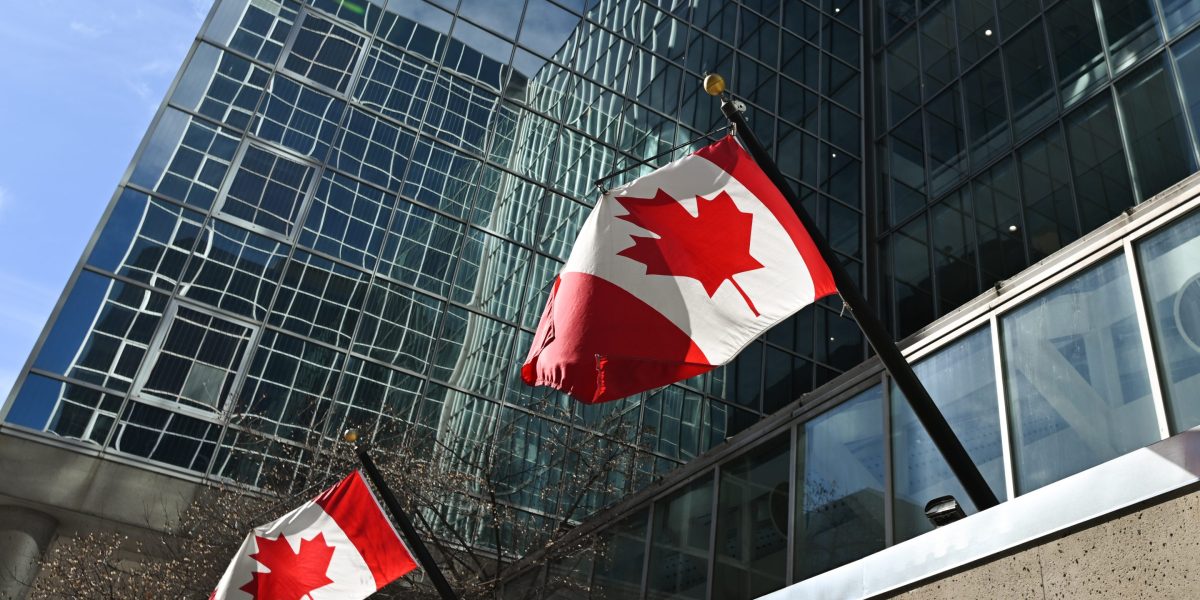
It makes little sense, when viewed from early April, that Canadian equities are closing out their second-best year this century.
Donald Trump had just unleashed the harshest tariffs since The Depression, effectively choking off trade and tearing up a trade agreement he had negotiated. The US president was also openly discussing annexing Canada, stoking unfathomable tensions between the two long-time allies. Political turmoil added to unease up North.
Then Trump backed down from his most punishing tariffs. Technocrat Mark Carney took over as prime minister, easing financial market jitters and cooling tensions with his US counterpart. And, it turned out, Canada’s economy — driven by miners and internationally renowned financial firms — was perfectly situated for the chaos of Trump’s new world order.
The S&P/TSX soared more than 40% from an April 8 low, putting the gauge on track to end 2025 with a 29% advance, trailing only 2009’s 31% gain for the best ever. The index notched a record 63 new all-time highs along the way, owing to a steady march higher over the year’s final seven months.
Miner and bank stocks have been central to the rally, with the materials subindex doubling on the back of rallies in gold, silver, copper and palladium. The financials group jumped 40%. Tech darlings like Shopify Inc. and Celestica Inc. have also contributed, moving the index by a combined 11% higher during the year.
“The numbers themselves are somewhat jaw dropping,” said IG Wealth Management chief investment strategist Philip Petursson by phone. “But, I mean, you could sit there and say this is still a well-balanced market that has further upside in 2026.”
The fuel for the rally that powered precious metals to new records may not be spent. Three Federal Reserve rate cuts were a boon to an asset class that doesn’t pay interest. The US central bank is expected to cut twice in 2026.
Gold and silver also served as a safe haven for traders worried about uncertainty around US trade policies and geopolitical tensions in Europe and the Middle East. Neither of those concerns have been laid fully to rest.
Petursson said he sees further runway for gold prices to continue supporting the S&P/TSX Composite index, but not to the same degree the markets have seen in the past year.
“It would be foolish to just extrapolate this year’s gains into 2026,” he said, noting though that “the fundamentals are still there” as central banks are expected to continue cutting rates.
Canada’s Big Six banks, including Toronto-Dominion and Bank of Montreal, posted stronger profits than expected over the year with the annual adjusted earnings coming ahead of Bloomberg consensus expectations by an average of 2 percentage points.
The group financial firms, including insurers and smaller banks, accounts for 33% of the Canadian index. They, too, have enjoyed lower rates in both the US and Canada, along with profits from dealmaking and a better batch of loans that required fewer set-asides. The Canadian group’s advance nearly doubled that of its US counterparts.
There is some concern over the group’s performance heading into 2026. Bank valuations have been elevated at the same time that the Canadian economy may be starting to feel the strain of higher tariffs, said Craig Basinger, Purpose Investments chief market strategist.
“Gold, energy: those sectors really don’t care about the Canadian economy, but the banks probably should,” Basinger said. “And this just doesn’t feel like the time to be paying a premium valuation for Canadian banks.”
The S&P/TSX Composite banking subindex’s price to earnings ratio reached nearly 15, up from a low of 9.7 in 2022.
The Canadian index’s record came despite one of the worst years for crude oil prices in recent memory. The problem, though, is the outlook for oil remains muted at best. Basinger said jumping into oil and gas stocks at the beginning of the year would be a very contrarian move given how demand is struggling to keep up with supply.
The market would also be vulnerable to any troubles in the precious metals markets. Already, silver is sliding into the end of the year, though still on track for a record gain.
Bassinger’s firm took a partial underweight position in S&P/TSX Composite in the fourth quarter, which he said was more about profit-taking after “three consecutive years of oversized gains” rather than any negative view of the index.
If the new year brings upside surprises to oil, then strategists like Petursson say the S&P/TSX Composite is a great way for foreign investors to leverage the energy play. For Petursson, the answer to the question of whether investors can be successful putting their money outside of the US is “yes”, and there are great options in other markets like Canada, Asia and Europe.
“When foreign investors are looking for pockets of opportunity, if the TSX was not on their radar, I think it is now,” Petursson said.
This story was originally featured on Fortune.com
Hence then, the article about canadian stocks set record for records in jaw dropping year was published today ( ) and is available on Fortune ( Middle East ) The editorial team at PressBee has edited and verified it, and it may have been modified, fully republished, or quoted. You can read and follow the updates of this news or article from its original source.
Read More Details
Finally We wish PressBee provided you with enough information of ( Canadian stocks set record for records in ‘jaw-dropping’ year )


Also on site :
- Current price of oil as of September 14, 2026
- Pulitzer-Winning Author’s Novel, Written in a Home Basement, Ranked ‘Greatest Book of the Last 20 Years’
- Do employers value University of Phoenix graduates? The Harris Poll survey finds 98% report satisfaction