
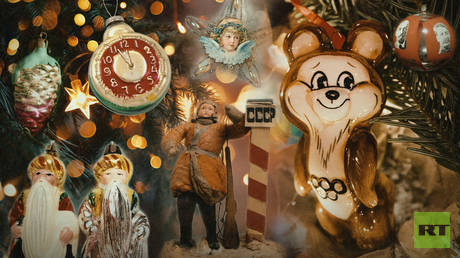
How communist-era tree toys became status symbols, family heirlooms, and million-ruble collectibles
Russians have developed a fascination with vintage Christmas ornaments and are willing to pay thousands of dollars for them. These ornaments weren’t crafted by famous designers or made from luxurious materials. But they have a history of their own and evoke nostalgia for a bygone era.
Russian holiday mood
The holiday celebrations in Russia unfold over a period of one and a half weeks. Most people are on vacation at this time, and celebrate in various ways.
Orthodox Christmas (celebrated on January 7) is a religious holiday, observed in churches with traditional services and an all-night vigil.
On regular days of the holiday break, Russians traditionally visit friends, host parties, or travel. Many head to Moscow, while Moscovites seek peace in the nearby suburbs.
Another holiday tradition is to attend fairs, visit ice skating rinks, take part in snowball fights and participate in other fun winter activities. These are usually organized by local authorities and large businesses.
However, New Year’s Eve in Russia is primarily a family affair. It is celebrated at home with family and close friends. Russian New Year’s Eve traditions are quite simple and unpretentious. They include preparing traditional salads (like “Mimosa”, “Herring under a fur coat”, and “Olivier”), and writing down a wish on a piece of paper, burning the paper, pouring the ashes into a glass of champagne, and drinking it as the clock strikes midnight.
For a long time, these traditions remained unchanged. Recently, though, a new trend has emerged: Soviet-era Christmas tree ornaments. Families, young enthusiasts, and collectors are on the hunt for ornaments that are 50, 70, or even 100 years old. They look for these decorations everywhere: in the homes of older relatives, in vintage and antique shops, and online.
How Christmas trees came to Russia
In Russia, the tradition of celebrating New Year on December 31 only began in 1699, following a decree of Peter the Great. Before that, September 1 marked the beginning of the new year; there was no fancy celebration – usually the harvest was recorded and some new laws were issued on that day.
However, Peter the Great introduced a new date for the celebration, along with new traditions. He ordered that homes and establishments be decorated with fir branches, which were affixed to roofs and doorways. Later, branches above doorways became a symbol of taverns in rural areas.
It wasn’t until the 19th century that people started to put up and decorate Christmas trees, a tradition initiated by the family of Nicholas I. Eventually, festive trees found their way into the homes of aristocrats and merchants, as well as public squares. Trees were set up by December 31, but were considered Christmas trees, adorned with decorations like angels and the Star of Bethlehem.
Initially, treats for children – apples, nuts, and candies – were hung on the trees. Later, the treats were hidden inside finely crafted ornaments – that’s how the vibrant ornaments came into existence.
At first, the ornaments were imported and only the wealthy could afford them. By the end of the 19th century, however, they began to be produced in Russia, particularly around Klin, where glassblowing workshops were located. These workshops sold colorful glass balls, icicles, and figurines of angels, birds, and animals.
Red Army soldiers replaced angels
By the time of the 1917 revolution, the tradition of decorating Christmas trees had taken hold, though it was still viewed as “bourgeois.” The religious significance of the Christmas tree also remained strong. This prompted the Bolsheviks, who aimed to eradicate Christian traditions, to curtail ornament production and effectively ban Christmas trees and their decorations.
However, the cultural war waged by the communists didn’t last long. By the 1930s, the ornaments made a comeback, albeit with a twist – reflecting the new “state values.” Instead of angels and the Star of Bethlehem, Soviet citizens were offered ornaments symbolizing national unity and state programs: figures of pioneers, Red Army soldiers, workers, airships, and tractors – along with figures of the country’s leaders.
Popular magazines published patterns for homemade ornaments. These were also patriotic, of course.
During the Second World War, the industry only operated for military needs, so ornaments were crafted from available materials like cotton, cardboard, and foil. Hospitals used empty medicine vials – painting them, attaching wires, and hanging them for patients to enjoy.
Factories repurposed scraps – wires, metal shavings, and defective parts – into decorations like snowflakes, flowers, and five-pointed red stars.
After the war, the production of ornaments resumed. The authorities no longer sought to create a “new Soviet person” and started to ease regulations on home aesthetics. This led to the emergence of a recognizable Soviet ornament style in the 1950s, featuring bright, colorful balls, pine cones, icicles, and fairy tale characters.
Why the Soviet look still divides Russians
Today, Russian people don’t have a single opinion about Soviet aesthetics. Some like monumental Brutalist architecture, the uniforms of Komsomol members, and Soviet automobiles. Even the drab Soviet panel buildings have their fans, who affectionately refer to them as “panelki.”
Images of the “Soviet future” remain particularly appealing; mosaics depicting cosmonauts and posters showcasing proud workers and soldiers continue to inspire people.
However, daily life during the communist era is generally viewed as outdated. Soviet interiors are often criticized for their clunky design, commonly dubbed “grandma’s renovation.”
Items from everyday life in the USSR only interest collectors and museums. However, there is one notable exception: Christmas tree ornaments. They aren’t just appreciated by the young and old alike – they have become a real trend.
This year alone, demand for such ornaments surged 80%. Prices for rare sets and even individual ornaments can reach up to 1.5 million rubles ($19,000). Not only antique dealers but also fashionistas proudly showcase their vintage Christmas ornaments.
And it’s not just a matter of nostalgia.
Fashion, money, family
Vintage and retro trends are taking hold across Russia. While Soviet-era clothes, furniture, and appliances may not appeal to everyone, Christmas ornaments offer a taste of history without any discomfort. These aren’t modern copies, they are tangible pieces of the past that can be appreciated and used as intended.
The growing popularity of Soviet ornaments is also driven by their scarcity. The supply is limited: many ornaments have long been broken, while others lie forgotten in dusty boxes in attics and basements. The original production was never mass-scale, and a significant number of these ornaments were handcrafted, making them truly unique. Experts already recognize Soviet Christmas ornaments as valuable antiques.
Additionally, there has been a shift in attitudes toward the Soviet past. After the collapse of the USSR, discussions of life under communism – whether in film, media, or literature – became highly politicized. Some idealized this era, while others portrayed it as a dystopia. Debates grew heated, even among those who simply appreciated Soviet aesthetics.
Over time, even Russians with strong opinions about the USSR became weary of emotional arguments. In recent years, the focus has shifted from glorifying or condemning Soviet citizens to depicting their real lives. Amid all the inconveniences and shortcomings of Soviet life, there’s definitely a certain charm to it.
Finally, these ornaments bridge generational gaps. Not every family has heirlooms that survived the upheavals of the 1990s, but old ornaments can both evoke fond memories for older relatives and delight children.
Recently, Russians have started spending more time with their families. Despite a rise in individualism, there’s a desire to connect more with loved ones. This makes the idea of incorporating vintage ornaments into the family’s New Year celebration even more appealing.
Hence then, the article about grandma s toys are cool again why russians are losing their minds over soviet christmas ornaments was published today ( ) and is available on Russia Today ( News ) The editorial team at PressBee has edited and verified it, and it may have been modified, fully republished, or quoted. You can read and follow the updates of this news or article from its original source.
Read More Details
Finally We wish PressBee provided you with enough information of ( Grandma’s toys are cool again: Why Russians are losing their minds over Soviet Christmas ornaments )


Also on site :
- In 1940, Hattie McDaniel became the first African American to win an Oscar and had to sit at a segregated table; the Academy replaced her lost statuette in 2023
- Golden Goose Teams With Disney for Mickey Mouse-Inspired Sneakers, Apparel and Global Customization Tour
- Ella Langley Appears to Deliver a Blunt Response to Riley Green’s Comments About Her Success: ‘Typical’