
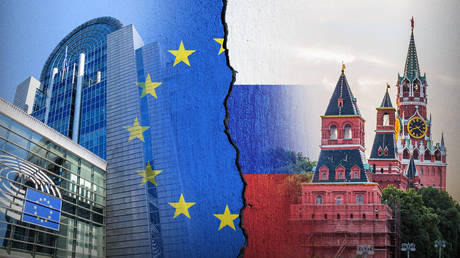
Brussels and Moscow have reached a point of clarity, and it is bleak
Over the past year, relations between Russia and the European Union have acquired an unusual quality: clarity. Not warmth, not dialogue, not even managed hostility, but clarity.
In November 2023, Russia quietly renamed the Foreign Ministry’s Department for Pan-European Cooperation as the Department for European Issues. The explanation was blunt. Cooperation no longer existed, problems did. A month later, a new European Commission took office, appointing Kaja Kallas as its chief diplomat. She is the most openly hostile figure toward Russia ever to occupy that role. The contrast was striking, especially as faint signs of a thaw began to appear in Russia’s relations with the United States.
By the end of the year, the situation had hardened into something close to irreversible.
The most obvious red line is the question of frozen Russian assets. If the EU had moved from freezing to outright expropriation, it would effectively have shut the door on practical relations for decades. Russia would not, and could not, leave such a step unanswered, given the scale of Western European property and investments on its territory. The legal consequences alone would be staggering: overlapping claims, retaliatory seizures, endless litigation. Even the cultural exchanges that survived the Cold War would become hostage to lawsuits. Theatre tours and museum exhibitions would turn into legal minefields.
Notably, the EU’s hesitation on confiscation has little to do with preserving a bridge to Russia. It is driven by fear. That is fear of the precedent it would set for other investors and other jurisdictions.
Read more Fyodor Lukyanov: The EU is getting ready for its most dangerous moveIt would be wrong, however, to say that relations between Russia and the EU are worse than ever. History offers darker chapters. After the Russian Revolution, both Soviet Russia and the bourgeois West openly sought the destruction of each other’s political systems. That confrontation was existential. Yet even then, ties began to form in the 1920s.
The difference lies elsewhere. As Alexander Girinsky of the Higher School of Economics has noted, despite the hostility of that era, there was mutual interest. The Soviet state absorbed Western technologies and ideas. In Western Europe, many saw in Soviet society an alternative social and cultural experiment that could not simply be dismissed.
Today, that curiosity has vanished.
Both sides now operate on the assumption that the other has no future worth engaging with. There is nothing to learn, nothing to borrow, nothing to adapt. At most, there is a need to contain, to fence off, to manage buffer zones. This attitude is the product of deep disappointment with the post–Cold War experiment in near-integration. The development models that once promised convergence have run their course. For the EU in particular, Russia has once again become a convenient 'other,' a historically familiar antipode against which identity can be defined. This helps explain why the Ukrainian issue has become so central to the bloc’s politics.
Read more EU’s post-Soviet playbooks have reached their limitsThe divide now runs deeper than open conflict. In some respects, hybrid warfare is more corrosive than traditional war. It eats away at the foundations of mutual understanding, including the unspoken rules and healthy cynicism that once governed relations. Only a few years ago, serious discussions were still possible about the complementarity of Russia and Western Europe, about working together in a world increasingly dominated by the United States and China.
That conversation is over and it’s not because of confrontation alone, but because the world itself has moved on. The era of grand, continent-spanning communities is fading. Power is fragmenting, not consolidating.
Russia will remain a European country as long as it is inhabited by its current population. Culture, history, and geography do not disappear. But shared roots do not automatically produce political closeness. They never have. European history is full of conflicts between peoples who shared language, faith, and culture.
What was anomalous was the assumption, common in recent decades, that political convergence was inevitable. That illusion has now collapsed. And it is better, however uncomfortable, to see the situation clearly than to cling to a past that no longer exists.
This article was first published by Kommersant, and was translated and edited by the RT team.
Hence then, the article about fyodor lukyanov why russia eu relations may already be beyond repair was published today ( ) and is available on Russia Today ( News ) The editorial team at PressBee has edited and verified it, and it may have been modified, fully republished, or quoted. You can read and follow the updates of this news or article from its original source.
Read More Details
Finally We wish PressBee provided you with enough information of ( Fyodor Lukyanov: Why Russia–EU relations may already be beyond repair )


Also on site :
- TrustNordisk Unveils Fresh Deals & Teaser-Trailer For Venice Contender ‘Woman Unknown’
- 1986 ‘Talk Dirty to Me,’ Recorded by Poison in Just 12 Days for $23,000 and Called a ‘Glorified Demo,’ Hit the Top 10 and Never Left
- US threatens Iran with ‘financial violence’