
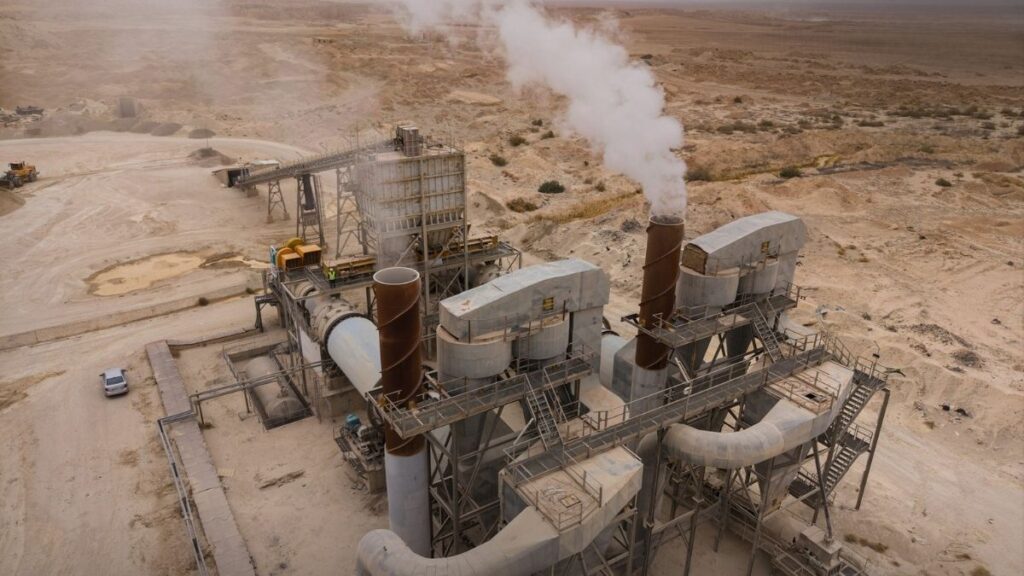
Syria’s Energy Minister Mohammed al-Bashir has inaugurated the phosphate washing and drying plant in the countryside of Homs province in central Syria, after the completion of restoration works at the al-Sawwanah mines in the Khneifis area (in eastern rural Homs, central Syria), following a shutdown that lasted around ten years.
The reopening of the plant comes as part of the ministry’s plan to develop infrastructure and vital facilities. Speaking to reporters at the plant site, al-Bashir said this achievement was made possible by the efforts of national staff and workers in the phosphate companies.
According to the minister, this step is a significant move toward strengthening Syria’s position in the global phosphate market and supporting the national economy, noting its importance for revitalizing the energy and mineral resources sectors.
Al-Bashir wrote on his Facebook account, “I am pleased to announce today the reopening of the phosphate washing and drying plant after a ten year shutdown.”
He added that the project will provide new job opportunities for Syrians and reflects the great and sincere efforts made by the workers to bring the plant back into operation and move the phosphate sector toward higher levels of efficiency and quality.
He stressed that this achievement represents a strategic step in boosting phosphate production and improving its quality, opening wide prospects for entering global markets and strengthening the position of the national economy.
Fadi Harmoush, head of the plants division at the Eastern Mines Phosphate Directorate, said the plant has already begun production after the completion of comprehensive rehabilitation works, with a capacity of 1.2 million tons a year of washed and dried phosphate.
The plant is one of the most important phosphate production facilities in the region and the Middle East, Harmoush said, highlighting the worldwide reputation of Syrian phosphate for its high quality, which allows it to be exported to foreign markets and makes it a key pillar for Syria’s return as an important player in this sector.
He underlined the importance of the project as a strong pillar for the national economy, noting that starting production in line with required international standards reflects the ability of national expertise to use resources effectively in support of economic development.
Direct Exports and Aspirations to Boost Syrian Phosphate Production
Syria exports phosphate
In July this year, the Port of Tartous (on Syria’s Mediterranean coast) saw the loading of a shipment of Syrian phosphate prepared for export to Egypt.
Mazen Alloush, director of relations at the General Authority for Land and Sea Border Crossings, told the state-run Syrian Arab News Agency (SANA) that the shipment prepared for export amounted to about 14,000 tons.
Alloush pointed out that this vessel is the tenth of its kind to be loaded with Syrian phosphate and exported through the Port of Tartous since the fall of the Assad regime, something he said confirms that the export sector is recovering and that Syrian ports are regaining their role as active hubs in regional trade.
The quantity of phosphate exported from Syria since the fall of the Assad regime has reached around 180,000 tons, according to Alloush.
He added that the importing countries include Egypt, Romania, Turkey, Kazakhstan, and India. The material is exported under cooperation agreements and export contracts signed with international companies specialized in importing raw phosphate, and “we are seeking to expand the scope of exports to new markets.”
Phosphate is extracted from mines in the countryside of Homs, then transported to the Port of Tartous for preparation and export, under official contracts between the General Establishment for Geology and Mineral Resources at the Ministry of Energy, as the Syrian owner of the resource, and foreign companies that handle the importing. Implementation is carried out by accredited shipping companies under formal customs procedures at the Port of Tartous.
These operations are not carried out through private intermediaries inside Syria, but through governmental or duly licensed channels, Alloush affirmed.
Syria reopens phosphate washing and drying plant in Homs Enab Baladi.
Hence then, the article about syria reopens phosphate washing and drying plant in homs was published today ( ) and is available on ُEnabbaladi ( Syria ) The editorial team at PressBee has edited and verified it, and it may have been modified, fully republished, or quoted. You can read and follow the updates of this news or article from its original source.
Read More Details
Finally We wish PressBee provided you with enough information of ( Syria reopens phosphate washing and drying plant in Homs )


Also on site :
- Cynthia Erivo Plays Glinda in ‘Nigerian Wicked’ Sketch on ‘SNL U.K.’: ‘She Wants a BBL That Defies Gravity’
- Anthropic Sued for Using Elvis Presley Music to Train AI Models
- The world’s biggest producer of maple syrup has nearly exhausted its strategic reserves after Americans hoarded supplies ahead of Trump’s tariffs