
4 min read
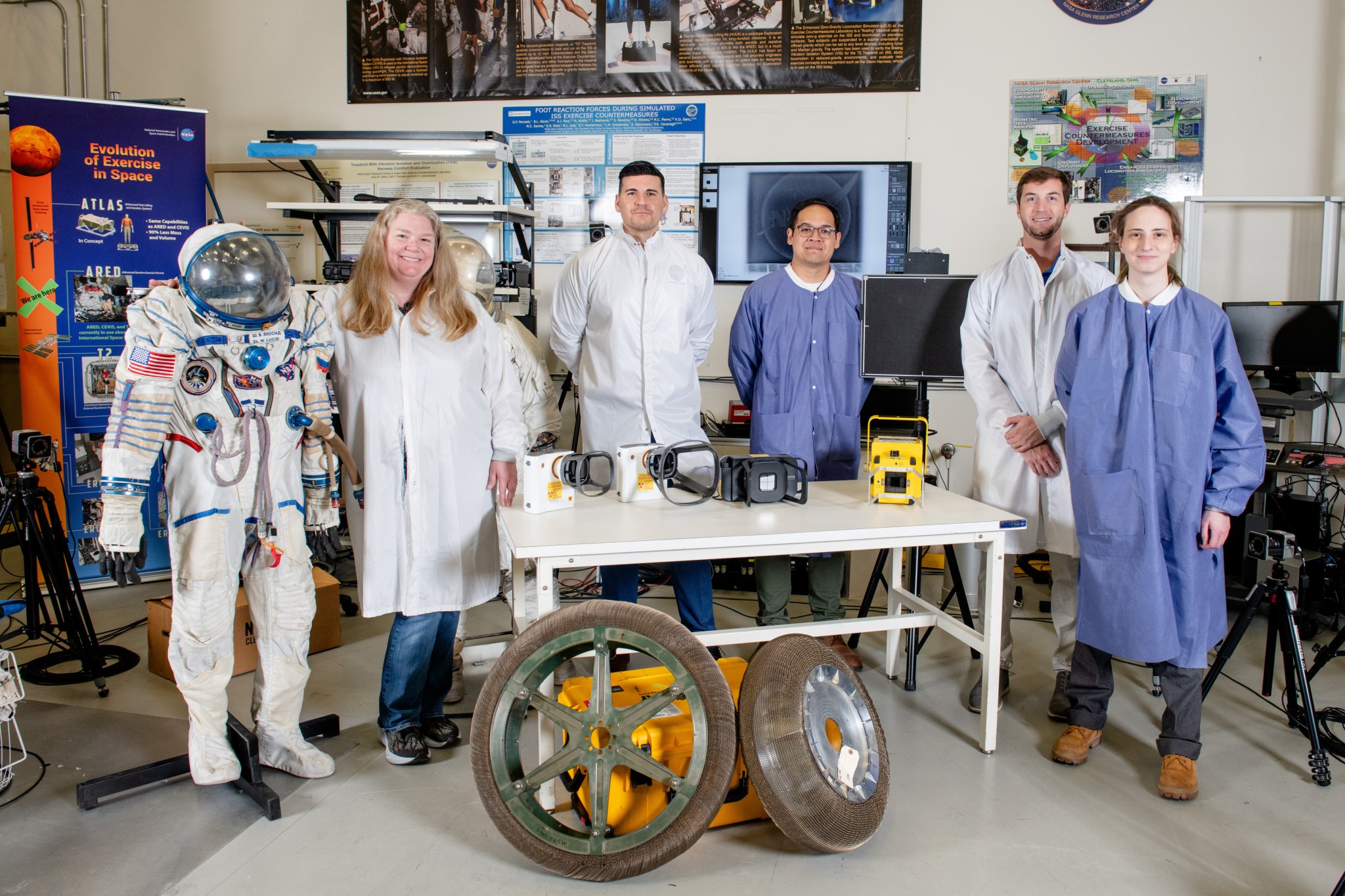
Preparations for Next Moonwalk Simulations Underway (and Underwater) Researchers Kelly Gilkey, Cy Peverill, Daniel Phan, Chase Haddix, and Ariel Tokarz test portable, handheld X-ray systems for use during future long-duration space missions at NASA’s Glenn Research Center in Cleveland on Friday, March 21, 2025. Credit: NASA/Sara Lowthian-HannaAs NASA plans future human exploration missions to the Moon, Mars, and beyond, new and unique challenges emerge — like communication delays and limited return-to-Earth options — so enhanced medical care capabilities are critical. Crews will need non-invasive imaging technology to diagnose medical conditions, like broken bones or dental injuries.
Scientists at NASA’s Glenn Research Center in Cleveland are testing portable, handheld X-ray systems for use during future extended space missions. Having portable X-ray capabilities aboard spacecraft would allow astronauts to immediately assess and treat potential injuries or identify equipment issues without having to disassemble the gear.
“Technological innovations like that of the mini-X-ray will help keep our astronauts healthy as we endeavor farther into space than ever before,” said acting NASA Administrator Sean Duffy. “Future missions to the Moon and Mars will be safer due to the research of our scientists at NASA Glenn.”
NASA reviewed more than 200 commercial systems — analyzing size, weight, image quality, ease-of-use, cost, and safety — and selected three systems for further testing: MinXray, Remedi, and Fujifilm.
“We’re working to provide evidence on why a mini-X-ray system should be included in future space exploration,” said Dr. Chase Haddix, a senior biomedical engineering research contractor working for Universities Space Research Association at NASA Glenn. “These X-rays could be used to detect both clinical and non-clinical diagnostics, meaning they can check an astronaut’s body or identify the location of a tear in an astronaut suit.”
Researchers capture X-ray images of a shape memory alloy rover tire at NASA’s Glenn Research Center in Cleveland on Friday, March 21, 2025. Credit: NASA/Sara Lowthian-HannaNASA Glenn is collaborating with other centers, including NASA’s Johnson Space Center in Houston and NASA’s Langley Research Center in Hampton, Virginia, and radiography experts at University Hospitals and Cuyahoga Community College in Cleveland.
“We’re fortunate to have enthusiastic medical and radiography experts right here in our community,” said Dr. Cy Peverill, project task lead at NASA Glenn. “Their knowledge and experience are invaluable as we work to test medical technologies that could significantly improve management of astronaut health on future missions to the Moon or Mars.”
Cuyahoga Community College contributed anatomical phantoms, which are lifelike models of the human body, in its radiography laboratory on the Western Campus and dental hygiene clinical facility at the Metropolitan Campus. Faculty and students consulted with NASA researchers on essential imaging principles, including patient positioning, image acquisition, and image quality.
University Hospitals is partnering with NASA Glenn on a medical study with real patients to compare the performance of the X-ray systems against hospital-grade equipment, focusing on usability, image clarity, and diagnostic accuracy.
“Astronauts live and work in small quarters, much smaller spaces than in a hospital,” Haddix said. “The system must be easy to use since astronauts may not be experienced in radiography. The data from these tests will guide the selection of the most suitable system for future missions.”
Researchers capture X-ray images of an astronaut spacesuit at NASA’s Glenn Research Center in Cleveland on Friday, March 21, 2025. Credit: NASA/Sara Lowthian-HannaUsing portable X-rays to improve health care in inaccessible areas is not new, with systems deployed to diagnose medical issues in places such as base camps in Nepal and remote villages in South Africa. NASA researchers theorize that if these systems are successful in high elevations and extreme temperatures on Earth, perhaps they are durable enough for space missions.
Glenn researchers will continue to collect data from all collaborators, including from an X-ray system sourced by SpaceX that launched in April during the Fram2 mission. The crew captured the first human X-ray images in space during their four-day mission to low Earth orbit. NASA plans to select a device near the end of 2025 and will test the chosen system aboard the International Space Station in 2026 or early 2027.
The Mars Campaign Office at NASA Headquarters in Washington and the agency’s Human Research Program at NASA Johnson fund this work as both organizations focus on pursuing technologies and methods to support safe, productive human space travel.
Explore More
2 min readLydia Rodriguez Builds a Career of Service and Support at NASA
Article 2 days ago 3 min readWhat’s Up: September 2025 Skywatching Tips from NASA
Saturn’s spectacle, a Conjunction, and the Autumnal Equinox Saturn shines throughout the month, a conjunction…
Article 2 days ago 2 min readHubble Homes in on Galaxy’s Star Formation
This NASA/ESA Hubble Space Telescope image features a galaxy whose asymmetric appearance may be the…
Article 6 days agoHence then, the article about nasa glenn tests mini x ray technology to advance space health care was published today ( ) and is available on NASA ( Middle East ) The editorial team at PressBee has edited and verified it, and it may have been modified, fully republished, or quoted. You can read and follow the updates of this news or article from its original source.
Read More Details
Finally We wish PressBee provided you with enough information of ( NASA Glenn Tests Mini-X-Ray Technology to Advance Space Health Care )


Also on site :
- Jordan Peele’s Monkeypaw Productions and Universal Film Team With American Cinematheque and Beyond Fest for ‘No Drama’ Initiative (EXCLUSIVE)
- VMAs Producer Van Toffler on Nirvana & George Michael Tributes at 2026 Awards and Why the VMAs Are Best at Their Most ‘Age, Genre & Color Blind’
- ‘America’s Got Talent’ 2026 Finale Moves to New Time Slot Tonight: Here’s How to Watch