
Enab Baladi – Diala al-Bahri
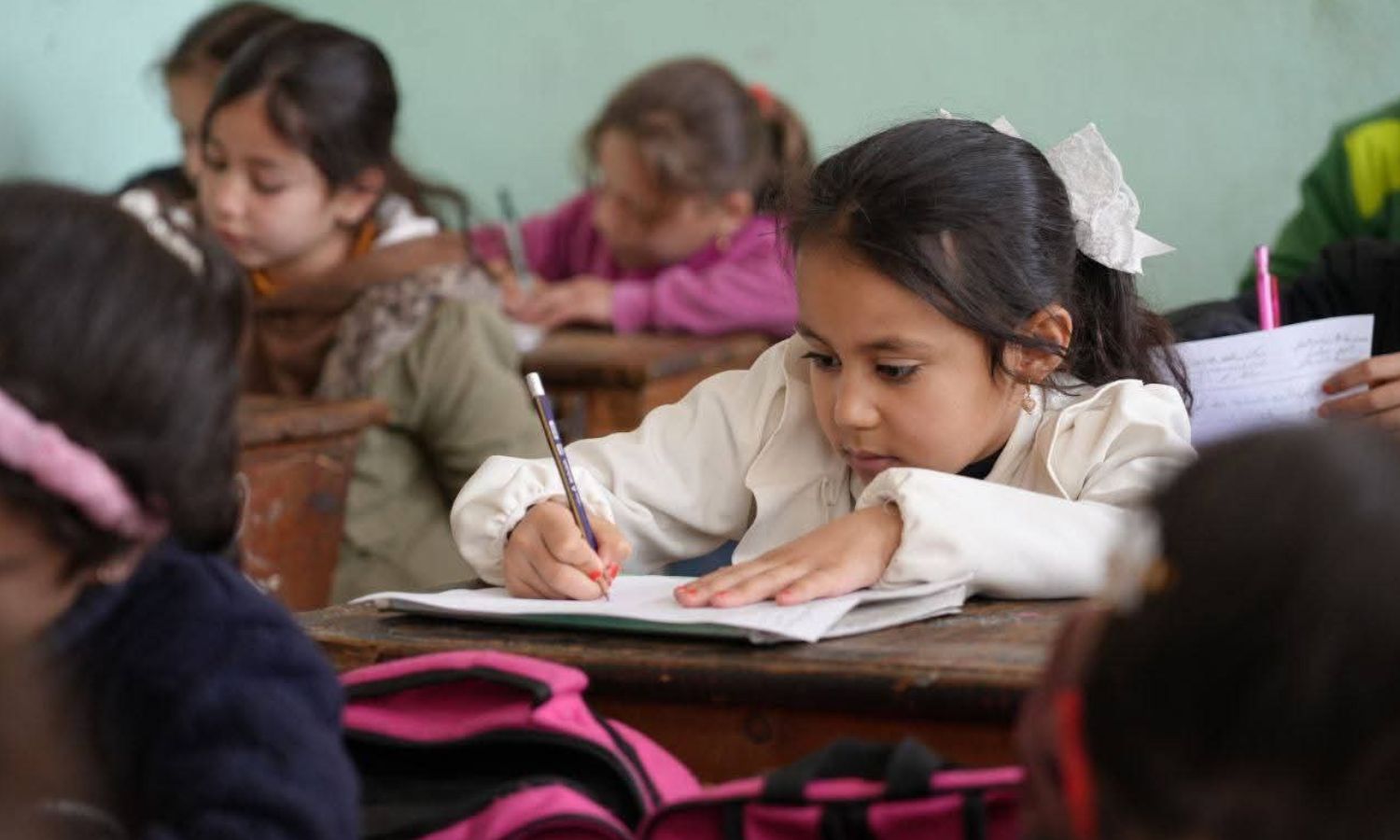
After the fall of the former regime, Syrian families returning from countries of asylum are facing new challenges in reintegrating their children into the Syrian education system.
Differences in curricula, the learning environment, psychological challenges, and language have placed returning students in an educational and emotional reality completely different from what they were accustomed to.
One of the most prominent challenges facing returnee students is the disparity in curricula. While they were used to educational systems that emphasized interaction and participation, they now find themselves in a system that prioritizes memorization and rote learning, with a heavy and dense workload.
Curricula, language, and overcrowded classrooms
Weam Badi, a high-achieving student preparing for her baccalaureate exams, described the struggles she encountered after returning from Turkey to her hometown of Hama (central Syria) and enrolling in a state school.
She told Enab Baladi that the Syrian curricula were much denser than those she studied in Turkey, particularly in scientific subjects such as mathematics and natural sciences.
Her greatest struggle, however, was with the Arabic language, especially grammar lessons. Having studied for years in Turkish, she had weak foundations in Arabic.
“I was embarrassed to answer my teacher’s questions because I couldn’t form a correct Arabic sentence. I was afraid my classmates would mock my broken language,” she said.
One incident left a deep impact on her: when she failed to parse a word correctly, the teacher scolded her in front of her peers. From then on, she lost confidence and hesitated to participate in class.
Despite attempts by some teachers and classmates to help, Weam still feels behind, and the decline in her performance has affected her psychologically. Facing the baccalaureate exams, she fears she may not reach the high average she once aspired to.
Difficulties are not limited to secondary students. Challenges begin as early as the first grades.
Abdel-Halim Irfan told Enab Baladi about his son’s experience entering first grade after returning from Turkey. “He struggled greatly with language, as his classmates were far ahead of him. It caused him confusion and anxiety,” he said.
Overcrowded classrooms and rigid teaching methods in Syria further complicated his son’s adjustment compared to the environment he was used to in Turkey.
Ultimately, Irfan requested that the school allow his son to repeat first grade. “We convinced him this wasn’t failure but a chance for a stronger start,” he explained. “It required psychological effort to make sure he didn’t feel inferior to his peers.”
No official plan: “It depends on the teacher”
With no clear policy from the Ministry of Education to address this category of students, responsibility for integration falls on schools and teachers working with limited resources.
Lamia Kakhi, a teacher at a private school in Homs (central Syria), said most returnee students struggled with language and academic difficulties from their very first days.
“No circular or plan was issued by the ministry to guide schools on how to deal with this group, it’s left entirely to the teacher’s discretion,” she explained.
She noted that private schools, though not without challenges, are better able to support returnees than public schools due to smaller class sizes, which allow teachers to dedicate more time to each student.
Reem al-Khatib, a first-grade teacher at a public school, agreed. She observed that many returnee children had difficulty interacting with peers and even understanding the local school culture.
She added that the challenges went beyond language to include exam styles, teaching methods, and content reliant on memorization, approaches that were unfamiliar to these students.
Kakhi suggested several steps to ease the crisis, including additional Arabic language support classes, training for teachers on how to work with children from different educational backgrounds, and stronger cooperation between schools and parents through home tutoring.
Al-Khatib hopes this year will bring better classroom organization, fewer students per class, and summer crash courses for returnees, especially those preparing for final exams.
Psychological and cultural displacement
Returnee students are not only burdened by academic hurdles but also by the psychological strain of abrupt lifestyle changes.
Wafaa Shaheen, a trainer in childhood and youth education, emphasized the psychological toll of return. “They are in their country, but they don’t feel a sense of belonging to the school or community, because they were used to a completely different environment,” she said.
Shaheen explained that many suffer from social anxiety, fear of bullying, and academic frustration due to the unfamiliar curricula and teaching methods.
Challenges differ by age group:
Primary level: nostalgia for the previous place of residence and difficulty expressing feelings.
Preparatory level: identity concerns and a sense of being different in language and habits.
Secondary level: heightened academic pressure linked to fears about university prospects and a sense of lost opportunities.
She added that previously high-achieving students may feel underappreciated in their new schools, further diminishing their motivation if no efforts are made to integrate and support them.
Shaheen stressed that the solution must start in schools through individual and group psychological support sessions, active roles for school counselors, stronger parental cooperation, teacher training in interactive methods that build life skills, and a culture of respect for diversity in classrooms.
Given these challenges, the need for a comprehensive integration strategy is urgent. Returnee students require not just academic catch-up but a holistic plan addressing psychological, educational, and social needs.
Returning Syrian Students Struggle with Education Gaps Enab Baladi.
Hence then, the article about returning syrian students struggle with education gaps was published today ( ) and is available on ُEnabbaladi ( Syria ) The editorial team at PressBee has edited and verified it, and it may have been modified, fully republished, or quoted. You can read and follow the updates of this news or article from its original source.
Read More Details
Finally We wish PressBee provided you with enough information of ( Returning Syrian Students Struggle with Education Gaps )


Also on site :
- Barcelona vs Real Madrid: Kick-Off Time, TV Channel, Live Stream and Expected Lineups for El Clásico
- In 1930, 3 Entrepreneurs Started a Toy Company During the Great Depression; Today, It’s a Household Name
- Target’s October Book Club Pick Is a Chilling Thriller, From Award-Winning Horror Author Ann Dávila Cardinal, Hailed as ‘Deeply Human and Unsettling’ on Goodreads