
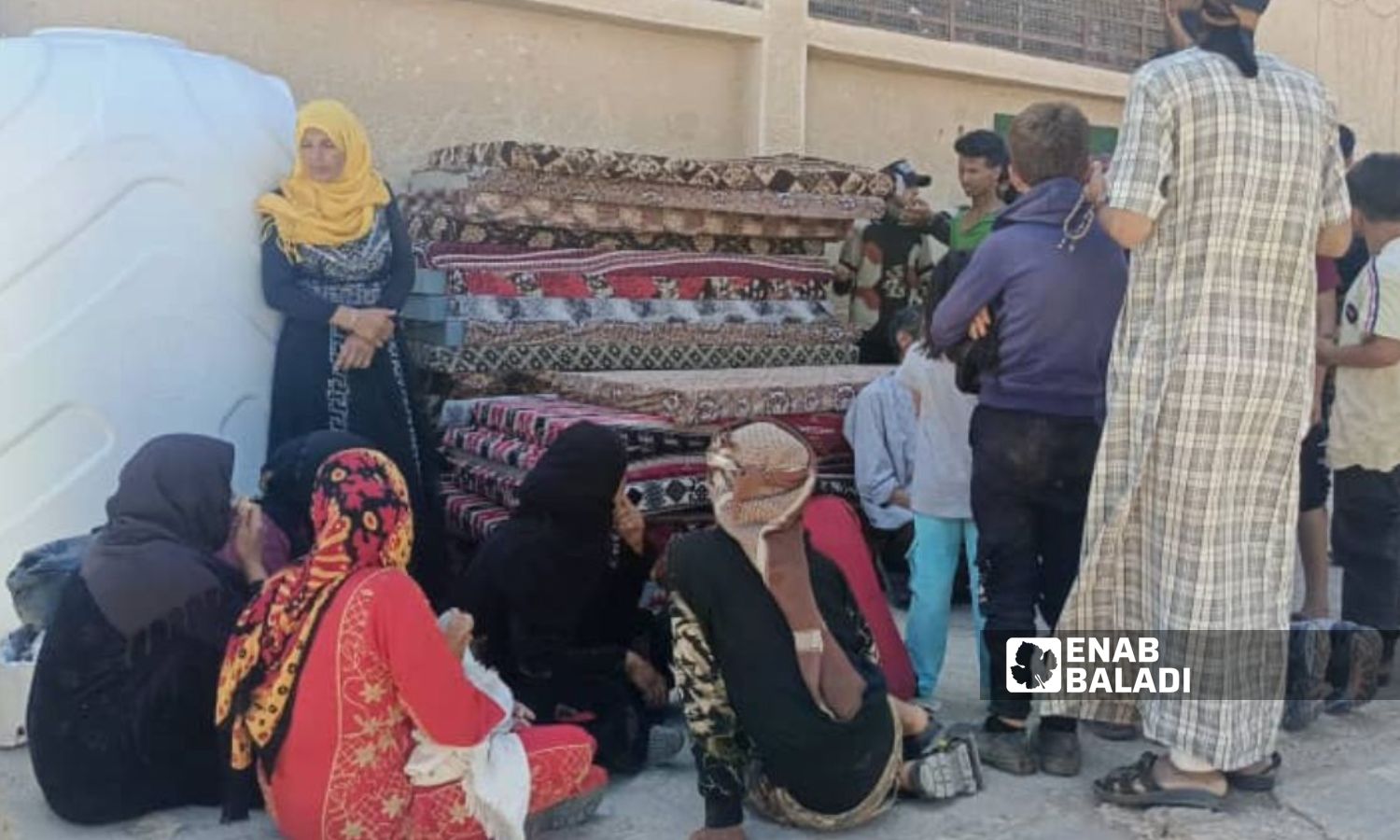
Enab Baladi – Raghad Othman | Mahjoub al-Hashish
In one of the shelters in Khirbet Ghazaleh in rural Daraa (southern Syria), a displaced woman from As-Suwayda, who preferred not to reveal her name, sat to recount her daily suffering. She told Enab Baladi that the absence of women-only restrooms, in light of the shelter being overcrowded with dozens of families, forces some families to resort to acquaintances’ homes to relieve themselves, expressing fear that her children might contract skin diseases due to poor sanitary conditions.
The constant noise deprives her of sleep, while her children lack clean clothes and basic hygiene items, noting that some of them are still wearing the same clothes they had on when they fled As-Suwayda weeks ago.
She bitterly continued that an expired food meal distributed at the shelter caused intestinal infections among children, expressing her discontent at not receiving any cash assistance like that distributed in other shelters, adding, “All I need is to buy clothes for my children.”
This suffering is not an isolated case but part of a broader humanitarian crisis unfolding in Daraa province, which has received more than 4,629 families, numbering over 25,000 people, displaced from As-Suwayda province following the security deterioration in several of its areas.
Most of these families belong to Bedouin tribes in As-Suwayda, who were subjected to violations by local factions after a wave of violence involving local factions, tribal fighters, and government forces.
In response, 63 schools were prepared as shelters, coordinated between government agencies, local and international organizations, and the local community to provide basic services and humanitarian needs.
But with the growing number of displaced people and scarce resources, these shelters face escalating living and service challenges, from shortages of basic supplies to limited capacity to meet actual needs, revealing a wide gap between available resources and the scale of the crisis, despite ongoing efforts. Testimonies from shelters in Busra al-Harir, Dael, and Khirbet Ghazaleh paint a picture of a reality where daily anxiety blends with food scarcity, lack of privacy, and deteriorating service infrastructure.
Complaints
In the Dael shelter, Amina al-Riffa, a displaced woman from As-Suwayda, spoke about the lack of fairness in distributing food and hygiene baskets, explaining that a single basket is given to several women collectively without referring to the family register.
As for Asra al-Riffa, who resides in the same shelter, she did not receive any hygiene basket due to a lack of identification papers, noting that she left her home in haste under gunfire without being able to take her belongings or official documents.
In the Khirbet Ghazaleh shelter, Mahmoud al-Jassem explained that food is distributed only once every three days, amid a lack of lighting and a clear shortage of blankets. Mahmoud called for alternative solutions before the start of the school year, such as providing tents for families.
For his part, Ali al-Rayan, one of the displaced in Khirbet Ghazaleh, pointed out that the shelter currently hosts 46 families, most of whom are thinking of leaving due to poor services, suggesting providing a tent for each family or relocating the displaced to government-controlled areas inside As-Suwayda.
Local Campaigns
The director of the Dael center, Mohammad al-Barghouth, told Enab Baladi that the current aid came from community efforts by the people of Dael and is insufficient to meet the needs of about 150 people residing in the center. He indicated that the distribution mechanism depends on the number of individuals, with one basket given for every four people, and larger families receiving two baskets.
He added that local campaigns helped secure batteries, install lighting in classrooms, and distribute blankets, food, meals, and personal hygiene supplies.
For his part, the director of the Khirbet Ghazaleh center said that the food meals provided to the displaced were made possible by voluntary efforts from the town’s youth, but this ended recently due to the absence of a permanent kitchen in the center.
He added that rapid response organizations initially prepared 12 rooms with mattresses and blankets, but these are not enough to cover all families, expressing hope that assistance will be provided according to each family’s needs, similar to other centers.
Regarding lighting, he explained that a battery and a solar panel were provided by local donors, and later an organization responded and provided an additional solar panel and battery to light the center.
The bathrooms in the center are in good condition and cleaned daily, with no recorded illnesses among residents, noting that medical organizations visit the center regularly to provide medicines and raise health awareness.
He concluded by saying that the most urgent needs today are blankets, mattresses, financial assistance, or alternative tents, pointing out ongoing communication with organizations to secure these needs.
For his part, the deputy director of the Izra area and the official in charge of the Busra al-Harir center and shelters in Izra, Imad al-Hariri, said that most of the services provided in the shelters rely mainly on support from humanitarian organizations, with food baskets containing canned goods and staples such as sugar, rice, and bulgur being distributed.
Local charitable institutions also provide ready meals to residents in these shelters, and these contributions cover about 70% of their basic needs.
As for bread, it is distributed daily by the provincial council to the various shelters across the sector.
He added that, regarding cleanliness, the shelters suffer from a lack of showers, even though some of the relief baskets distributed included cleaning materials such as shampoo and soap.
On healthcare, al-Hariri explained that it is provided in coordination with the health directorate through mobile teams that offer medical services, distribute medicines, and conduct necessary tests. In addition, medical points are located near most shelters and also provide continuous healthcare.
What Is Needed?
The member of the Executive Office for Social Affairs, Labor, and Emergencies in Daraa province, Hussein al-Nuseirat, told Enab Baladi that some centers are more overcrowded than others, such as the Rakham and Busra al-Harir centers, due to their geographical proximity to As-Suwayda, making them the preferred destination for the displaced.
He explained that most of the current shelters are schools initially equipped with sanitary facilities and water connections, with families provided with mattresses and blankets. In addition, mobile clinics affiliated with the Ministry of Health, in cooperation with local organizations, distribute medical and women’s supplies and infant formula, with some health cases referred to hospitals.
Food is provided through contributions from the local community and donors, with some centers having kitchens that serve hot meals, while others distribute food baskets containing canned goods.
Nevertheless, al-Nuseirat stressed that challenges remain significant, especially with the increase in displaced people. He said the most urgent needs include clothing, showers, and designated areas for washing and cooking inside each center, as ready meals do not meet all needs, especially for children or those with special health conditions.
Regarding funding, he explained that the centers rely on joint efforts between the local community, the Disaster Committee, and some international organizations, noting that international support remains limited so far. He pointed to the World Food Programme’s contribution in providing flour to bakeries that distribute bread for free, while the state bears the cost of bread production.
Some shelters in the villages of eastern rural Daraa suffer from a shortage of aid due to the difficulty of delivering assistance because of long distances and high transportation costs, in addition to the strain on personnel required at each center from several entities such as the municipality, civil defense, and the Red Crescent.
Al-Nuseirat explained that 45% of Daraa’s schools are out of service due to destruction, and with the new school year approaching, it is necessary to vacate the shelters located in schools as soon as possible. The province is also experiencing population congestion and a sharp rise in housing rents, which has led the authorities to consider establishing a temporary camp until the displaced return to their areas in As-Suwayda.
Temporary Solutions
In response to the suffering of residents in Daraa shelters, the Action For Humanity organization, under the supervision of the Syrian Civil Defense, provided several sanitary facilities to some shelters in eastern rural Daraa.
The facilities included showers and toilets, which were distributed on August 8 to centers in the towns of Ghasm, al-Sahwa, Eastern al-Maliha, al-Musayfrah, and al-Hirak, according to Enab Baladi’s correspondent in Daraa.
The head of al-Sahwa municipality, Mar’i al-Iqab, explained that caravans reached only two out of five centers in the town, with each center receiving two separate showers for males and females, noting that al-Sahwa hosts about 600 families, or around 3,200 displaced people from As-Suwayda.
In al-Musayfrah, the shelter director, Zahir al-Zoubi, said the center received one caravan containing showers but confirmed that this amount was insufficient, calling for an additional unit, especially as the center houses around 300 displaced people.
As for Eastern al-Maliha, the head of the municipality, Mohammad al-Amari, reported that the organization delivered four caravans, all designated for showers, stressing their importance given the high temperatures and urgent need for personal hygiene in the shelters.
The families arrived in the area after an agreement between government forces and local factions for a truce, under US sponsorship, after which convoys of the displaced began leaving As-Suwayda, but without any official clarification as to whether this displacement is permanent or temporary.
Displaced Families Speak Out on the Reality of Shelters in Daraa, southern Syria Enab Baladi.
Hence then, the article about displaced families speak out on the reality of shelters in daraa southern syria was published today ( ) and is available on ُEnabbaladi ( Syria ) The editorial team at PressBee has edited and verified it, and it may have been modified, fully republished, or quoted. You can read and follow the updates of this news or article from its original source.
Read More Details
Finally We wish PressBee provided you with enough information of ( Displaced Families Speak Out on the Reality of Shelters in Daraa, southern Syria )


Also on site :
- Elvis Presley Estate Sues AI Company for Training Use of 274 ‘Iconic’ Songs Without Permission
- 1989 Classic Cover, Hailed as One of Dolly Parton’s ‘Best Songs of All Time,’ Gets New Life by Reba McEntire
- Christopher Abbott Gushes Over Welcoming First Child with Partner Aubrey Plaza: ‘It’s Like the Best Movie Ever’