
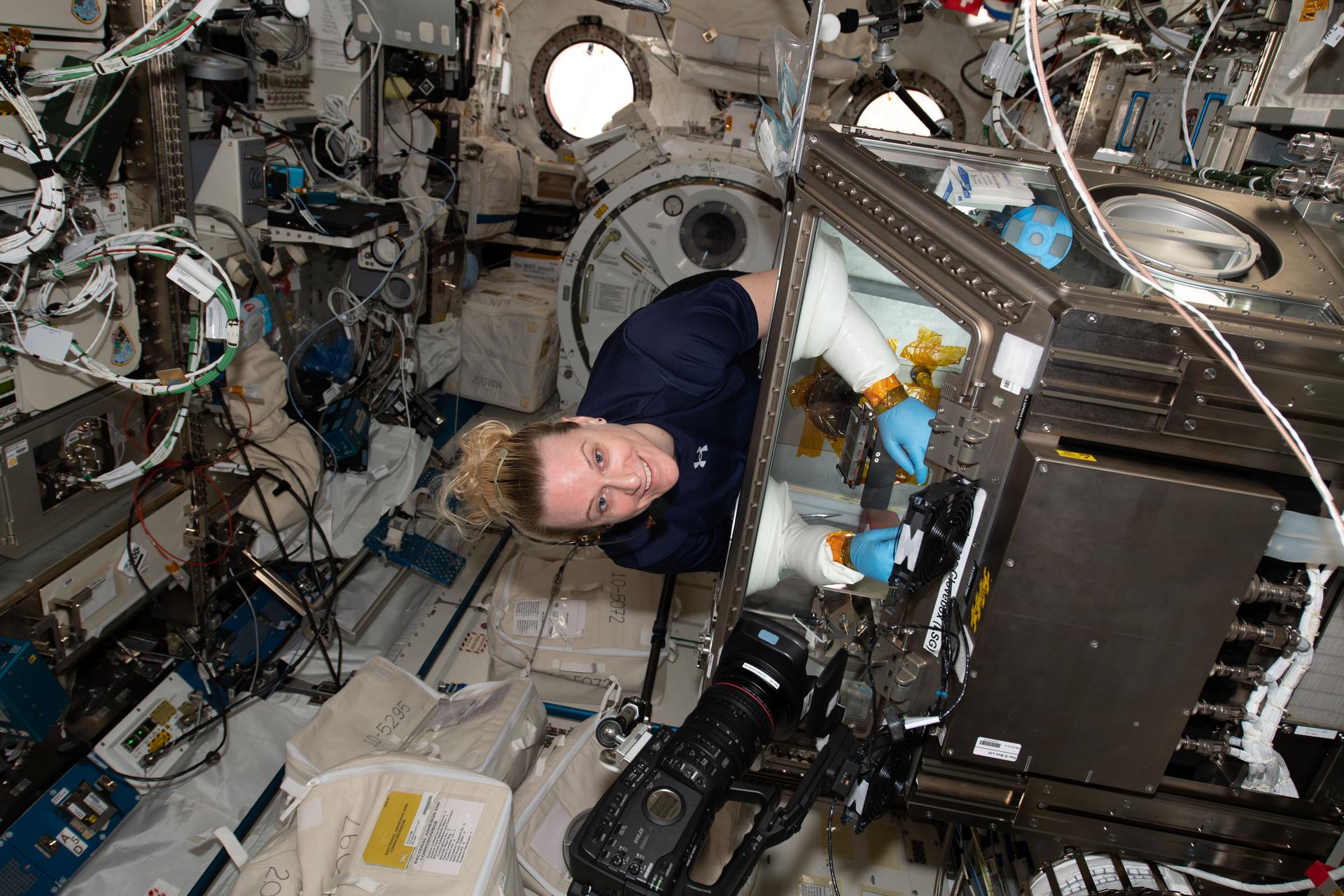
This November marks a quarter century of continuous human presence aboard the International Space Station, which has served as a springboard for developing a low Earth economy and NASA’s next great leaps in exploration, including human missions to the Moon and Mars. To kick off the orbiting laboratory’s silver 25th anniversary countdown, here are a few silver-themed science investigations that have advanced research and space exploration.
Antimicrobial properties
Silver has been used for centuries to fight infection, and researchers use its unique properties to mitigate microbial growth aboard the space station. Over time, microbes form biofilms, sticky communities that can grow on surfaces and cause infection. In space, biofilms can become resistant to traditional cleaning products and could infect water treatment systems, damage equipment, and pose a health risk to astronauts. The Bacterial Adhesion and Corrosion investigation studied the bacterial genes that contribute to the formation of biofilms and tested whether a silver-based disinfectant could limit their growth.
Another experiment focused on the production of silver nanoparticles aboard the space station. Silver nanoparticles have a bigger surface-to-volume ratio, allowing silver ions to come in contact with more microbes, making it a more effective antimicrobial tool to help protect crew from potential infection on future space missions. It also evaluated whether silver nanoparticles produced in space are more stable and uniform in size and shape, characteristics that could further enhance their effectiveness.
Wearable tech
Silver is a high-conductivity precious metal that is very malleable, making it a viable option for smart garments. NASA astronauts aboard the orbiting laboratory tested a wearable monitoring vest with silver-coated sensors to record heart rates, cardiac mechanics, and breathing patterns while they slept. This smart garment is lightweight and more comfortable, so it does not disturb sleep quality. The data collected provided valuable insight into improving astronauts’ sleep in space.
Silver crystals
In microgravity, there is no up or down, and weightlessness does not allow particles to settle, which impacts physical and chemical processes. Researchers use this unique microgravity environment to grow larger and more uniform crystals unaffected by the force of Earth’s gravity or the physical processes that would separate mixtures by density. The NanoRacks-COSMOS investigation used the environment aboard the station to grow and assess the 3D structure of silver nitrate crystals. The molecular structure of these superior silver nitrate crystals has applications in nanotechnology, such as creating silver nanowires for nanoscale electronics.
Keep ExploringDiscover More Topics From NASA
Missions
Humans in Space
Climate Change
Solar System
Share
Details
Last Updated Aug 14, 2025Related Terms
ISS ResearchHumans in SpaceInternational Space Station (ISS)Hence then, the article about countdown to space station s silver jubilee with silver research was published today ( ) and is available on NASA ( Middle East ) The editorial team at PressBee has edited and verified it, and it may have been modified, fully republished, or quoted. You can read and follow the updates of this news or article from its original source.
Read More Details
Finally We wish PressBee provided you with enough information of ( Countdown to Space Station’s Silver Jubilee with Silver Research )


Also on site :
- Ted Lasso's Annette Badland Reflects On Mae's Journey With The Lady Greyhounds In Bittersweet Episode 9
- Jimmy Fallon Just Dropped a Brutal Title for Karoline Leavitt’s Hypothetical Memoir, and the Internet Is Having a Field Day
- Six Flags Magic Mountain Permanently Closes World-Famous X2 Roller Coaster Following Mounting Safety Concerns