
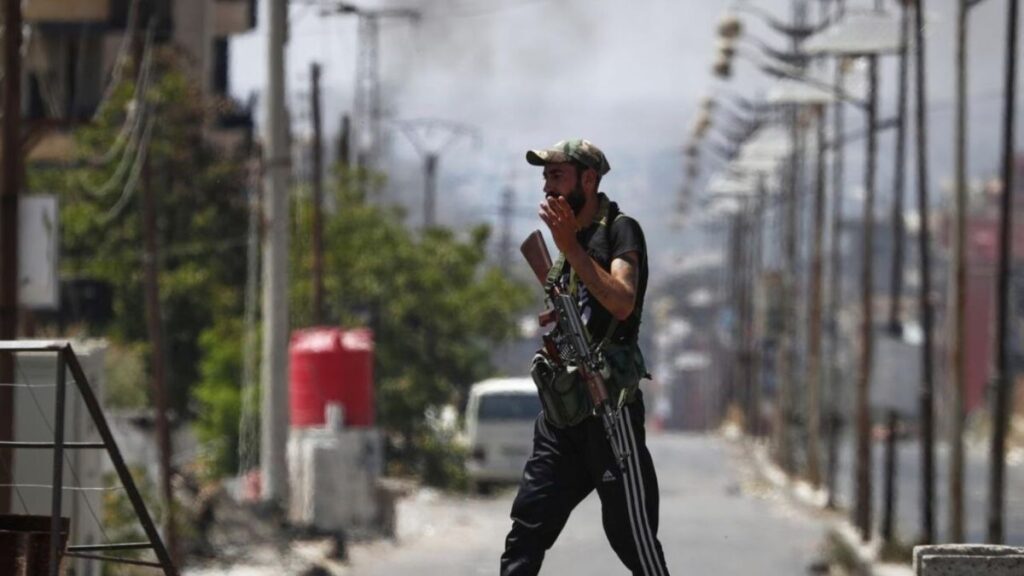
Enab Baladi- Mowaffak al-Khouja
The spiritual leadership of the Druze community in southern Syria’s Suwayda province has formed committees to oversee service, legal, and security affairs in the province, sparking questions over the reasons and motives behind their creation—whether they carry separatist ambitions or are merely aimed at organizing the province’s internal affairs.
The so-called “Supreme Legal Committee,” which will oversee the area’s affairs after the withdrawal of government institutions, announced its formation on August 6. It includes six judges and four lawyers.
According to a statement from the committee’s media office, its tasks include managing all sectors in Suwayda, safeguarding public and private institutions, “lifting injustice and harm from all citizens regardless of their background, and fighting corruption.”
Enab Baladi reached out to the Suwayda governorate’s press office for comment but received no response at the time of publication.
Organization or Stalemate?
Fayez al-Qantar, a Syrian academic from Suwayda, told Enab Baladi that the reason for forming the committee was to oversee internal affairs and “put the house in order” in the absence of Damascus’ authority.
He added that the people of Suwayda reject the presence of that authority (the Syrian government) and are working to organize their own affairs while awaiting a resolution.
At the same time, al-Qantar said Suwayda is now “besieged and starved,” with no medicine or water, accusing the Internal Security Forces of destroying drinking water wells that supply the city, as well as damaging the Faculty of Agriculture and key facilities such as mills, small factories, hospitals, and looting pharmacies.
Ayman al-Desouki, a researcher at the Omran Center for Strategic Studies, described the committee’s formation and its administrative measures as a sign of the province’s political stalemate in the absence of an agreement with the central government in Damascus.
Speaking to Enab Baladi, he called the move a challenge to the government’s legitimacy and an attempt to impose a new governance reality, institutionalize it, and use it as leverage in negotiations.
End of the Zones of Influence?
The “Supreme Legal Committee” was created amid regional and international efforts, alongside the Syrian government’s own moves, to end the state of fragmented control in the country, as negotiations continue between Damascus and the Syrian Democratic Forces (SDF).
Al-Desouki noted that for zones of influence and governance to endure, they require political backing, economic resources, security arrangements, and a local authority capable of monopolizing the use of force—lessons drawn from previous years of the Syrian conflict.
He added that Syria has not moved beyond the zones-of-influence model but is instead witnessing its reconfiguration, with the situation in Suwayda serving as a clear example.
Exiting this model, he said, would require both international-regional consensus and local agreement.
Al-Qantar stressed that Suwayda is not seeking secession, asking rhetorically, “Where would it go? It is cornered, with no access to any external or regional state and no coastline.”
Two Former Regime Officers
The committee appointed Shakib Ajoud Nasr, a former regime brigadier general and former head of the Political Security Branch in Tartus province, as commander of Suwayda’s Internal Security Forces.
He is deputized by another former regime brigadier general, Anwar Adel Radwan, who previously served as director of Baniyas district in Tartus province.
Al-Desouki said Nasr’s appointment was merely a detail within the broader picture.
On the services side, the “Supreme Legal Committee” formed an interim executive office of eight members, including engineers, lawyers, and doctors, appointing Maher Ghaleb al-Andari as Secretary-General of Suwayda province.
The executive office’s mandate includes managing public services, forming specialized sub-committees for relief work, documenting violations, tracking the cases of missing and forcibly disappeared persons, supporting the families of the “martyrs” and wounded, accepting and distributing aid to those affected, preserving public and private institutions, banks, and economic facilities, following up on health and humanitarian issues, overseeing public and private hospitals, and carrying out other humanitarian and social functions.
The spiritual leadership, headed by Sheikh Hikmat al-Hijri, has not commented on the formation of the committees as of the time of publication. However, local networks in Suwayda, including “al-Rased,” have confirmed the authenticity of the statements.
Judges Referred for Investigation
On August 7, the Syrian Arab News Agency (SANA) quoted an unnamed Justice Ministry official as saying that the ministry had referred the judges involved in the “Supreme Legal Committee” to the Judicial Inspection Department for investigation.
The source claimed the committee members had engaged in activities that violate the duties of a judge under the Judicial Authority Law, particularly articles 78 and subsequent provisions, which prohibit judges from holding other jobs or performing any additional work directly or indirectly.
The ministry alleged that the judges’ actions were political, conflicted with national interests, and fueled calls for division, and that they acted under orders from an authority other than the Supreme Judicial Council—a reference to the Druze spiritual leadership.
Suwayda Outside Government Control
Suwayda has long held a unique military and security status, never falling fully under the control of the Syrian government that assumed power after the fall of the previous regime, nor under that of the former regime in recent years.
Al-Qantar noted that Suwayda has been without real state authority for more than two years and said that a May agreement aimed at strengthening state institutions was never implemented by Damascus, which he accused of biding its time to launch a “malicious incursion” that created a deep rift in Syrian national unity.
That May agreement was reached between the Syrian government and local factions in Suwayda and stipulated the activation of the judicial police and the formation of a local police force from the province’s residents.
The province has witnessed heightened security tensions since July 12, following reciprocal kidnappings between residents of the al-Maqous neighborhood, which has a majority Bedouin population, and local factions loyal to Sheikh al-Hijri. These incidents escalated into armed clashes the following day.
On July 14, forces from Syria’s Interior and Defense ministries entered the city to end the clashes, but encountered resistance after reports emerged of violations committed by government forces against civilians.
Israel then intervened, targeting government positions in Suwayda as well as other government sites outside the province, most notably the General Staff headquarters and an area near the Presidential Palace in Damascus, on July 16.
The Syrian government later announced its withdrawal from Suwayda city, redeploying to positions on its outskirts. Local factions subsequently committed violations against Bedouin residents inside the city, prompting tribal groups to send convoys to join the fighting—also committing violations against civilians.
On July 19, the government announced a truce between the two sides, backed and sponsored internationally. Tensions eased afterward, except for limited breaches of the agreement.
Suwayda: Syria’s Battle of the Losers
Why Suwayda’s Druze Spiritual Leadership Formed a New Local Administration in Syria Enab Baladi.
Hence then, the article about why suwayda s druze spiritual leadership formed a new local administration in syria was published today ( ) and is available on ُEnabbaladi ( Syria ) The editorial team at PressBee has edited and verified it, and it may have been modified, fully republished, or quoted. You can read and follow the updates of this news or article from its original source.
Read More Details
Finally We wish PressBee provided you with enough information of ( Why Suwayda’s Druze Spiritual Leadership Formed a New Local Administration in Syria )


Also on site :
- Barcelona vs Real Madrid: Kick-Off Time, TV Channel, Live Stream and Expected Lineups for El Clásico
- Christopher Abbott Gushes Over Welcoming First Child with Partner Aubrey Plaza: ‘It’s Like the Best Movie Ever’
- The U.S. military and NASA have power problems. Nuclear microreactors might solve both