
3 min read
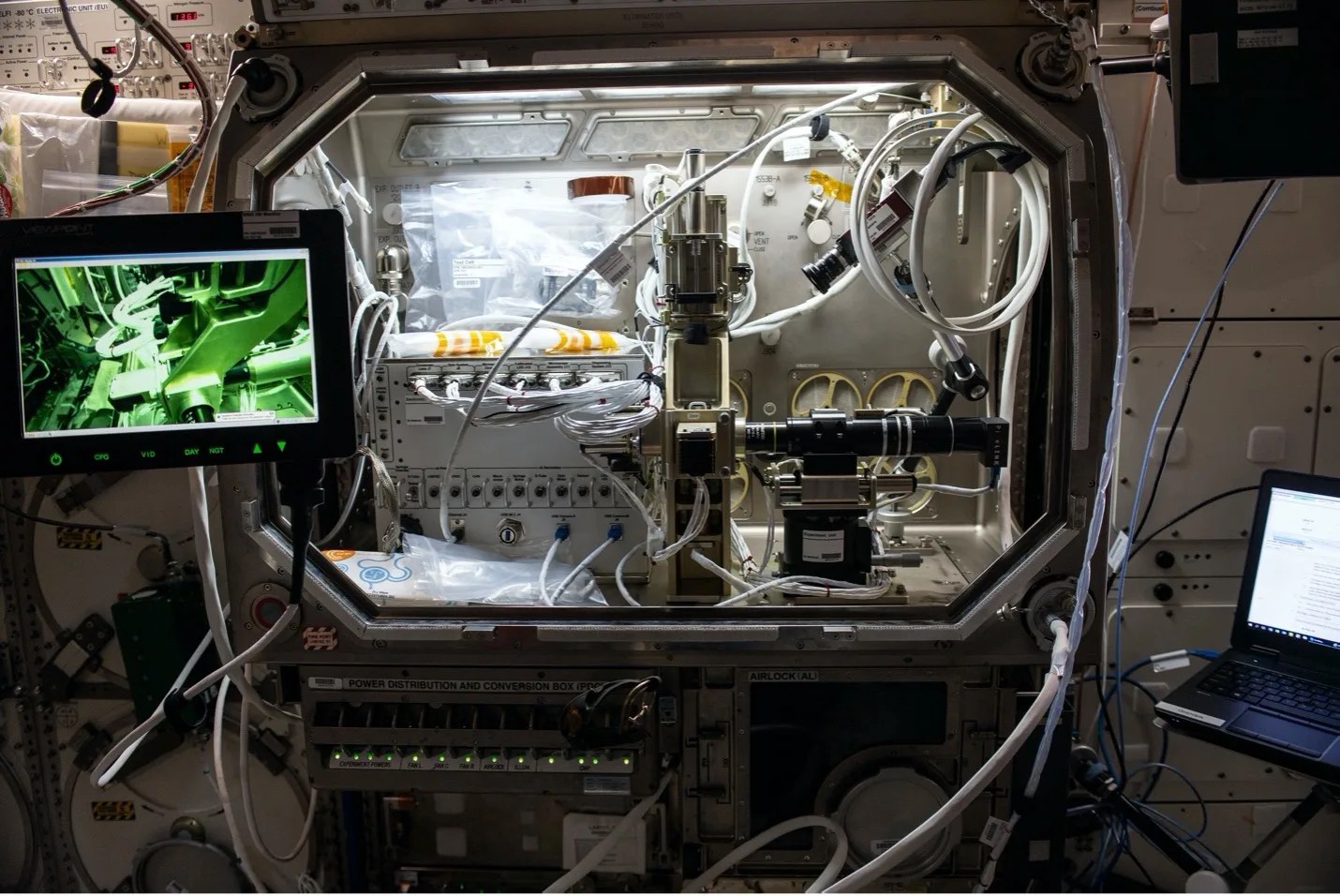
Adam and Hirsa Present Research on the Ring-Sheared Drop Abnormal fibrous, extracellular, proteinaceous deposits found in organs and tissues are associated with neurodegenerative diseases such as Alzheimer’s. (“Amyloid fibril formation in microgravity: Distinguishing interfacial and flow effects” NNX13AQ22G). The Ring Sheared Drop investigation studies the biophysics of protein amyloidogenesis in the absence of gravity in order to study fibril formation at fluid interfaces, in the absence of solid walls. NASAResearchers across Space Biology and Physical Sciences come together for a special presentation at the May PSI Users Group.
The Ring-Sheared Drop (RSD) is a Microgravity Science Glovebox experiment that launched in July 2019 to the ISS to study shearing flow in the absence of solid walls. The major goals of this project were to adapt and use the RSD module to develop and test predictive models of non-Newtonian flow of high-concentration proteins at the interface.
At the May Physical Sciences Informatics (PSI) User Group, Dr. Joe Adam, Research Scientist at Rensselaer Polytechnic Institute and University Payload Director of the RSD module, presented, “Protein Solution Hydrodynamic Studies in the Ring-Sheared Drop” detailing the history of RSD, research campaigns and data to be released in PSI. This investigation was led by Principal Investigator, Prof. Amir Hirsa of Rensselaer Polytechnic Institute.
The ring-sheared drop interfacial bioprocessing of pharmaceuticals-I (RSD-IBP-I) campaign aimed to study non-Newtonian interfacial hydrodynamics of the blood transport proteins bovine serum albumin (BSA) and human serum albumin (HSA) in microgravity. Specifically, scientific aims focus on the effects of protein primary structure (BSA or HSA), protein concentration and interfacial shear rate on microgravity fluid flow, measured using velocimetry of hollow glass microsphere tracer particles within protein samples. This campaign intended to confer improved understanding of interfacial protein flows in relation to physiology, the environment, and industry relevant to both spaceflight and Earth. Results from this line of research could have applications to in situ pharmaceutical production, tissue engineering, and diseases such as Alzheimer’s, Parkinson’s, infectious prions, and type 2 diabetes.
To encourage collaboration across common areas of BPS’s Physical Sciences and Biology research, PSI invited Ryan Scott, ALSDA lead Scientist, and members of the ADBR (Alz Disease & Brain Resilience) and Parkinson’s AWG subgroups to attendee this month’s meeting which fueled discussions and led to several connections. During the discussions the two relevant collaborative publications that were shared are:
McMackin, P., Adam, J., Griffin, S. et al. Amyloidogenesis via interfacial shear in a containerless biochemical reactor aboard the International Space Station. npj Microgravity 8, 41 (2022). doi.org/10.1038/s41526-022-00227-2 Nilufar Ali paper resulting in part from a collaboration within the Parkison’s AWG subgroupAli, N., Beheshti, A. & Hampikian, G. Space exploration and risk of Parkinson’s disease: a perspective review. npj Microgravity 11, 1 (2025). doi.org/10.1038/s41526-024-00457-6
Ring-Sheared Drop – Interfacial Bioprocessing of Pharmaceuticals(RSD-IBP-I) is now accessible in PSI. doi.org/10.60555/smat-bb74
Share
Details
Last Updated Jul 29, 2025Related Terms
UncategorizedExplore More
1 min read2025 NASA Space Apps Challenge
Article 22 hours ago2 min read
OSDR Chats with Begum Mathyk
Article 22 hours ago4 min read
Helio Highlights: June 2025
Article 2 weeks agoKeep Exploring
Discover Related Topics
Missions
Humans in Space
Climate Change
Solar System
Hence then, the article about adam and hirsa present research on the ring sheared drop was published today ( ) and is available on NASA ( Middle East ) The editorial team at PressBee has edited and verified it, and it may have been modified, fully republished, or quoted. You can read and follow the updates of this news or article from its original source.
Read More Details
Finally We wish PressBee provided you with enough information of ( Adam and Hirsa Present Research on the Ring-Sheared Drop )


Also on site :
- 1982 Steven Spielberg Tearjerker, Featuring One of the Saddest Movie Scenes Ever, Is Still Just as Powerful 44 Years Later
- Ana Luisa’s ‘Dainty’ Crystal Huggie Earrings Capture the Essence of ‘Minimalist Chic,’ Now on Sale at Nordstrom
- 1976 Rock Song, Written by Tom Petty After His Solo Deal Fell Apart, Launched One of Rock’s Greatest Bands