
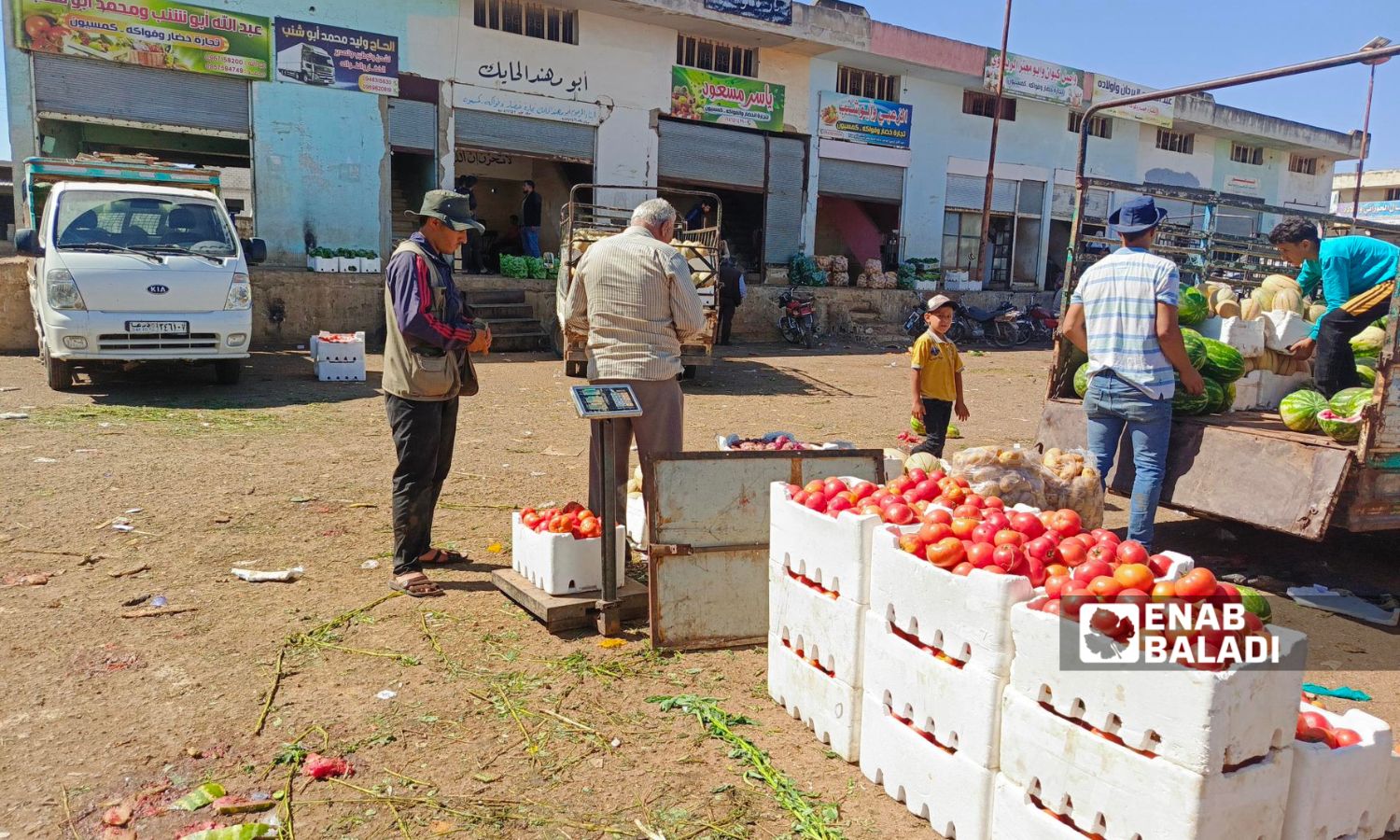
The tomato crop in Daraa, southern Syria—on which the governorate heavily relies—came in below production expectations this season due to several factors, most notably rainfall drought, disease outbreaks, and high summer temperatures.
Selling prices also failed to compensate farmers for their losses, as the price of a kilogram of tomatoes did not exceed 1,800 Syrian pounds—prices that do not even cover harvesting costs, according to several farmers interviewed by Enab Baladi.
Low Yields
Oday Shehab, a tomato farmer in the western countryside of Daraa, said the tomato yield came in lower than expected this season. Production per dunum (equivalent to 1,000 square meters) did not exceed three tons, whereas in previous seasons it had reached more than eight tons.
Shehab planted 12 dunums of tomatoes and estimated his loss this season at around 50 million Syrian pounds—approximately 5,000 US dollars.
Farmer Karem Abu Dahloosh said the drought impacted his crop, causing the growth of broomrape (Orobanche), a parasitic plant that harms tomatoes and thrives in drought years.
He added that he had to double the amount of fertilizer and irrigation from a nearby well to treat the broomrape. Abu Dahloosh estimated his yield at four tons per dunum, whereas in past years it approached ten tons.
Shrinking Acreage
The Daraa Agriculture Directorate estimated the governorate’s tomato production this season at 200,000 tons. In a statement to Enab Baladi, the Director of Agriculture, Ahed al-Zoubi, said the planned area for tomato cultivation in Daraa was 1,384 hectares, while 2,508 hectares were planted—an increase of 1,124 hectares over the agricultural plan.
The director attributed the drop in productivity to the lack of rainfall last winter, stressing that summer irrigation water cannot compensate for the loss of rain, which affects crop yields.
Agricultural Pests
Bassam al-Aqleh, a tomato farmer from the town of Koya in western Daraa countryside, said he had to apply pesticides—both insecticides and fungicides—more than five times this season.
He added that his debts to the agricultural pharmacy amounted to 5,000 US dollars, which he was unable to pay off this season.
For his part, Karem Abu Dahloosh said each 1,000-liter pesticide spray cost him around two million Syrian pounds, especially since unfamiliar diseases appeared in his crop this year.
Agricultural engineer Ezzedine al-Ahmad said he had observed the spread of the Tuta absoluta moth—a larva that feeds on tomato foliage, penetrates the fruit, and causes it to rot.
He explained that while the pest reproduces rapidly, it can be controlled with pesticides. However, farmers often do not follow proper spraying schedules, which leads to the pest becoming unmanageable.
He also reported cases of “sun scorch” affecting tomato crops, adding that chemical treatments were largely ineffective against its damage.
Director Ahed al-Zoubi said the agriculture department provides farmers with agricultural guidance and pheromone traps, which are used to detect pest numbers per square meter, based on which the need for pesticide spraying is determined.
Disappointing Prices
Several farmers interviewed by Enab Baladi reported no financial profit after tomato prices dropped below 2,000 Syrian pounds per kilogram on the local market, barely enough to cover harvesting costs.
Fouad al-Hourani, a commission agent at the Tafas wholesale market, attributed the decline in tomato prices to the halt in exports.
Previously, packaging facilities that prepared tomatoes for export would purchase large quantities from the market, which helped improve prices.
Al-Hourani noted difficulties in marketing the product, despite low production, as domestic trade to wholesale markets in other Syrian provinces also declined—especially to al- Zablatani market in Damascus—due to the influx of tomatoes from Aleppo, Idlib, Hama, Homs, and other governorates.
He added that the main outlet for Daraa’s tomato production is the local market, which cannot absorb the current supply.
Tomato processing plants also procure some of the produce, but only take ripe fruit at a rate of 1,000 Syrian pounds per kilogram, without packaging, and with them covering workers’ wages.
In a previous statement to Enab Baladi, the head of the Daraa Chamber of Commerce, Qassem al-Masalmeh, said that resolving the issue of agricultural oversupply and organizing exports lies in establishing cooperatives specialized in each type of crop—a system he referred to as contract farming.
He explained that the mission of these cooperatives would be to sign contracts with exporters and major distributors inside the country.
Al-Masalmeh justified the need for such cooperatives by pointing to the lack of transparent pricing policies at the wholesale markets (Sooq al-Hal), where prices are mainly set based on product volume without proper studies of actual yields. Cooperatives, he added, would plan cultivation based on their marketing capacities.
Losses and Recession in Tomato Crop in Daraa Enab Baladi.
Hence then, the article about losses and recession in tomato crop in daraa was published today ( ) and is available on ُEnabbaladi ( Syria ) The editorial team at PressBee has edited and verified it, and it may have been modified, fully republished, or quoted. You can read and follow the updates of this news or article from its original source.
Read More Details
Finally We wish PressBee provided you with enough information of ( Losses and Recession in Tomato Crop in Daraa )


Also on site :
- iPhone Duo Launches in Santa Barbara
- Starbucks China tells customers to buy something before they sit down, as it invests $45 million in the store experience
- 1999 Cult-Favorite TV Series Featured Van Halen, Rush, Styx—And Has the ‘Greatest Halloween Episode of All Time’