
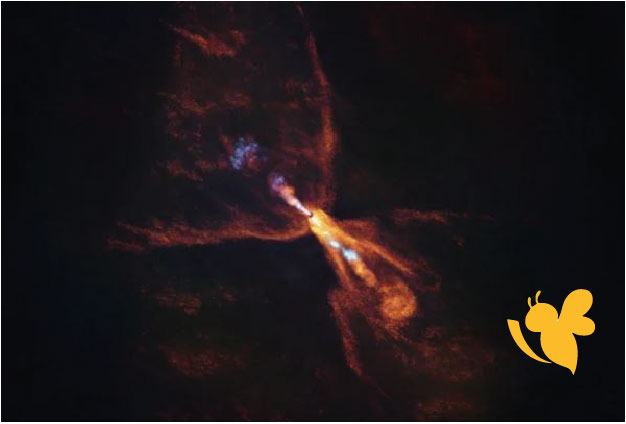
The observation of the birth of an alien solar system represents a significant milestone in the field of astronomy, shedding light on the processes that govern planetary formation beyond our own. Recent advancements in observational technology have enabled astronomers to capture detailed images of protoplanetary disks, which are crucial environments where new stars and their accompanying planets develop. These observations not only enhance our understanding of solar system formation but also provide insights into the potential for life beyond Earth.
Using combined observations from the James Webb Space Telescope (JWST) and the Atacama Large Millimeter/submillimeter Array (ALMA) in Chile, an international research team has glimpsed the earliest moments of planetary creation around the protostar HOPS-315, which lies in a giant star-forming region that is located about 1,400 light-years away in the constellation of Orion. Their findings appear in a study published on Wednesday in Nature.
Weighing in at 0.6 solar mass, HOPS-315 should someday grow to become a star much like our own sun; this makes it a promising stand-in for studying the first stages of our solar system’s history. For now, however, it’s shrouded by a vast and obscuring envelope of inflowing material—baby food for a hungry stellar newborn.
Astronomers have witnessed the birth of a planetary system that could one day resemble the solar system. The discovery offers scientists a proxy to study how our home planetary system formed around the sun around 4.6 billion years ago.
The team was able to pinpoint the moment specks of material that will one day forge planets began to form around the infant star HOPS-315, located around 1,300 light-years away.
The young protostar HOPS-315 is observed at infrared and millimetre wavelengths with the James Webb Space Telescope (JWST) and the Atacama Large Millimeter Array (ALMA), revealing a reservoir of warm silicon monoxide gas and crystalline silicate minerals low in the atmosphere of a disk within 2.2 au of the star, physically isolated from the millimetre SiO jet. Comparison with condensation models with rapid grain growth and disk structure models suggests the formation of refractory solids analogous to those in our Solar System. Our results indicate that the environment in the inner disk region is influenced by sublimation of interstellar solids and subsequent refractory solid recondensation from this gas reservoir on timescales comparable with refractory condensation in our own Solar System.
Read more
South Korea's top court acquits Samsung Chairman Lee in 2015 merger fraud case Google announces Pixel 10 launch event will take place on August 20th this year
Sara H


Also on site :
- This Comfy Shoe Brand Has Affordable Holiday Gifts for Everyone on Your List—From Golfers to Fashionistas
- WHO questions Russia: "If plague is ruled out, what did she actually die from?"
- Taylor Swift Ex Reportedly Tried to ‘Resolve Lingering Issues’ with Her Right Before Travis Kelce Wedding as the NFL Player Pushed Back on the ‘Painful’ Request