
4 min read
Linking Satellite Data and Community Knowledge to Advance Alaskan Snow ScienceSeasonal snow plays a significant role in global water and energy cycles, and billions of people worldwide rely on snowmelt for water resources needs, including water supply, hydropower, agriculture, and more. Monitoring snow water equivalent (SWE) is critical for supporting these applications and for mitigating damages caused by snowmelt flooding, avalanches, and other snow-related disasters. However, our ability to measure SWE remains a challenge, particularly in northern latitudes where in situ SWE observations are sparse and satellite observations are impacted by the boreal forest and environmental conditions. Despite limited in situ SWE measurements, local residents in Arctic and sub-Arctic regions provide a vast and valuable body of place-based knowledge and observations that are essential for understanding snowpack behavior in northern regions.
As part of a joint NASA SnowEx, NASA’s Minority University Research and Education Project (MUREP) for American Indian and Alaska Native STEM (Science, Technology, Engineering, & Mathematics) Engagement (MAIANSE), and Global Learning & Observations to Benefit the Environment (GLOBE) Program partnership, a team of scientists including NASA intern Julia White (NASA Goddard Space Flight Center, University of Alaska Fairbanks), Carrie Vuyovich (NASA Goddard Space Flight Center), Alicia Joseph (NASA Goddard Space Flight Center), and Christi Buffington (University of Alaska Fairbanks, GLOBE Implementation Office) is studying snow water equivalent (SWE) across Interior Alaska. This project combines satellite-based interferometric synthetic aperture radar (InSAR) data, primarily from the Sentinel-1 satellite, with ground-based observations from the Snow Telemetry (SNOTEL) network and GLOBE (Global Learning Observations to Benefit the Environment). Together, these data sources help the team investigate how SWE varies across the landscape and how it affects local ecosystems and communities. The team is also preparing for future integration of data from NASA’s upcoming NISAR (NASA ISRO Synthetic Aperture Radar) mission, which is expected to enhance SWE retrieval capabilities.
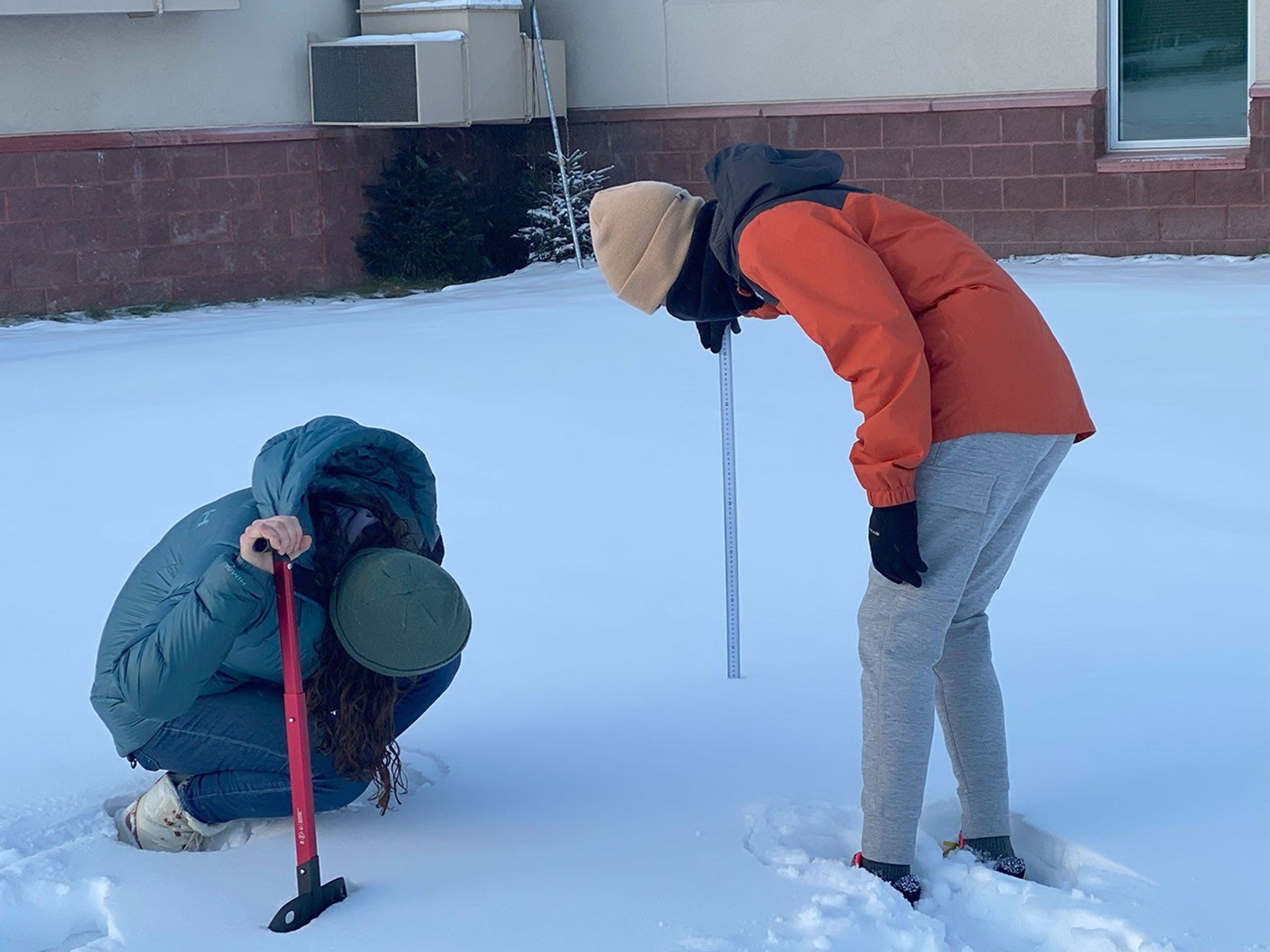
After a collaborative visit to the classroom of Tammie Kovalenko in November 2024, Delta Junction junior and senior high school students in vocational agriculture (Vo Ag) classes, including members of Future Farmers of America (FFA), began collecting GLOBE data on a snowdrift located just outside their classroom. As the project progressed, students developed their own research questions. One student, Fianna Rooney, took the project even further — presenting research posters at both the GLOBE International Virtual Science Symposium (IVSS) and both the FFA Regional and National Conventions. Her work highlights the growing role of Alaskan youth in science, and how student-led inquiry can enrich both education and research outcomes. (This trip was funded by the NASA Science Activation Program’s Arctic and Earth SIGNs – STEM Integrating GLOBE & NASA – project at the University of Alaska Fairbanks.)
In February 2025, the team collaborated with Delta Junction Junior High and High School students, along with the Delta Junction Trails Association, to conduct a GLOBE Intensive Observation Period (IOP), “Delta Junction Snowdrifts,” to collect Landcover photos, snow depth, and snow water equivalent data. Thanks to aligned interests and research goals at the Alaska Satellite Facility (ASF), the project was further expanded into Spring 2025. Collaborators from ASF and the Alaska Center for Unmanned Aircraft Systems Integration (ACUASI) collected high resolution airborne data over the snowdrift at the Delta Junction Junior and Senior High School. This complementary dataset helped strengthen connections between satellite observations and ground-based student measurements.
This effort, led by a NASA intern, scientists, students, and Alaskan community members, highlights the power of collaboration in advancing science and education. Next steps will include collaboration with Native Alaskan communities near Delta Junction, including the Healy Lake Tribe, whose vast, generational knowledge will be of great value to deepening our understanding of Alaskan snow dynamics.
Learn more about how NASA’s Science Activation program connects NASA science experts, real content, and experiences with community leaders to do science in ways that activate minds and promote deeper understanding of our world and beyond: science.nasa.gov/learn/about-science-activation/
Julia White and Delta Junction student following GLOBE protocols for snow depth. Tori BrannanShare
Details
Last Updated Jul 14, 2025 Editor NASA Science Editorial Team Location Goddard Space Flight CenterRelated Terms
Earth Science Goddard Space Flight Center MUREP Science ActivationExplore More
2 min readHubble Snaps Galaxy Cluster’s Portrait
Article 3 days ago7 min read
NASA’s Parker Solar Probe Snaps Closest-Ever Images to Sun
On its record-breaking pass by the Sun late last year, NASA’s Parker Solar Probe captured…
Article 4 days ago8 min read
NASA’s Webb Scratches Beyond Surface of Cat’s Paw for 3rd Anniversary
Article 4 days agoKeep Exploring
Discover More Topics From NASA
James Webb Space Telescope
Webb is the premier observatory of the next decade, serving thousands of astronomers worldwide. It studies every phase in the…
Perseverance Rover
This rover and its aerial sidekick were assigned to study the geology of Mars and seek signs of ancient microbial…
Parker Solar Probe
On a mission to “touch the Sun,” NASA’s Parker Solar Probe became the first spacecraft to fly through the corona…
Juno
NASA’s Juno spacecraft entered orbit around Jupiter in 2016, the first explorer to peer below the planet’s dense clouds to…
Hence then, the article about linking satellite data and community knowledge to advance alaskan snow science was published today ( ) and is available on NASA ( Middle East ) The editorial team at PressBee has edited and verified it, and it may have been modified, fully republished, or quoted. You can read and follow the updates of this news or article from its original source.
Read More Details
Finally We wish PressBee provided you with enough information of ( Linking Satellite Data and Community Knowledge to Advance Alaskan Snow Science )


Also on site :
- The Zodiac Killer shot cab driver Paul Stine in 1969, the last of his five confirmed murders; San Francisco police marked the case inactive in 2004, then reopened it and still list it as open
- After Kelly Clarkson Slams Brooklyn Novelty Store, Shop Says the ‘One-of-a-Kind’ Singing Animatronic Bird She Wanted Wasn’t Actually For Sale
- Hit FOX Reality Show Moves to Dangerous New Location For Season 3; Uses More Cameras Than the Super Bowl