
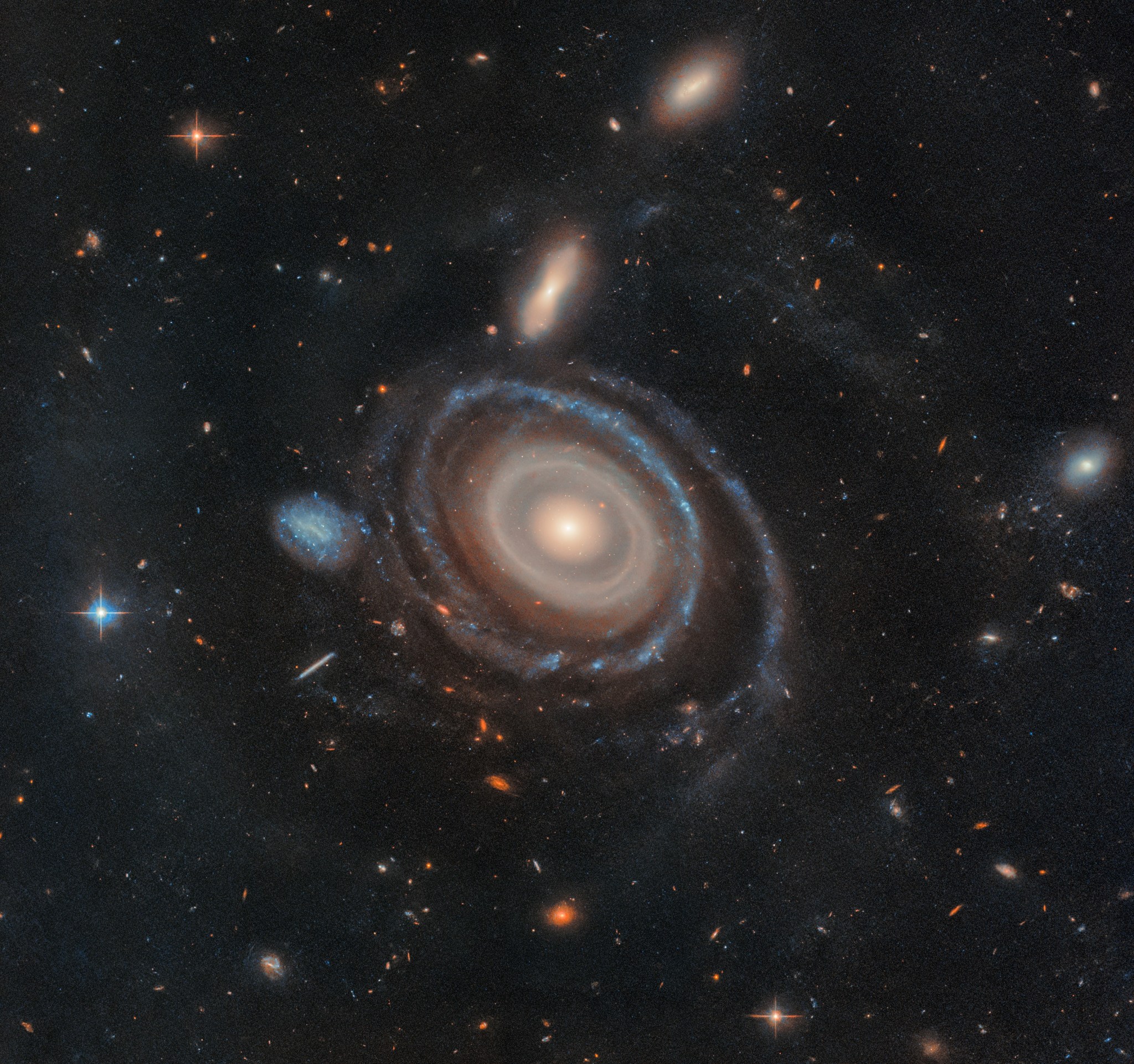
This image from NASA’s Hubble Space Telescope, released on Feb. 4, 2025, shows the gargantuan galaxy LEDA 1313424, aptly nicknamed the Bullseye. A far smaller blue dwarf galaxy went through the Bullseye’s center, leaving nine star-filled rings. Astronomers using Hubble identified eight visible rings, more than previously detected by any telescope in any galaxy, and confirmed a ninth using data from the W. M. Keck Observatory in Hawaii. Previous observations of other galaxies show a maximum of two or three rings.
Hubble and Keck’s follow-up observations also helped the researchers prove which galaxy plunged through the center of the Bullseye — a blue dwarf galaxy to its center-left. This relatively tiny interloper traveled like a dart through the core of the Bullseye about 50 million years ago, leaving rings in its wake like ripples in a pond. A thin trail of gas now links the pair, though they are currently separated by 130,000 light-years.
Read more about this “serendipitous discovery.”
Image credit: NASA, ESA, Imad Pasha (Yale), Pieter van Dokkum (Yale)
Hence then, the article about bullseye was published today ( ) and is available on NASA ( Middle East ) The editorial team at PressBee has edited and verified it, and it may have been modified, fully republished, or quoted. You can read and follow the updates of this news or article from its original source.
Read More Details
Finally We wish PressBee provided you with enough information of ( Bullseye! )


Also on site :
- APOD: 2026 September 23 – A New Lunar Crater: McGetchin
- The Seemingly Harmless 4-Word ‘I’ Statement That’s Actually a Massive Relationship Red Flag, According to a Psychologist
- Kit Harington Thinks There Still Could Be A Jon Snow Spinoff, Says He Now Feels More Comfortable With ‘GOT’ Character