
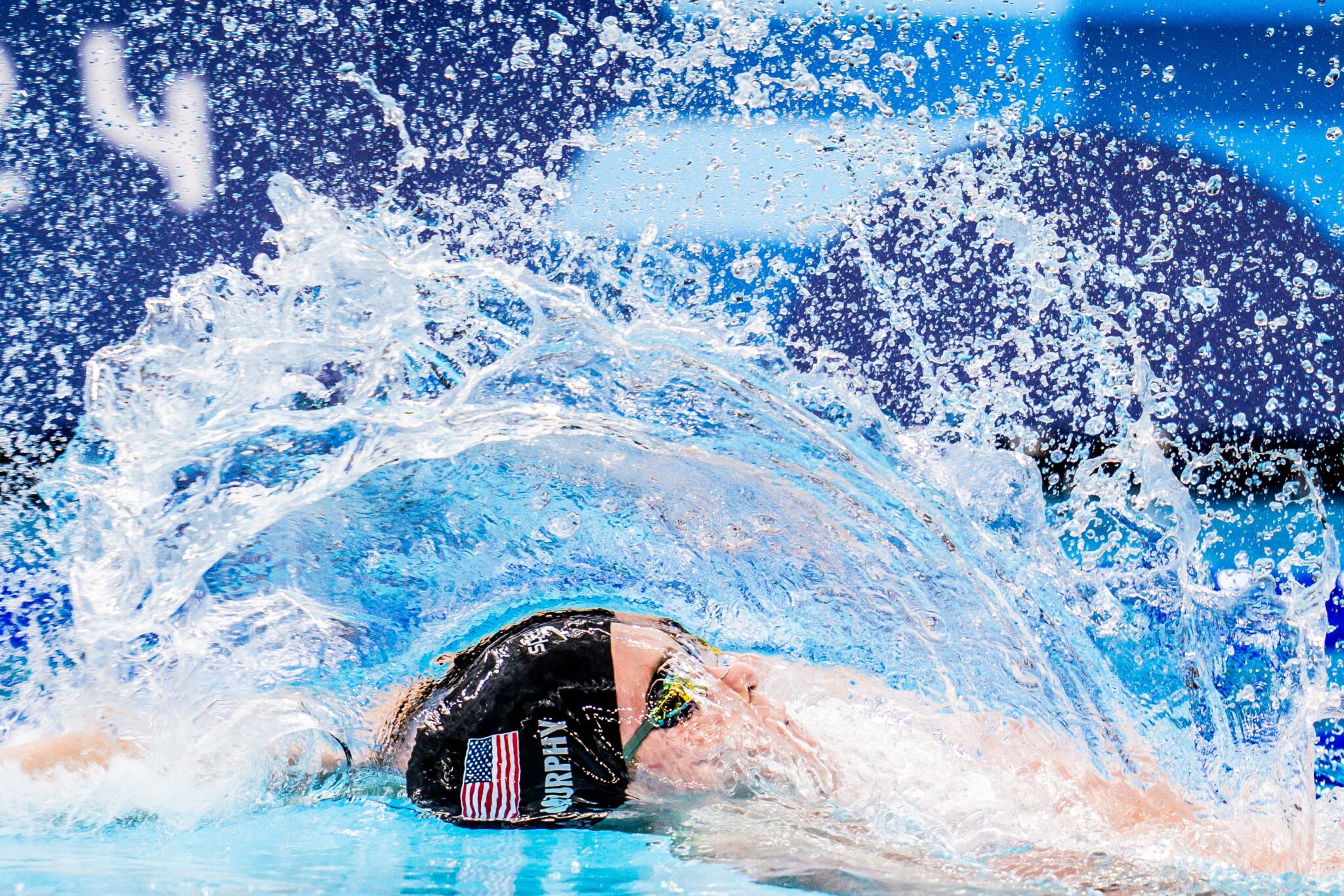
By Olivier Poirier-Leroy on SwimSwam
Want to improve your sprint backstroke speed?
(Be rude not to!)
Whether you’re looking to drop time in the 50 and 100 backstroke, swimming faster requires explosive power, high stroke rates, proper technique, and whole lot of thunderkicking speed coming off of the walls.
But where to start? What should you focus on at the pool today to crank up the velocity on your back?
Fortunately enough, research into elite backstroke swimming gives us some pretty good clues about what separates the fastest swimmers from the rest of the pack.
From cranking up tempo to training with resistance, here are six evidence-based ways to improve backstroke speed.
Increase tempo
Faster backstroke sprinting starts with a higher stroke rate—getting the arms moving more rapidly without tanking distance per stroke.
Fernandes et al. (2022) compared elite and lower-level backstrokers when doing 25s of max backstroke. Both groups used the same stroke length—~1.9m per stroke cycle—but the elites used a stroke rate that was 15.5% higher.
Metric Elite Backstrokers Good-level Backstrokers Stroke Rate 49.2 cycles/min 42.6 cycles/min Stroke Length 1.88m/stroke cycle 1.90 m/stroke cycle Swim Speed 1.54m/s 1.35 m/sThe key is that elite backstrokers weren’t spinning out and sacrificing stroke length to hit those higher tempo numbers. They were cycling the arms faster while also maintaining distance per stroke.
To increase backstroke swim speed, focus on working a higher turnover without letting the stroke fall apart. Spinny arms are great and toss up a lot of white water, but not great if you aren’t holding any water.
Smaller propulsive gaps between the strokes
Backstroke and freestyle share some movement features—alternating arms, flutter kicking, rotating along the long axis, and using a distinct catch-up stroke timing at submax speeds.
At sprint speeds, freestylers are able to take their stroke into superposition, where propulsive phases overlap. Backstrokers tend to maintain a catch-up pattern when engaging sprint mode, but faster backstrokers reduce the gaps between propulsive phases, creating more continuous forward propulsion.
Fernandes et al.’s comparison of elite and non-elite backstroke sprinting showed that the faster swimmers had less dead spots in the stroke.
They weren’t using a ton of stop-and-go in their strokes, and instead had more consistent forward propulsion.
Index of Coordination* Elite Backstrokers -8.4% So-So Level Backstrokers -11.2%* = Index of Coordination measures the timing between the propulsive phases of each arm. The more negative the value, the more catch-up in the stroke. The closer to zero, the smaller the gap.
Both groups used a catch-up stroke, but elite swimmers did it less and had smaller gaps between propulsive actions of each arm.
Accelerate the hand exit
Faster backstrokers spend less time getting their hands out of the water. Quite literally—as the pull/push ends, and your hand is about to exit the water and recover through the air.
Lerda and Cardelli (2003) compared the stroke technique of good and not-good backstrokers and saw that faster backstrokers spent much less of each stroke cycle during the hand exit (19.2% versus 29.1%).
Faster backstrokers also spent more time in the entry and catch phases, setting up a more boom-boom pull.
When sprinting, not lingering in the hand exit makes sense. You aren’t creating propulsion any longer, and the more time you spend there is less time you are spending pulling. Finish the push phase of the stroke crisply, get the hand out of the water, and charge into the next stroke more quickly.
More explosive underwaters
Backstrokers spend a lot of time under the surface doing dolphin kick. This is pretty obvious in short course pools, where a start and three walls can easily lead to over half the race being spent underwater.
Even in the long course pool, elite backstroke sprinters dolphin kick a lot.
At the Paris Olympics in 2024, for example, the men’s finalists in the 100m backstroke nearly maxed out allowable distance for underwaters. Off the start they averaged 14.6m underwater and 13.1m off the turn.
Sprint backstrokers should focus on developing a dolphin kick that is powerful and leads them to the surface with lots of speed. Veiga and Roig (2016) noted that elite backstrokers time their breakout so that they surface faster than mid-pool swimming speeds.
To improve your underwater dolphin kick:
Improve undulation by methodically working the timing of the trunk, hips, legs, and feet to create a powerful body wave Add tethered dolphin kick sets to your training to improve kick power Use a kick count in practice to make dolphin kicking automatic“If you don’t apply it every time, it won’t pay off in a race,” says Ryan Murphy, Olympic, NCAA, and Worlds gold medalist.
Improve core strength
The core is essential for fast swimming—it stabilizes the trunk, transfers force up and down the body, and gives backstrokers more control over body roll.
At sprint speeds, this roll can get real speedy.
Gonjo et al. (2021) examined body roll in competitive swimmers at four different intensities:
83% 88% 93% 100%As backstroke speed went up, stroke rate jumped by nearly 50%. But shoulder, hip, and whole-body roll amplitudes remained relatively consistent.
In other words, sprint backstroke meant swimmers were using the same amount of body roll, but doing it much faster.
This velocity of roll requires a lot of effort from the core, which is tasked with accelerating and decelerating the trunk, stabilizing the body, and transferring force up and down the body to achieve those high stroke rates and rapid body roll.
Which means:
Anti-rotation core training. Build the ability to resist unwanted rotation and maintain trunk control as the arms spin up. Deep core stability. Strengthen the muscles responsible for stabilizing the spine, creating a more stable platform. Rotational strength and power. Power up the violent deceleration and acceleration.The result is a stronger, more stable trunk that can better support the crispy roll and high stroke rates that sprint backstroke demands.
Use resisted sprinting
The most straightforward way to improve backstroke sprint speed—that also naturally helps with many of the points listed above—is to add some resisted sprinting to your training.
Grab a drag chute, buckle into a tether, pour a bunch of 45lb weight plates into the buckets on your power tower and get to work.
Resisted sprinting overloads the muscles directly responsible for propulsion (about as “swim-specific” as it gets), forcing you to generate more force with each stroke to conquer added load.
See also: 5 Resisted Sprint Sets for Building Tons of ForceWhile most resisted sprint research is with freestylers, Mavridis et al. (2006) showed that using resistance in the water works across all four strokes, including backstroke.
Swimmers improved 10m backstroke sprint performance by 7.9% while the control group—who did the same sprint sets but without resistance—improved just 1.0%.
10m Backstroke Sprints Before After Improvement Resisted group 7.48s 6.89s 7.9% Control group 7.68s 7.60s 1.0%Of course, getting faster with resistance requires a little more planning and precision than just making swimming harder.
So:
Keep reps short and explosive. Focus on 10-25m efforts with max intent and speed. Load properly. Load affects what you are training. Going really heavy primarily works force, moderate loads are power-centric, and light resistance is great for working mechanics and transfer. Rest enough to maintain power. Give yourself 2–3 minutes between hard resisted efforts so each rep is explosive instead of conditioning work. Protect your stroke rate. Turnover runs through most of this article, and for good reason. Higher stroke rates generally mean faster swimming, but it’s critical to remember that stroke rate also drives coordination. Avoid letting heavy resistance turn your sprint backstroke into a slow, disconnected grind.(Want to take the guesswork out of resisted swim training? My book, Resisted Sprint Training for Swimmers, breaks it all down, from choosing the right resistance loads and building high-performance sprint sets to mastering the stroke-specific technique that makes resisted training work for backstrokers. Check it out below.)
Wrapping Things Up
Faster backstrokin’ is a finely-blended mix of producing more propulsion, increasing turnover, adapting technique to the demands of speed, and nailing your underwaters.
Pick 1-2 areas where you see lots of runway for improvement, make a point to focus on them at practice, and steadily press the accelerator on your backstroke velocity.
Want to Get Faster with Resisted Sprint Training?
Olivier Poirier-Leroy is a former national-level swimmer, two-time Olympic Trials qualifier, and author of several high-performance guides for swimmers, including his newest, Resisted Sprint Training for Swimmers.
Working your tail off against a drag chute or power tower but not seeing the results on the clock? Stuck at a speed plateau? Unsure how much resistance to use or which sets will actually make you faster?
Resisted Sprint Training for Swimmers shows you how to choose the right loads, build explosive power, break through speed plateaus, and turn resisted training into race-day speed.
Backed by 100+ scientific studies, with 40+ ready-to-use sprint sets and eight structured training plans to put it all into action.
Get your hands on the complete resisted sprint training guide today.
Read the full story on SwimSwam: How to Improve Sprint Backstroke Speed (6 Proven Tips)
Hence then, the article about how to improve sprint backstroke speed 6 proven tips was published today ( ) and is available on swimswam ( Middle East ) The editorial team at PressBee has edited and verified it, and it may have been modified, fully republished, or quoted. You can read and follow the updates of this news or article from its original source.
Read More Details
Finally We wish PressBee provided you with enough information of ( How to Improve Sprint Backstroke Speed (6 Proven Tips) )


Also on site :
- Arsenal vs Man City Combined XI: Gunners dominate as Martin Odegaard, Riccardo Calafiori & Jeremy Doku miss out
- Stony Brook vs. Delaware Prediction: Spread, Total Points, Moneyline Picks – Saturday, November 28, 2026
- Spurs fan shoves Luka Doncic in wild exchange after Lakers star flings headband in frustration