
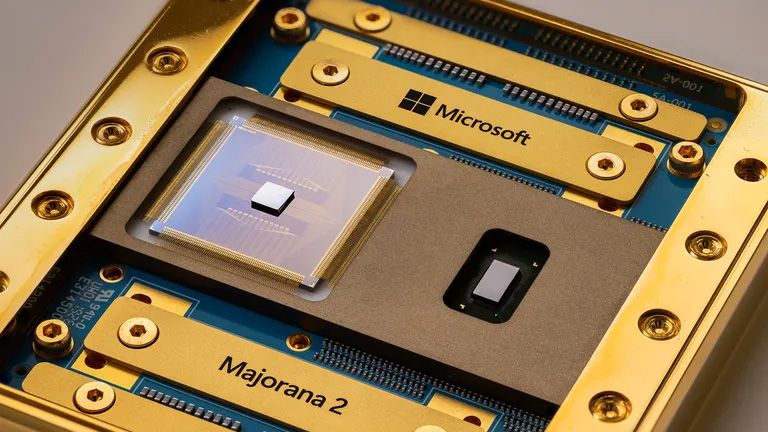
Microsoft scientists have doubled down on their controversial Majorana 2 quantum computing platform after encountering pushback for saying its "topological qubits" were powered by an enigmatic subatomic particle. In August of 2025, they said they would field a scalable, fault-tolerant quantum computer by 2033 — years ahead of schedule.
Now, after opening a new lab at the University of Maryland and partnering with the Defense Advanced Research Projects Agency (DARPA) to conduct hardware validation, Microsoft has moved up this timeline to 2029.
The company's confidence is based on research suggesting that Majorana 2 represents a generational breakthrough in quantum computing. Scientists first announced that they had created this new qubit in a study published in the journal Nature in February 2025. Then, they followed up by announcing the Majorana 2 platform in a preprint study published this past June.
If verified, the prototype quantum processor would give Microsoft a commanding lead in the race to build a fault-tolerant, universal quantum computer, given that scientists said it can maintain a quantum state for much longer than alternative platforms. But some experts in the quantum physics community dispute the company's claims, suggesting that the qubit modality is highly experimental and had never been demonstrated in a working quantum computer prior to Microsoft's 2025 announcement.
Microsoft started its quantum computing program in 2005 after mathematician Michael Freedman convinced company leadership that conventional quantum architectures would eventually hit a brick wall. He advocated for a radical new approach to quantum computing based on a mathematical concept known as topological quantum field theory (TQFT). TQFT is a branch of theoretical physics and mathematics in which physical observables do not depend on local geometry (such as distances, curvature or angles) of space-time but rather on global topology.
Essentially, in TQFT, local geometry can change without disrupting qubits because its topology remains invariant. This feature of the theory is very attractive to hardware developers because it could yield qubits that are extremely resilient to disturbances such as atmospheric noise and perturbation. By contrast, conventional modalities, such as superconducting qubits, are perturbed pretty easily.
Microsoft subsequently built the first Majorana platform, named after theoretical physicist Ettore Majorana —who in 1937 hypothesized the existence of particles that act as their own antiparticles — to explore the use of TQFT in quantum computing.
If Microsoft's internal data holds up against DARPA's scrutiny, Freedman's theoretical bet may finally be paying off. According to internal research, Majorana 2 creates qubits that last between 20 seconds and a minute. By contrast, conventional qubits tend to last only microseconds.
Why Microsoft encountered pushback
In 2018, a research team that included Microsoft research scientist Roman Lutchyn published a study in the journal Nature Reviews Materials in which they claimed to have observed compelling evidence of Majorana "zero modes" — ostensibly demonstrating the existence of the theoretical Majorana quasiparticle.
However, when the data was released to reviewers in 2019, several noteworthy physicists raised objections centered on allegations of data trimming, confirmation bias and the potential misidentification of trivial electrical noise as exotic physics. That study was retracted in 2021, after the authors conceded that some of their methodology may have been flawed.
In the new study from June, Microsoft's claims were even bolder. The new study’s authors wrote that they observed physics indicating qubits built with the Majorana platform could last "orders of magnitude longer than typical qubit operation times."
(Image credit: Bloomberg via Getty Images)The study was received with skepticism by many of the same critics of the 2018 research paper. The most common criticism, based on those that have been published, is that Microsoft researchers didn't operate a working qubit but instead tracked how long an electron state sits undisturbed before a stray charge flips its parity. The critics noted that measuring an electron's parity state isn't analogous to measuring a qubit's reliability.
Alex Khan, vice president of quantum research and development at physics acceleration firm BQP and a fellow at the University of Maryland QLab, dismissed much of the ballyhoo surrounding the Majorana research papers, comparing nascent quantum computing efforts such as Microsoft's to the Wright brothers' early airplane trials: There were only a few people there, and the aircraft went just a short distance. "And you could have had a lot of people sitting there saying, 'You know, this is never going to really do anything’,'" Khan, who wasn't involved in the Majorana 2 research, told Live Science.
When it comes to quantum computing breakthroughs, he took a more utilitarian view. "I've used a lot of quantum computers, but in order for me to use a quantum computer, it needs to be available," he said. "My most important thing is, can I have access to the computer? What kind of algorithms can I run on it? What can I test or what can I benchmark? What kind of capability will this provide? And does it begin to show some of the quantum advantage that's coming out of the quantum computer versus a simulator?"
Determining whether Microsoft or its critics are correct isn't as simple as running the team's experiments on another system. Microsoft is building Majorana 2 from scratch, one engineering feat at a time, Zulfi Alam, corporate vice president of Azure Quantum at Microsoft, told Live Science in an interview.
"The secret sauce is that we build our devices atom by atom, and that reduces disorder dramatically," Alam said.
Despite the back-and-forth between Microsoft and its critics, the question of whether the company has leapfrogged its competitors on the journey to build fault-tolerant, useful machines remains.
But with the topological qubits, they might know how to read the topological state, but then the question is, what are they reading? Also, is it able to store quantum information? Is it able to build a quantum state?
Alex Khan, vice president of quantum research and development at physics acceleration firm BQP
The U.S. government might be able to validate Microsoft's claims. The company will be included in DARPA's Quantum Benchmarking Initiative, which seeks to determine whether it's possible to build an industrially useful quantum computer by 2033. From now until 2029, the government will evaluate Majorana and Microsoft’s timeline to establish a framework for testing quantum computing claims.
In support of this endeavor, Microsoft is building a quantum computing lab at the University of Maryland so DARPA researchers can conduct their own hands-on evaluation of the hardware.
Khan described the partnership as "exciting," adding that he hopes DARPA can help determine the system's capabilities. "The physics is already known now," he said. "But with the topological qubits, they might know how to read the topological state, but then the question is, what are they reading? Also, is it able to store quantum information? Is it able to build a quantum state?"
If DARPA validates the biggest Majorana 2 claims, not only will Microsoft be vindicated, but the QBI team will have demonstrated their capabilities at the furthest frontiers of quantum computing research.
Alam said Microsoft is looking forward to the challenge. He described the shift in focus from theoretical science to "productizing" results as a focusing mechanism. DARPA has a team of about 50 engineers who are looking at the results and operating the machine at the University of Maryland, he noted.
"We have this deliverable for DARPA, and every six months or so, we have these massive deliverable dumps that we are giving to them," Alam said. "They know everything about our program."
Changing the quantum game
Essentially, Microsoft's claims indicate that Majorana 2 solves most of quantum computing's biggest bottlenecks.
Designing reliable qubits is often cited as quantum computing's greatest challenge — and to solve problems at the edges of cryptography, chemistry and physics, we'll need quantum computers capable of fielding millions of qubits.
The first bottleneck is hardware. Scaling current systems such as those developed by IBM, Google and other quantum hardware labs requires scaling infrastructure in lockstep. Superconducting and spin qubits, for example, both need dedicated analog microwave lines for each physical qubit. This equates to millions of physical cables per computer.
If Majorana 2 works as Microsoft scientists claim, the cable problem goes away because its qubits can be controlled digitally via an integrated processor core that needs only a few connecting wires.
The next bottleneck that Majorana 2 solves is the massive qubit counts required to conduct useful calculations. Majorana 2 purportedly produces exponentially more reliable qubits than other platforms do, which promises a dramatic reduction in the number of error-correcting qubits needed to run a stable quantum computing system.
As Alam put it: "Our own internal teams thought we would need 16 million qubits to look at Shor's algorithm.” This is in reference to a commonly used encryption algorithm that it’s believed would take a classical computer years to crack while a sufficiently powerful quantum system is hypothesized to reduce that time to months or even hours.
Exclusive to Live Science ProAn Anthropic mathematician claims to have proven the Riemann hypothesis. We have to rethink how we reward expertise.What if space and time don't exist? Physicists are chasing hints that our reality emerges from something deeperCould AI ever build itself? Scientists map the road to the 'last AI built by humans.'
"Since then," he added, "we have been able to publicly refine our estimates and think that we need more like 600,000 to 400,000 qubits."
Joseph Kearney, chief strategy officer and post-quantum cryptographer at Quantum Future in the U.K. who was not involved in the research, said that, if verified, Microsoft's Majorana 2 would revolutionize the field of quantum computing and shorten the timelines for quantum advantage in complex fields of study by years.
"If Microsoft had genuinely solved error correction, the 2035 deadline would no longer be credible,” he told Live Science in an email. "A breakthrough of this kind would remove our warning period, the clock is already running. Data intercepted today can be decrypted in the future, and Microsoft's claims, if they hold, would bring that future considerably closer than most organizations have planned for."
Help us improve Live Science Pro: We're always trying to make our content better. Leave us feedback about Pro here.
Hence then, the article about darpa is assessing microsoft s controversial quantum computing technology what will happen if the majorana 2 platform is vindicated was published today ( ) and is available on Live Science ( Middle East ) The editorial team at PressBee has edited and verified it, and it may have been modified, fully republished, or quoted. You can read and follow the updates of this news or article from its original source.
Read More Details
Finally We wish PressBee provided you with enough information of ( DARPA is assessing Microsoft's controversial quantum computing technology. What will happen if the Majorana 2 platform is vindicated? )


Also on site :
- Hallmark’s New Christmas Movie Asks What Happens When Santa Delivers Your Childhood Wishes 20 Years Late
- Rowdy ’60s Rockers Banned From Touring the U.S. for 4 Years Just Named One of the Greatest Bands of the British Invasion
- Lands’ End’s Zip Canvas Tote Is a ‘Stunning Bag of the Highest Quality Materials,’ and It Comes in 37 Styles