
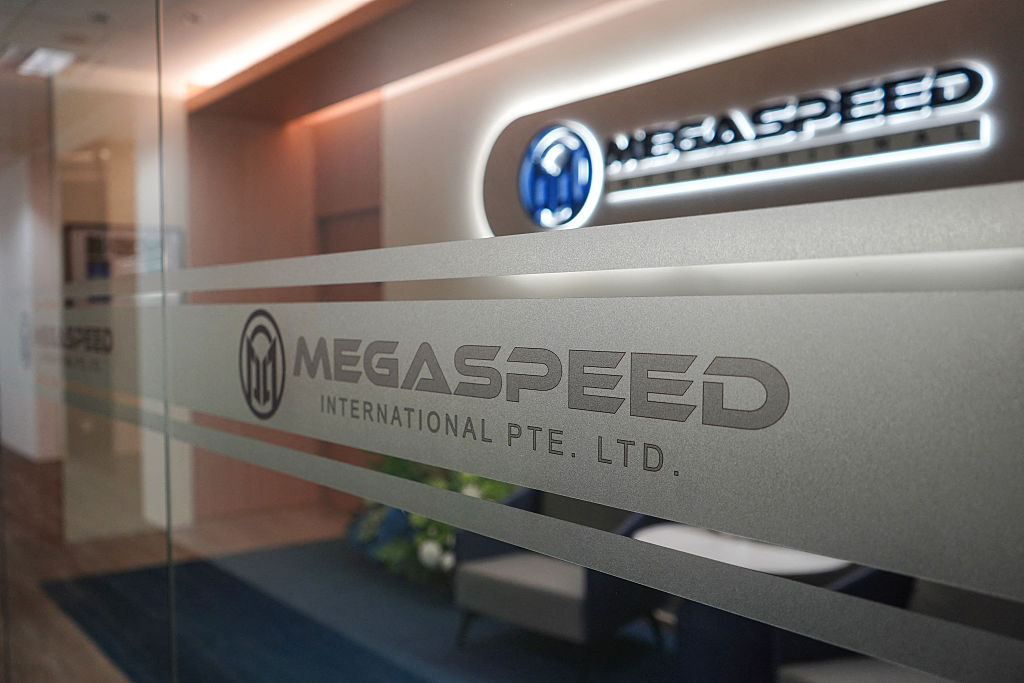
Megaspeed, the Singapore-based company that became one of NVIDIA’s largest clients in Southeast Asia, grew out of a corporate network with links to Chinese state entities that should have raised “red flags” for NVIDIA and its partners, according to experts in international finance and Chinese corporate governance.
Corporate records and open-source data obtained by TIME reveal that Megaspeed had a complex financial and corporate structure that obscured ties between three separate Chinese state entities and Megaspeed’s former parent company, 7Road Holdings Ltd. While the total investment from Chinese state entities amounted to a small minority stake, it was enough to qualify 7Road as a “state-invested enterprise” under Chinese law.
A review of the convoluted maze of holdings shows that the affiliated companies share directors, registered addresses, and common naming conventions—patterns that experts say should have been noted by the U.S. Commerce Department, NVIDIA, and banks doing due diligence on the U.S. chipmaker’s sales to Megaspeed.
“Nvidia should know who it's doing business with because of the reasons for sanctions,” says Jason Sharman, a professor of international relations at Cambridge University and an expert in China and offshore finance. “If that involves looking all the way through to the end of the chain, that's something they should do, and at least that's something they're legally required to do.”
Megaspeed, a computing company registered in Singapore with operations in Malaysia, was rebranded in 2023, shortly before it emerged as a key NVIDIA partner, and before Alice Huang, a Megaspeed executive, began her affair with NVIDIA chief Jensen Huang. The data obtained by TIME on its corporate structure was initially collated by Quantifind, an AI-powered risk intelligence company.
“Megaspeed’s historical ownership connections to Chinese entities, the involvement of offshore holding companies, and the subsequent changes in its corporate structure raise legitimate questions about the extent of its independence,” says Graham Bailey, who spent over a decade in financial crimes analytics and compliance at Wells Fargo, and is chief operating officer at Quantifind. “These connections do not, by themselves, establish wrongdoing or continued control. But they underscore why examining ownership records alone is insufficient.”
NVIDIA, 7Road, and Megaspeed did not respond to a list of questions requesting comment.
Prior to Megaspeed’s 2023 rebrand, its parent company, 7Road Holdings Ltd., received indirect minority investment from three Chinese state entities: The State Council (China’s central government cabinet), the Wuhan State-owned Assets Supervision and Administration Commission (an agency of local government), and the Hubei Provincial People's Government, according to corporate records TIME reviewed.
In total, these Chinese entities held an indirect 1.9% stake in 7Road Holdings Ltd., Megaspeed’s former parent company. It is unclear if the remaining 98% hold any further Chinese state investment. The minority investment arrived via an offshore entity registered in the British Virgin Islands, which was owned by a Chinese state-linked fund called Shanghai Baohu Investment Management Center.
The links were buried in a complex matrix of corporate entities and name changes. Megaspeed was separated from 7Road Holdings Ltd via a series of corporate handovers. In March 2023, its Hong Kong arm, 7Road International HK Ltd, transferred away the Singapore company 7Road International Pte Ltd to an offshore entity in the British Virgin Islands called Huang Le Ltd, named after Alice Huang. The original Singapore company was renamed Megaspeed.
“The ownership appears complicated by design, not accident,” said Justyna Gudzowska, a former U.S. Treasury sanctions official, and executive director of the anti-corruption organisation The Sentry. “The multiple layers of companies; successive ownership changes; indirect, historical connection to a minority Chinese state invested entity; and overlapping directorships and office addresses are red flags that would have warranted enhanced due diligence on the part of any U.S. company doing business with Megaspeed.”
An expert in international finance who formerly worked for a large American financial institution told TIME that if the Chinese connection were known, it would have made Megaspeed a “risky client” and led to a risk intelligence report being commissioned by any US bank doing business with it to uncover such red flags.
The red flags
Five different entities across this matrix of companies share a naming convention: their monikers begin with trees or plants (Maple, Poplar, Hawthorn, Malus, Osmanthus), and end with “Vale.” The network’s footprint stretches from southeast Asia—spanning Singapore, Hong Kong, China, and Malaysia—to the Caribbean, with entities incorporated in the mostly opaque jurisdictions of the British Virgin Islands and the Caymans.
In two cases, these companies share addresses. In the first, businessman Kang Wei (Alice Huang’s associate, and the builder of a billion-dollar AI data-center network in China) was linked to one “Vale” company which shared the same Hong Kong address with 7Road's international HK.
In the second, Megaspeed’s Malaysian subsidiary, Speedmatrix, allegedly conducted business with Apex Enterprise Solutions, a company that reportedly functioned as an Alibaba procurement unit—and also shared the same address as Alibaba’s local offices. Alibaba was added to the Pentagon blacklist in June this year, restricting the military and defense contractors from doing business with it, due to its alleged links to the Chinese military.
One of the figures that emerges from this complicated web of holdings is a little known Singaporean businessman named Tan Yong Pong, who goes by James. He is the current director of Megaspeed, and also reportedly a director of Speedmatrix, which is linked to Alibaba.
In November 2023, after a corporate reshuffle, Huang Le Ltd sold its stake in Megaspeed to Swiftdata, which remains its owner today. Tan is linked to both Megaspeed and Swiftdata.
This complex structure is common for Chinese companies. It's at least as much for escaping Chinese regulations as for “hoodwinking the outside world,” opines Sharman. “But of course it does have the added benefit that it can make it difficult for foreigners to work out who actually owns this thing.”
China is now one of the largest users of offshore vehicles, according to two experts. “Offshore holding companies are often used to obfuscate the true ‘beneficial owners,’" John Cassara, who spent six years with the U.S. Treasury Department’s Financial Crimes Enforcement Network (FinCEN), wrote in an email. “That is the intent. They want to make it as difficult as possible for investigators (and perhaps journalists) to follow the money trail.”
NVIDIA’s due diligence
Nvidia’s compliance team told the New York Times last year it had looked into Megaspeed and determined it was “wholly owned and operated by a company based and headquartered outside China, with no China shareholders”.
Jodi Vittori, a Georgetown University professor specializing in corruption, illicit finance, and U.S. national security, said NVIDIA’s ties to Megaspeed were troubling. “The lack of even basic due diligence on the firm Megaspeed and its associated firms is deeply alarming,” Vittori says. “That a company with so many red flags was nonetheless permitted to acquire such important chips could have significant national security ramifications for years or even decades to come.”
A statement from the U.S. Department of Commerce to TIME said: "Commerce is enforcing export controls more strongly than ever before and has concluded some of the largest cases in history against export control violators. This is in stark contrast to the previous administration which approved several thousand licenses to entity listed parties and allowed the H20 to be exported to China without any restrictions.”
The department did not respond to specific questions about Megaspeed. It pointed to six enforcement cases since August 2025—involving charges or arrests of 16 individuals accused of illegal chip smuggling to China—saying they “collectively cover billions of dollars in smuggled semiconductors.”
“In all these cases, DOJ and Commerce have worked together to stop the illegal activity and bring the perpetrators to justice,” the statement added.
However, new congressional disclosures of BIS (Bureau of Industry and Security) license requests between December 2025 and April 2026 show NVIDIA sought approval to export hundreds of thousands of advanced chips to China, which included “requests for the export, re-export, or transfer (in-country)... to multiple companies identified as Chinese Military Companies” by the Department of Defense’s blacklist in June. The NVIDIA requests precede the addition of some of the companies to this blacklist.
NVIDIA self-certified every transfer request as having a “low risk of diversion.” These requests were approved, not shipped. The disclosures raised questions from Democrats and Republicans about BIS and NVIDIA’s due diligence and risk assessment. A spokesperson for NVIDIA told the New York Times that NVIDIA’s shipments, while authorized by the U.S. government and legal, were halted from shipping to China, and that Nvidia “did not and will not” ship an H200 (advanced chip) to the company linked to Megaspeed, or any other company.
Following the release, BIS added Megaspeed, Swiftdata, Speedmatrix and Apex Enterprise Solutions to its Entity list, restricting exports to them without federal permission. The Entity List flags companies that “have been involved, are involved, or pose a significant risk of being or becoming involved in activities contrary to the national security or foreign policy interests of the United States.” Prior to this update, BIS had not added any new entities to this list in a year.
Since the reinstatement of Jensen Huang as chief executive on Nov. 23, NVIDIA added in its statement that its Board has formed a “National Security and Export Control Committee comprised solely of independent directors to oversee trade compliance and national security risks,” and “commencing a search to fill a new position, Chief Compliance Officer”.
In a previous statement, Megaspeed told TIME it “conducts legitimate and lawful business” and that the company had retained external legal counsel to conduct an internal investigation.
“Megaspeed designs and maintains its global operational and supply-chain control frameworks to comply with all applicable laws and regulatory regimes, including United States export control requirements and local jurisdiction rules in every market where we operate,” the statement added.
Hence then, the article about the red flags behind nvidia customer megaspeed was published today ( ) and is available on Time ( Middle East ) The editorial team at PressBee has edited and verified it, and it may have been modified, fully republished, or quoted. You can read and follow the updates of this news or article from its original source.
Read More Details
Finally We wish PressBee provided you with enough information of ( The ‘Red Flags’ Behind Nvidia Customer Megaspeed )


Also on site :
- Ezra Frech Says He ‘Blacked Out’ When His Prosthetic Fell Off During ‘DWTS’ Finale Dance: Here’s What Happened
- Backed by Samsung, SK Hynix, and the Korean government, Rebellions CEO Sunghyun Park wants to prove sovereign AI pays off
- 1970s ‘Night Moves’ Legend Dies, Leaving Behind 50-Year Rock Career That Started With a Last-Minute Call