
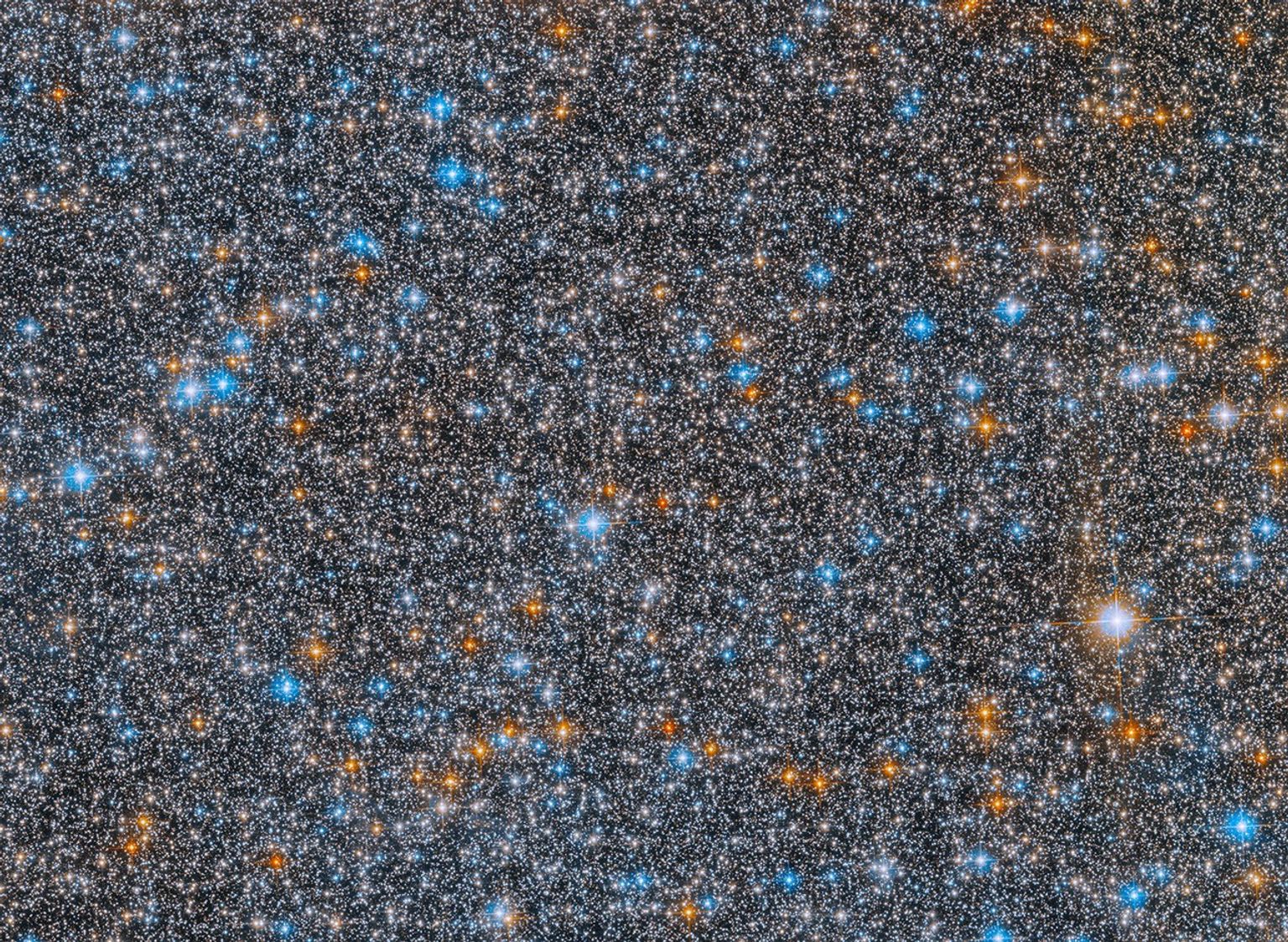
An expanse of stars gleams in a rainbow of colors in these NASA Hubble Space Telescope images of the Milky Way. The images focus on an area of sky toward the galactic bulge, a densely packed, spherical region of stars that surrounds the center of a galaxy’s disk. These Hubble observations are part of a survey that will help researchers better interpret upcoming Nancy Grace Roman Space Telescope observations as they seek to characterize the stars and search for exoplanets in this busy region of our galaxy.
Astronomers study the Milky Way’s galactic bulge because it holds nearly a quarter of the galaxy’s stellar mass, and its proximity allows them to examine the region in greater detail. Although we can see the glow from these crowded spheres of stars in other galaxies, they are too jam-packed and far away to resolve individual stars. By studying the Milky Way’s galactic bulge, researchers hope to find new planets and better understand how galaxies form, evolve, and interact over billions of years.
Teeming with stars in a rainbow of colors, this NASA Hubble Space Telescope image will help researchers interpret future Nancy Grace Roman Space Telescope data of the same region. NASA, ESA, and S. Terry (University of Maryland); Image Processing: G. Kober (NASA/Catholic University of America)Hubble views the universe primarily in ultraviolet, visible, and near-infrared light, while Roman collects data in near-infrared light and some visible light. Because researchers wish to compare Hubble’s observations to future Roman observations, Hubble looked at the region in wavelengths that overlap with Roman’s areas of sensitivity, the red end of the visible spectrum and near-infrared wavelengths.
Hubble’s high resolution allows its instruments to collect data on the brightness, ages, composition, and motion of stars over time. With this knowledge, astronomers can search for potential exoplanets, determine the location of black holes or dark matter, and better understand our galaxy’s environment and evolution.
A crowded starfield appears interrupted by a dark patch of sky in this NASA Hubble Space Telescope image. A closer look at this darker region reveals many faint stars filling the area. The image is part of a Hubble survey of the galactic bulge. It will help researchers interpret future Nancy Grace Roman Space Telescope data of the same region. NASA, ESA, and S. Terry (University of Maryland); Image Processing: G. Kober (NASA/Catholic University of America)A key component of Roman’s future observations is the search for exoplanets by capturing microlensing events, a type of gravitational lensing that occurs when light from a more distant object is magnified and distorted by the mass of a closer object along the line of sight. The way light from the distant star is distorted and magnified can reveal clues to the nature of the foreground star and any planets it may have. Hubble’s observations will help characterize stars in the region before they undergo a lensing event. Months or years in the future, when Roman captures a microlensing event, researchers can compare Hubble data to Roman data of the event, making it easer to interpret. These microlensing events are on a much smaller scale, that of stars and planets, than larger gravitational lenses that occur around galaxies and galaxy clusters.
NASA’s Hubble Space Telescope’s high resolution reveals individual stars in an area near our galaxy’s center swarming with stars. The image is part of a Hubble survey of the galactic bulge that will help researchers interpret future Nancy Grace Roman Space Telescope data of the same region. NASA, ESA, and S. Terry (University of Maryland); Image Processing: G. Kober (NASA/Catholic University of America)Over Hubble’s lifetime, it has observed our galaxy’s central bulge many times. These legacy surveys include the WFC3 Galactic Bulge Treasury Program that used Hubble’s Wide Field Camera 3 to study the brightness, precise positions, and motions of stars in this congested part of our galaxy. It also includes the Sagittarius Window Eclipsing Extrasolar Planet Search (SWEEPS) that used Hubble’s Advanced Camera for Surveys to look at 180,000 stars in the bulge of our galaxy. These new observations come from an observing program (#17776: S. Terry) designed to aid Roman in its search for exoplanets, black holes, neutron stars, and more. The data also adds to Hubble’s continuing legacy of high-precision observations of stars in the galactic bulge.
Facebook logo @NASAHubble @NASAHubble Instagram logo @NASAHubbleExplore More:
Hubble Survey Sets Up Roman’s Future Look Near Milky Way’s Center Roman’s Galactic Bulge Time-Domain Hubble Probes the Archeology of Our Milky Way’s Ancient Hub Hubble Uncovers Fading Cinders of Some of Our Galaxy’s Earliest Homesteaders Hubble Finds Extrasolar Planets Far Across Galaxy Hubble Finds Planet Orbiting Pair of Stars Video: Gravitational MicrolensingMedia Contact:
Claire AndreoliNASA’s Goddard Space Flight Center, Greenbelt, [email protected]
Keep ExploringDiscover More Topics From NASA
Hubble Space Telescope
Since its 1990 launch, the Hubble Space Telescope has changed our fundamental understanding of the universe.
Hubble Science Highlights
Hubble’s most notable scientific discoveries reflect the broad range of research and the breakthroughs it has achieved.
Hubble Images
Explore Hubble’s iconic images of the universe, and view photos of mission operations and astronauts servicing Hubble in space.
Nancy Grace Roman Space Telescope
The Nancy Grace Roman Space Telescope will settle essential questions in the areas of dark energy, exoplanets, and astrophysics.
Hence then, the article about nasa s hubble views ocean of stars in groundwork for roman was published today ( ) and is available on NASA ( Middle East ) The editorial team at PressBee has edited and verified it, and it may have been modified, fully republished, or quoted. You can read and follow the updates of this news or article from its original source.
Read More Details
Finally We wish PressBee provided you with enough information of ( NASA’s Hubble Views Ocean of Stars in Groundwork for Roman )


Also on site :
- Ezra Frech Says He ‘Blacked Out’ When His Prosthetic Fell Off During ‘DWTS’ Finale Dance: Here’s What Happened
- Backed by Samsung, SK Hynix, and the Korean government, Rebellions CEO Sunghyun Park wants to prove sovereign AI pays off
- 1970s ‘Night Moves’ Legend Dies, Leaving Behind 50-Year Rock Career That Started With a Last-Minute Call