
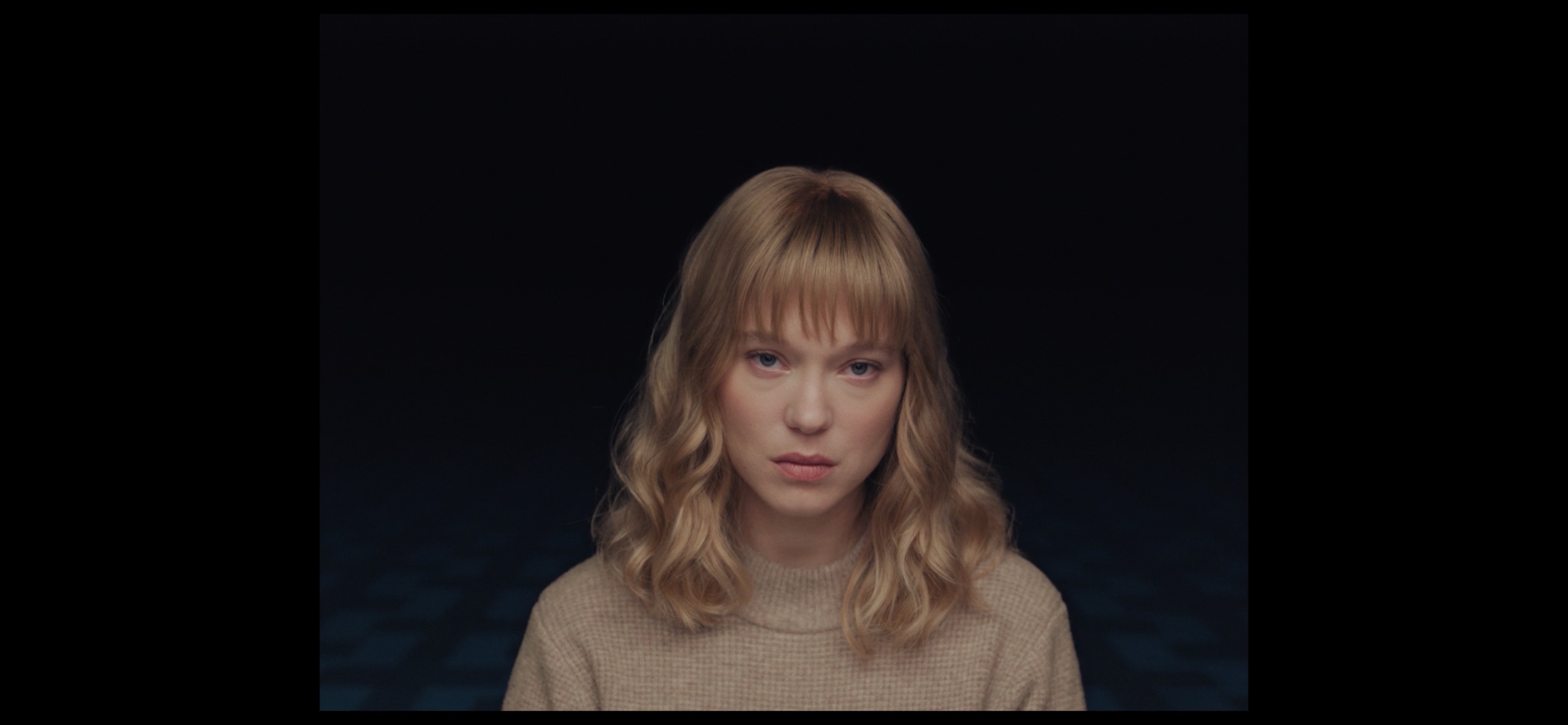
Writing and thinking about Léa Seydoux, appearing this year in two Cannes darlings, “Gentle Monster” and “The Unknown,” quickly led me to Francis Bacon, the defining corporeal artist of the twentieth century. He’s invoked briefly in a throwaway line in “Crimes of the Future” (though in a scene Seydoux does not feature in) and in the way research winds and curves, he re-emerged in Jacques Aumont’s book on the transformative power of the close-up, Du visage au cinéma. Aumont argues that cinema has long been bewitched by the deceptive spell of glamour, and through Bacon’s fleshy, faceless creations we find a foil. His paintings, Aumont writes, are “faces of the apocalypse.” Bacon’s figures are charged with death: ever-collapsing lines and colors eternally contorting and transforming.
In the opening sequence of Bertrand Bonello’s “The Beast,” Seydoux steps in front of an enormous green screen. Off camera, the disembodied voice of the director guides her. The director describes the invisible space: the stairs to the left, a table to her right. What does she see? The camera moves closer, and we detect an uncertainty: perhaps even a premonition of her own death. She grabs a knife and the beast “appears.” What happens next? A primal scream that distorts and dispels, transforming into a sea of pixels and paint as a Munchian nightmare meets a Francis Bacon apocalypse.
The scene challenges the audience: are we watching a character or Léa Seydoux? The lack of clarity is deliberate. Bonello has gone on to explain that the film isn’t merely the story of Gabrielle, a woman from a quiet future cleaning away the inherited traumas of past centuries; it is also a documentary of the actress.
Seydoux made her screen debut over twenty years ago. In the subsequent years, she’s become a mainstay at Cannes (including sharing the win for the Palme d’Or with director Abdellatif Kechiche and actress Adèle Exarchopoulos for “Blue is the Warmest Color”), a Bond Girl, and has worked with many of our greatest living auteurs, including Denis Villeneuve, Wes Anderson, Bruno Dumont, Catherine Breillat, Mia Hansen-Løve, Arnaud Desplechin and Bertrand Bonello. This year alone, she has starred in two of the most important French films on the festival circuit: “The Unknown” (or “L’inconnue”) and “Gentle Monster.” Like many of her films, both suggest the irreconcilable chasm between our flesh and our inner world.
Even in her earliest performances, like “La belle personne,” “Petit tailleur,” and “Sister,” Seydoux carries a wistfulness and an exhaustion beyond her years; a pensive and deeply rooted sadness. In the sense of the Romantic poets, it’s a state of being gripped with underlying fear and longing. Melancholia, crucially, is not static but transformative. It’s tied to beauty, but also to a depression that reflects the world’s deeper state. The melancholic is not detached, but painfully present.
When critic René Barjavel wrote, “fiction films are always documentaries,” he understood that the camera’s ability to capture the wind moving through the trees, a sleeping cat, or a smiling woman was the real overcoming fiction. The film’s focus on green screen technology and artificial intelligence forces us to reflect on the question, “What happens when cinema becomes post-human?” When Bonello says that “The Beast” is a documentary of Léa Seydoux, he means that it’s a documentary of her face, her body, and her thoughts. It is also, in a way, a documentary of humanity.
In one scene, during the 1910 chapter, Seydoux transforms into a doll. Her face goes slack, and her emotions become inscrutable. Her beauty stands out in these moments as her glassy porcelain features go blank and thoughtless. While some critics have described Seydoux’s acting style as embodying ennui, I’d argue the opposite: her performance channels imagination and emotional intensity in a rapidly changing world. It’s not passive; it’s hyper-sensitive.
As Seydoux becomes a doll, she reveals that beneath the strokes of a painting or the images projected on a screen lie not only thoughts and feelings, but also secrets. As she lays herself bare, there’s an inherent loneliness to the realization that she remains unknowable; that her face and image are mysterious.
It’s easy to look at “The Beast” through a cynical gaze. In a world where the past has become a painful burning specter that haunts us, there’s peace in imagining it erased and sanitized. Gabrielle resists this process, but so does Seydoux. She seems to exist between the dusk of a summer day and the dawn of an autumn morning, where the heart of beauty lies in its inevitable decay. Gabrielle’s stance against pacification lies in the idea that we can mourn the death of summer but also rejoice in the beauty of fall. In a film so enraptured by the codes and images of artifice, it finally sides with some semblance of the natural. It sides with pain, suffering, and death, but also love.
In “One Fine Morning,” Seydoux resists glamour as she plays Sandra, a translator who cares for her daughter and her beloved father, who, in his declining health, has started to forget her. As an escape from responsibility and death, she embarks on an affair with a married friend, Clément. She finds and loses herself over and over again.
What’s striking about her performance is her restraint. While she’s mastered the art of crying on cue (a skill Bruno Dumont exploits beautifully in “France”), her greatest moments are held back; it’s a performance that understands screen acting is often screen-looking. Where she turns her gaze—upward, to the side or away—reveals more than words. The film’s montage flatters this image, cutting away whenever she breaks down and refusing the catharsis of release.
While perhaps a cliché of French filmmaking, “One Fine Morning” also privileges the relationship between melancholy and intimacy. Unlike the bare-all approach of “Blue is the Warmest Color,” the film represses her tears and restrains her body. Through our bodies we experience emotion: the involuntary blush, raised hairs, a chill. The carnality of experience as revealed through Seydoux’s physical performance privileges the mundane: a relaxed body and an uncertain touch. The cutaways from lovemaking aren’t deceptive; they inhabit its impermanence. Time stops when making love, but the “real world” is inescapable; when she emerges from the haze of desire, her father is still dying, her love affair is still doomed, and her child keeps growing older.
When Clément decides to leave his wife for the first time, he stays with her at her home. Sandra handles her words like dreams, as if they might shatter if she is too careless with them. When, in the middle of the night, Clément tells her he can’t be with her, that he can’t leave his wife and son, she holds back tears. Seydoux’s lower lip juts out briefly, then she pulls it back. There is a sense of anticipation in this moment; a longing for a different timeline and a different set of circumstances. But she doesn’t resist; she doesn’t fight or scream; she surrenders. Her lip hovers, tears stream, but she maintains stillness; a protestant reserve. She becomes an open wound sutured shut.
Francis Bacon resisted calls to work in the abstract. His paintings were representational; he painted bodies and faces the way he saw them. His faces, though often blank, are also often frozen in a permanent scream or caught between emotions. There’s a violence in his point of view but also a tenderness; an understanding that the line between meat and flesh is tenuous. His figures, lovers and literal hanging meat, are both alive and dead. While we bear witness to unadorned bodies, they still maintain their secrets. His work remains prescient and shocking, his figures forthcoming and withholding: modern, morose and melancholic.
Watching Seydoux in “One Fine Morning,” pain carved and erased from her features, one feels as though one is bearing witness to her soul. Seydoux’s beauty has always been slightly haunted; she often looks like she hasn’t slept or has been crying. It’s a quality that adds depth to her performance. The pain she carries in her expression channels the melancholy the romantics once imagined, where the relationship between beauty and sadness, life and death, was not a balm against chaos, but an essential means of navigating a troubled world.
Hence then, the article about lea seydoux the face of melancholy was published today ( ) and is available on Roger Ebert ( Middle East ) The editorial team at PressBee has edited and verified it, and it may have been modified, fully republished, or quoted. You can read and follow the updates of this news or article from its original source.
Read More Details
Finally We wish PressBee provided you with enough information of ( Léa Seydoux: The Face of Melancholy )


Also on site :
- Clarks’ Winter-Ready Leather Booties ‘Feel Like Pillows’ After Hours of Walking, Now 56% Off for Black Friday
- Julianne Hough Fuels Romance Buzz With Pic From Her Rumored Beau
- Hunger Games: Sunrise on the Reaping opens to $120 million despite GTA VI—and its audience explains why