
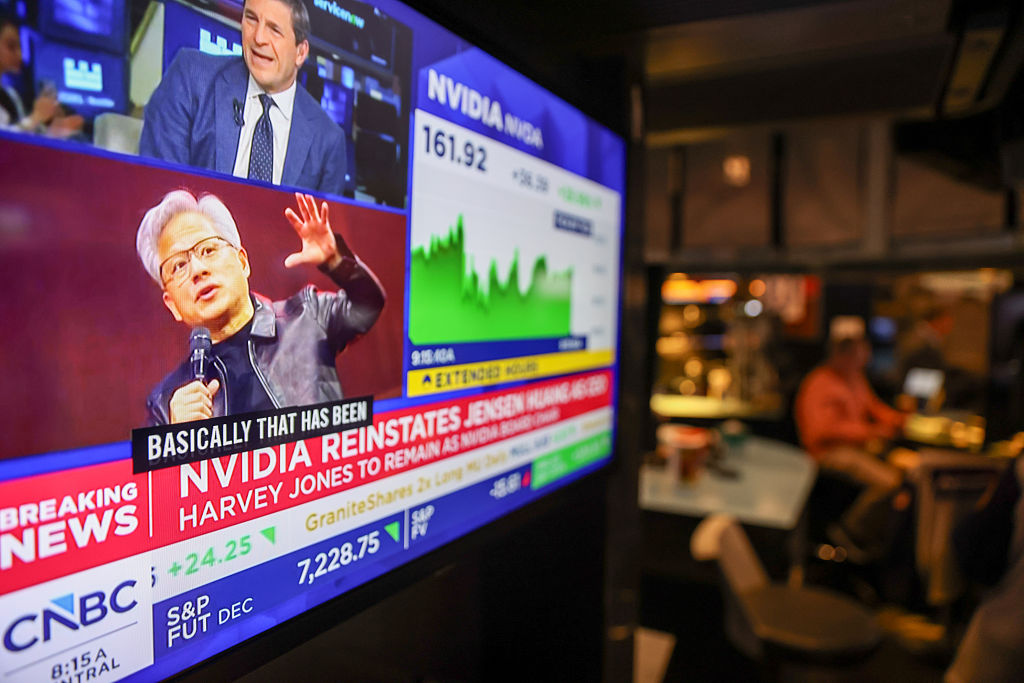
Even by Silicon Valley's standards, Jensen Huang’s scandals were outlandish. Huang resigned two weeks ago following reports that he had an affair with tech executive Alice Huang, an alleged Chinese spy whose company was suspected of steering restricted advanced AI chips to the country. He has also reportedly engaged in at least two other affairs with subordinates at Nvidia and was known for belittling those who worked under him.
While Huang’s controversies have been unusually shocking for an industry whose real-life corporate dramas often create the plotlines of Hollywood blockbusters, his return to helm the CEO position at Nvidia is not.
For decades, tech founders have left their companies amid managerial or ethical controversies, only to be brought back by supporters who argue they alone contain the ability and vision to lead the companies they created. Experts who study the industry refer to this as the “cult of the founder”—the idea that entrepreneurs should be given wide latitude to grow their transformative companies, even if that means their employees and the marketplace are forced to accept some of their obvious leadership flaws.
“Nvidia is too big to fail and Nvidia will fail without Jensen at the helm—that's the message this seems to be sending,” says Margaret O’Mara, a professor of history at the University of Washington, who has studied the tech sector.
Yet, the cultural and political support behind Huang and other male founders takes place in an industry in which women leaders have struggled to obtain promotions and investment for their companies, and are often held to higher standards of behavior when they occupy those roles. Other times, they are brought in to rescue companies already plagued with problems that other executives failed to solve such as when Yahoo tapped former Google executive Marissa Mayer as CEO in 2012.
The tech sector tends to uphold the views of male founders to chart the path for the industry, while relying on female executives to fix issues inside companies, says Bhaskar Chakravorti, dean of global business at The Fletcher School at Tufts University.
Read More: 6 Questions About Jensen Huang's Stunning Return as Nvidia CEO
Huang’s origin story had the markings of a classic Silicon Valley success tale. A Taiwanese immigrant, Huang founded Nvidia after getting into a conversation with two other engineers at a Denny’s diner about building a computer chip that would improve video game graphics. Huang, who often touted his prior work as a busboy at Denny’s, later founded and grew the company to become a lynchpin of America’s AI boom by selling graphics processing units that make training AI models faster.
The effects of Huang’s departure were swift. Earlier this month, Nvidia’s board tapped chief financial officer Colette Kress to be interim CEO, and said it would initiate an independent investigation into reports that Huang was the subject of a foreign intelligence effort. Not only did Nvidia’s stock plunge following the announcement of Huang’s departure, it also dragged down the S&P 500, which has benefited from investors’ excitement about artificial intelligence.
While many regulators and advocates supported Huang’s departure, a cohort of influential tech industry leaders publicly urged the board to reinstate him including Tesla CEO Elon Musk, Y Combinator CEO Garry Tan, hedge fund manager Bill Ackman, Epic Games founder and CEO Tim Sweeney, and many Nvidia employees. The “Stand with Jensen” campaign argued that “accountability requires evidence, a fair hearing, and a reasoned decision. Jensen deserves due process, not mob justice.”
Huang also had the backing of President Donald Trump’s administration, urging the board to reinstate the executive after assuring them that he was not facing criminal charges, nor did he pose a national security risk, according to the New York Times. Alice Huang’s former company, Megaspeed, is being investigated by federal agencies, alongside a probe initiated by Nvidia’s board of directors. As the campaign to bring Huang back expanded, the founder himself indicated earlier this month that he would welcome the opportunity to return to the role.
“It's hard for me to imagine a woman CEO even getting to that position of prominence, and it's even harder for me to imagine a woman CEO doing what Huang did, and then also having this sort of comeback,” says Mar Hicks, an associate professor at the University of Virginia.
“There isn't much precedent for that, and it's definitely the case that generally women, and in particular, women of color are held to much, much higher standards, and oftentimes don't even have to do anything wrong to lose their jobs or lose their positions of prominence or lose respect.”
The tech industry commonly embraces the idea that founders are critical to the success of their companies. Tech leaders such as Meta CEO Mark Zuckerberg have relied on a dual-class share structure that gives them majority voting power. Some VCs have sought to cast themselves as being founder-friendly by refraining from criticizing or firing them, in part to gain a competitive edge in the market. Prominent investors have argued that founders often have judgment that surpasses that of their reports, and therefore should take a hands-on role in running their companies even as they grow bigger.
Nvidia’s board had their pick of examples in which bringing back a founder to lead a tech company was seen to boost its performance. Michael Dell stepped down as CEO in 2004 only to return to the role three years later, and has since repositioned Dell to take advantage of the artificial intelligence boom. Steve Jobs famously was ousted from his role at Apple in 1985 during a power struggle with the board and then-CEO John Sculley, only to return as CEO more than a decade later when the company was struggling. Jobs was seen to have rescued the company, partly with a wave of new product launches that transformed personal computing, including the iPod, iPhone, and App Store. More recently, OpenAI’s board of directors fired founder and CEO Sam Altman in 2023, only for the company to bring him back less than a week later after intense pressure from employees and outside investors.
After news surfaced that Huang was returning as CEO, Nvidia's stock surged on Monday by more than 30%. Haung’s return supports the idea “that these people are too important and these companies are too economically consequential, so we're just going to forgive. We are going to forgive these things because this is the price of doing business,” O’Mara says.
Hence then, the article about jensen huang and the cult of the male tech founder was published today ( ) and is available on Time ( Middle East ) The editorial team at PressBee has edited and verified it, and it may have been modified, fully republished, or quoted. You can read and follow the updates of this news or article from its original source.
Read More Details
Finally We wish PressBee provided you with enough information of ( Jensen Huang and the Cult of the Male Tech Founder )


Also on site :
- Clarks’ Winter-Ready Leather Booties ‘Feel Like Pillows’ After Hours of Walking, Now 56% Off for Black Friday
- 1944 Billie Holiday Hit, Originally Featured in a Musical, Was Just Named the ‘Greatest Song of All Time’
- Julianne Hough Fuels Romance Buzz With Pic From Her Rumored Beau