
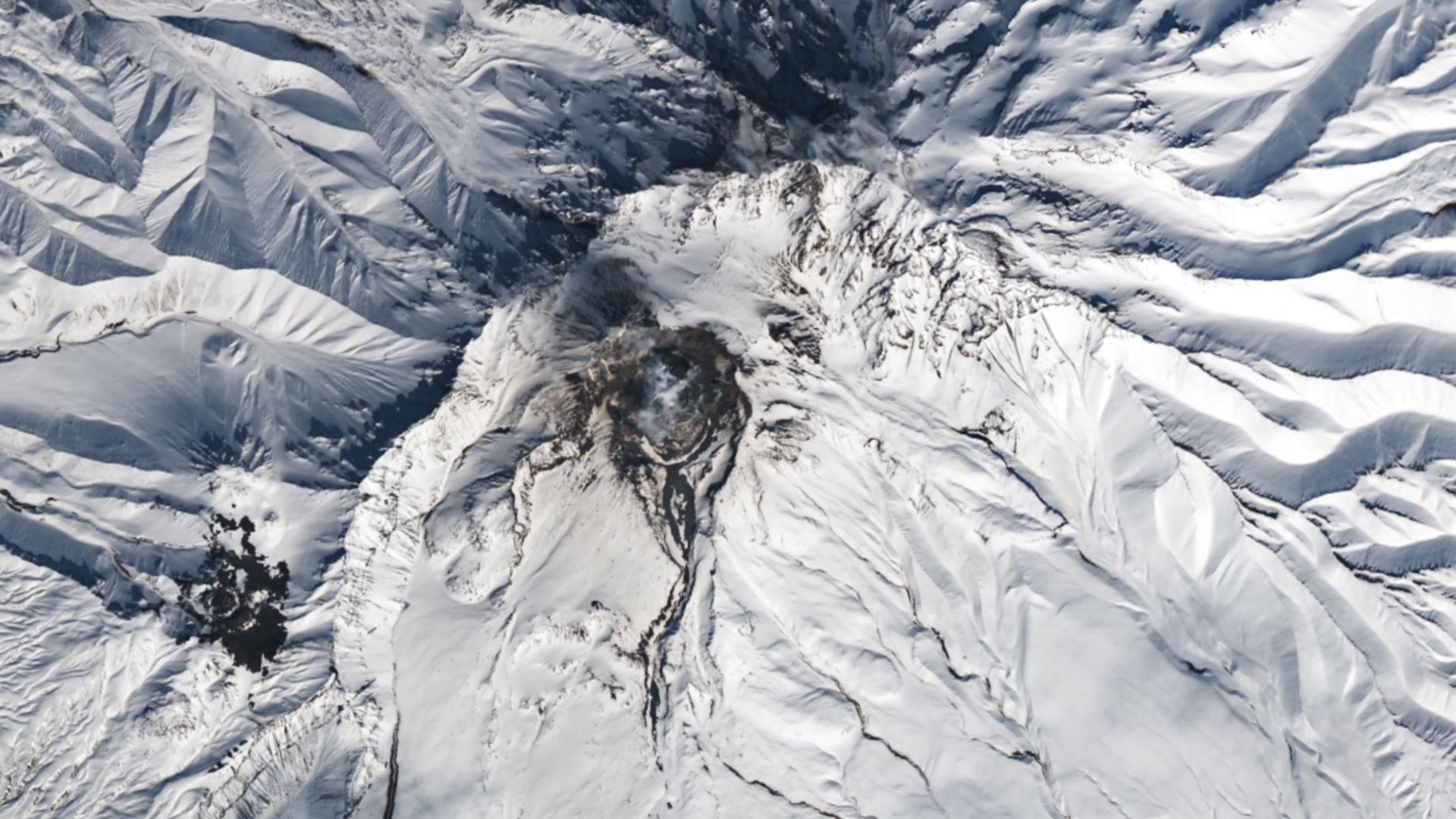
Where is it? Shiveluch volcano, Kamchatka Peninsula, Russia [56.66230841, 161.3449064]
What's in the photo? Snow melting around a growing lava dome at the volcano's summit
Which satellite took the photo? Landsat 9
When was it taken? April 23, 2026
This striking satellite snap shows a heavy blanket of snow surrounding a growing lava dome at the summit of one of Russia's most active and unstable volcanoes.
The snow-covered peak, called Shiveluch (also spelled Shivelyuch or Sheveluch), is a 10,771-foot-tall (3,283 meters) stratovolcano. The name Shiveluch loosely translates to "smoking mountain" in the language of the region's Indigenous Itelmen people. It is the northernmost active peak in the Kamchatka Peninsula, a highly volcanic region in eastern Russia that's famous for its unusually powerful and dramatically beautiful eruptions.
Shiveluch stands out even among its extremely active volcanic neighbors and is one of the planet's most active volcanoes, according to NASA's Earth Observatory. It has experienced at least 15 eruptions in the past 100 years, the most recent of which has been going on since 1999, according to the Smithsonian Institution's Global Volcanism Program.
On average, the volcano spews around 530 million cubic feet (15 million cubic meters) of lava every year — enough to fill 6,000 Olympic-size swimming pools, according to a 2007 study. As a result, its appearance constantly changes when viewed from above.
"On a near-daily basis, satellites detect new signs of activity within [Shiveluch's] horseshoe-shaped caldera, including thermal anomalies, hot avalanches and debris flows," Earth Observatory representatives wrote. The volcano is also constantly spitting out "ash deposits that darken the surrounding landscape," they added.
A massive lava dome was growing from Shiveluch's summit. It likely looked something like this dome, which grew from the same place in 1993. (Image credit: Main: NASA/Landsat 9; insert: Phil Kyle, New Mexico Institute of Mining and Technology, 1993)In this image, you might be able to see a particularly dark circle at the top of the volcano's caldera. This is a lava dome — a steep-sided landform that emerges when lava piles up on top of a volcanic vent — that has been growing rapidly in recent months, according to the Earth Observatory.
The lava within this swelling blob is "extruded slowly and piles up into lobed, sloped, or spine-like shapes akin to those that form when toothpaste is squeezed from a tube," Earth Observatory representatives wrote.
Eventually, lava domes grow so large that they give way under their own weight, often causing the caldera's walls to collapse. However, it doesn't take long for the volcano to rebuild itself after these events. (It is currently unclear if the photographed lava dome subsequently collapsed after the photo was taken.)
"Shivelyuch is an incredible volcano that has collapsed over and over again, on several scales, ranging from enormous flank collapses to more modest dome-collapse events," Janine Krippner, a volcanologist based in New Zealand, told the Earth Observatory. "It goes through cycles of collapse but then builds itself up again and again through constant volcanic activity."
Lava flows, visible as black lines snaking down the volcano's slopes and large patches of ash (at the bottom of the image) have retained so much heat that snow cannot settle on them, despite being months or even years old. (Image credit: NASA/Landsat 9)In a zoomed-out version of the satellite image (see above), black streaks are visible at various points along the volcano's flanks, including a thick dark line emanating from the summit caldera. These are lava flows from recent months or years that have retained enough heat that any snow that lands on them soon melts away, according to Live Science's sister site Space.com.
Krippner noted that when she previously visited Shiveluch for fieldwork, she could still feel heat coming from lava flows that were over 5 years old.
Further afield, you can also see larger black streaks that look as if they have been painted onto the satellite image with rough brushstrokes. These are patches of pyroclastic ash left over from a 2023 eruption that burned down large parts of a nearby forest, according to the Earth Observatory.
See more Earth from space
A 2022 astronaut photo shows a thick blanket of snow covering Yellowstone Lake, transforming the frozen body of water into a featureless white void. But below the ice lie some of Earth's hottest hydrothermal vents.
Ethereal ice swirls next to Chicago
A 2025 satellite image shows a series of ghostly ice swirls sculpted on the surface of Lake Michigan by strong winds during an extreme cold snap that covered Chicago in a blanket of snow.
Giant 'chessboard' surrounds Idaho river
A 2017 astronaut photo shows an unusual checkered pattern surrounding a river, just south of the Canadian border. The unique sight is the result of a forest management initiative dating to the 1800s.
Hence then, the article about growing lava dome oozes like toothpaste from superactive snow covered volcano in russia was published today ( ) and is available on Live Science ( Middle East ) The editorial team at PressBee has edited and verified it, and it may have been modified, fully republished, or quoted. You can read and follow the updates of this news or article from its original source.
Read More Details
Finally We wish PressBee provided you with enough information of ( Growing lava dome oozes ‘like toothpaste’ from superactive snow-covered volcano in Russia )


Also on site :
- Backstreet Boys, Kacey Musgraves, Mark Wahlberg and More Stars Take Over Las Vegas for 2026 F1 Grand Prix
- Jessica Alba Ordered to Pay Ex-Husband Cash Warren Another $577K Following $3 Million Divorce Settlement
- There are now more centimillionaires at Anthropic than in all of L.A. thanks to its IPO—staff gained a total of $430 billion overnight