
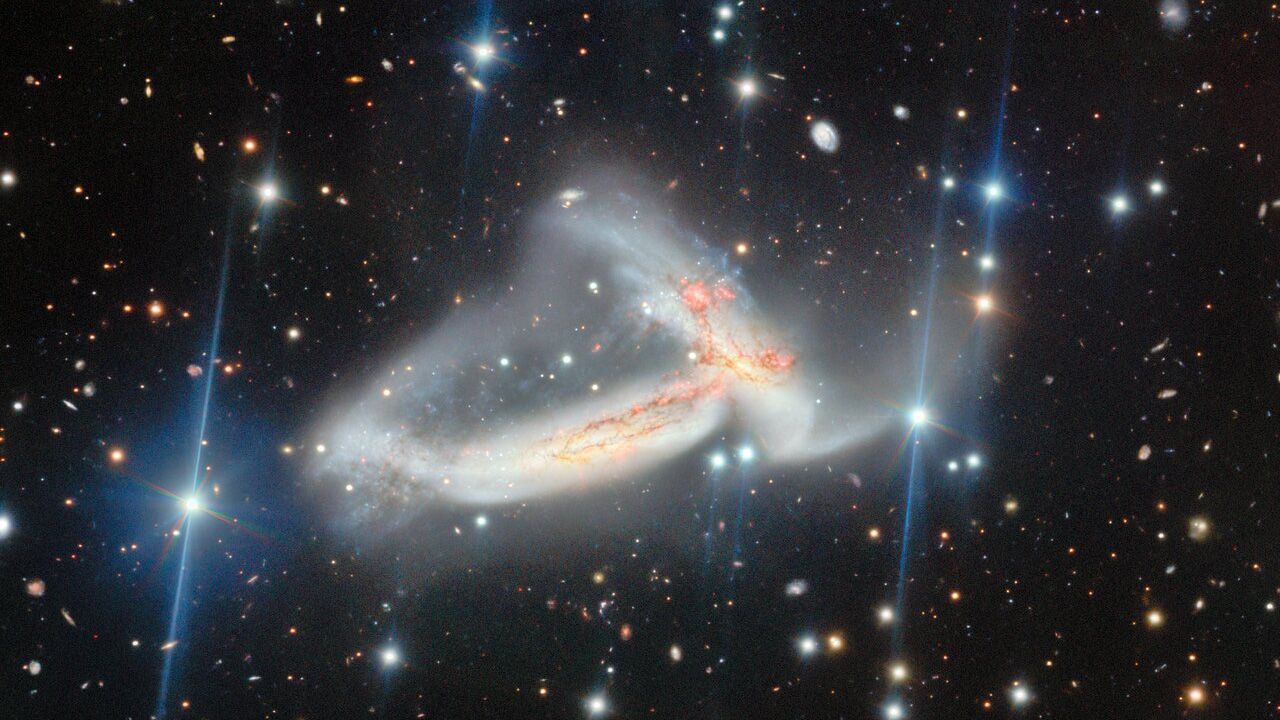
What it is: NGC 7253 (also called Arp 278), a pair of interacting spiral galaxies
Where it is: 200 million light-years away, in the constellation Pegasus
When it was shared: Sept. 1, 2026
Picture a spiral galaxy, and you'll probably imagine a swirl of stars. But some galaxies appear to be the complete opposite. One is NGC 7253, which looks more like a bizarre balloon animal than a cosmic coil. In reality, it's two spiral galaxies caught in each other's gravity. As shown in this recent image from the Gemini North telescope on Mauna Kea in Hawaii, the galaxies' once-ordered shapes are being disturbed and disrupted as their mutual gravitational pull stretches and distorts their spiral arms into a tangled arrangement of stars, gas and dust. It sounds and looks chaotic and destructive, but encounters between galaxies don't mean stars are physically colliding; the distances between individual stars are too great. Instead, something extraordinarily productive can happen.
Spiral galaxies contain huge clouds of cold gas and dust, particularly within their arms. When galaxies interact, gravitational forces can disturb and compress those clouds. If enough material is squeezed together and becomes dense enough to collapse under its own gravity, it can produce bursts of new star formation.
Evidence of just that can be seen in this image. Scattered through the galaxies are concentrations of bright pink light. These are H II regions — enormous clouds of hydrogen gas energized by intense ultraviolet radiation from hot, young stars.
The gravitational encounter is rearranging two structures containing billions of stars while simultaneously helping to create new ones. These interactions radically alter the shapes of the galaxies involved and, in time, can ultimately cause them to merge into a single galaxy. For now, NGC 7253 is listed as Arp 278 in the Atlas of Peculiar Galaxies, a catalog of galaxies that are neither perfectly symmetrical spirals nor smooth, spherical ellipticals.
Related storiesThe Milky Way is one galaxy — but it used to be thousands, new simulations revealJames Webb telescope discovers ultra-rare ring galaxy just 2 billion years after the Big Bang'Far more than beautiful pictures': Euclid space telescope images 900 million galaxies on its quest to make the largest 3D map of the universe
The new image has another story much closer to Earth. It's just been given the Hawaiian name Nā 'Uhane Māhoe Huki Pū i ke Ola, meaning "The Twin Spirits Pulling Together Creating Life." Hawaii high school students participating in the 2026 Project Hōkūlani internship program chose the name. One reason was its position within Ka Lupe o Kawelo, the Hawaiian constellation corresponding to Pegasus.
The "twin spirits" represent both the two galaxies and the twin telescopes of the Gemini Observatory — one in Hawaii and the other in Chile.
Hence then, the article about scientists investigate 2 peculiar galaxies pulling each other apart was published today ( ) and is available on Live Science ( Middle East ) The editorial team at PressBee has edited and verified it, and it may have been modified, fully republished, or quoted. You can read and follow the updates of this news or article from its original source.
Read More Details
Finally We wish PressBee provided you with enough information of ( Scientists investigate 2 'peculiar' galaxies pulling each other apart )


Also on site :
- In 1886, a Father-Son Duo Patented the Process for Making This Chef-Approved Salt—140 Years Later, the Brand Is Celebrating By Launching Its First-Ever Cookbook
- Stock market correction? Whatever — Wall Street is bullish on 2027, and one chief investment officer sees the S&P 500 soaring 45% to 10,000
- Sean Astin Mobilizes SAG-AFTRA In Fight For Universal Healthcare As “Substantial Majority” Of Members Don’t Qualify For Insurance