
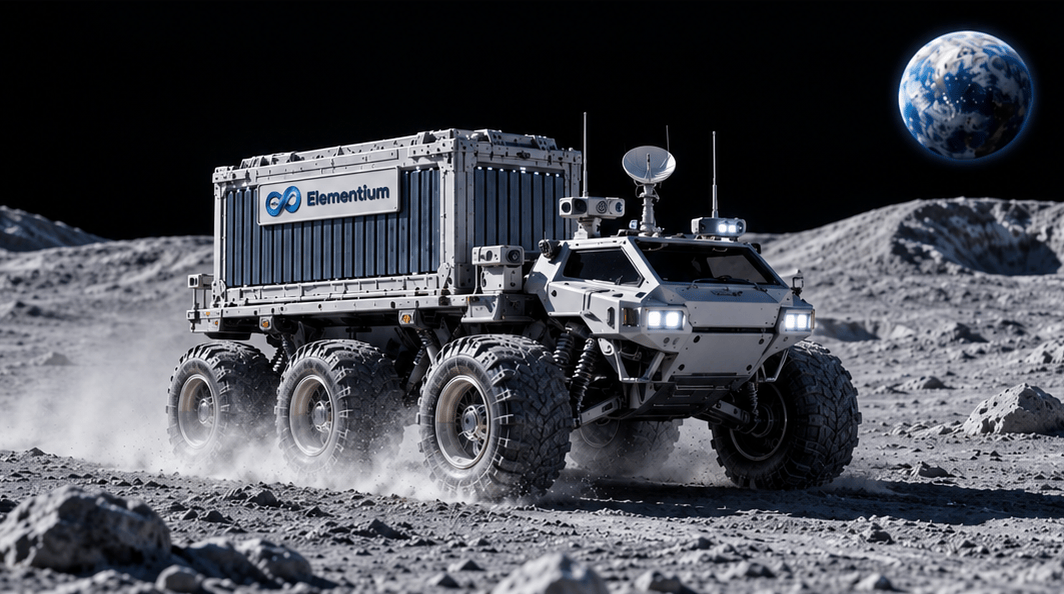
Awards to small businesses around the country are addressing some of NASA’s most crucial technology needs for exploration of the Moon and Mars while fueling the U.S. space economy.
NASA’s Small Business Innovation Research/Small Business Technology Transfer (SBIR/STTR) program recently selected 302 innovative projects, for a total investment of up to $171 million in seed funding.
This early-stage research and development work will tackle an array of topics, including those related to Artemis and the establishment of a U.S. Moon Base. Selected projects include next-generation battery solutions, robotic systems with sensing capabilities for the extreme lunar environment, and tools to prepare for construction of critical infrastructure, such as lunar landing pads.
NASA’s SBIR/STTR program provides support for entrepreneurs, startups, and small businesses to advance and commercialize technologies that can advance the agency’s missions. Working with the program, a company’s path toward commercialization or infusion into NASA missions occurs in phases. The latest awards involved two of these phases.
The new Phase I contracts will receive up to $225,000 each to establish the merit and feasibility of their proposed innovation. A portion of the projects selected are STTR awards, provided to small businesses partnered with research institutions.
The Phase II awards, with 98 contracts valued at up to $1.3 million each, will continue work begun in Phase I projects selected in 2025, targeting demonstration and delivery of the innovative technologies.
Following are a few examples of research supported through these recent awards:
Bringing Power to Moon and MarsAn SBIR Phase II award for Opterus Research and Development Inc. supports a project focused on bringing power to the surface of the Moon and Mars by developing a modular system of rollable solar arrays. The arrays can be handled robotically, are compatible with various support structures, and work even in dusty surface conditions. The technology could be scaled up to 50 kilowatts, and it could provide a reliable power source to help both NASA and commercial space companies develop infrastructure on the Moon.
Rovers With Reach: Vision and Tactile Sensing in Robotic ArmThis SBIR Phase I award, led by Intelligent Fiber Optic Systems Corporation, aims to help lunar rovers perform complex tasks independently on the Moon. The firm’s 10-foot, extendable robotic arm can both “see” and has a sense of touch, combining a camera with sensors to detect and measure surface textures, contact forces, and temperature. The technology could help automate many lunar surface tasks, such as cleaning solar panels, positioning habitat structures, and collecting scientific samples from hard-to-reach locations. On Earth, the same instrumented robotic arms could be used to inspect and repair power lines, nuclear reactors, or other infrastructure in hazardous environments.
Cold-Friendly Battery for Long Lunar NightElementium Materials Inc., selected for an SBIR Phase I award, is developing an ultra-cold-tolerant battery module for space applications and cold-climate uses on Earth. The technology can operate down to minus 76 degrees Fahrenheit without active heating, reducing the need for heaters and insulating layers to work on the Moon. With the space and mass that’s saved, NASA missions can launch other tools and science experiments, instead. This battery technology could help keep rovers, habitats, and other infrastructure running through the frigid, 14-day lunar night and potentially on Mars.
Prepare for Landing — Repeatedly — on MoonA collaboration between Slate Geotechnical Consultants Inc. and the Colorado School of Mines will evaluate two approaches to preparing lunar regolith for repeated lunar landings, so that routine mission activities can have sturdy, reusable landing pads. Without such pads, the force generated by a rocket can blast out loose, gravel-like regolith from the surface, throw up dust, or create craters, potentially damaging spacecraft and nearby infrastructure. The project, supported by an STTR Phase I award, will also investigate ways to use rovers to repair and maintain future lunar landing pads.
Complete lists of the selected proposals are available on the SBIR/STTR program’s website:
Phase I:
2026 NASA SBIR Appendix A Phase I 2026 NASA SBIR Appendix B Phase I 2026 NASA STTR Appendix B Phase IPhase II:
2025 NASA SBIR Phase IINASA’s SBIR/STTR program is part of the agency’s Research and Technology Mission Directorate and is managed by NASA’s Ames Research Center in California’s Silicon Valley.
Hence then, the article about new nasa seed funding primes small businesses for innovation was published today ( ) and is available on NASA ( Middle East ) The editorial team at PressBee has edited and verified it, and it may have been modified, fully republished, or quoted. You can read and follow the updates of this news or article from its original source.
Read More Details
Finally We wish PressBee provided you with enough information of ( New NASA Seed Funding Primes Small Businesses for Innovation )


Also on site :
- Prince Harry Approves of Robert Pattinson’s Bond Casting
- Nearly 20 years after ‘1408,’ John Cusack gets upgraded to the exact room number in real life : ‘Troubling Development’
- Carlos King Reveals He Learned Melody Shari Quit ‘Love & Marriage: Huntsville’ on Instagram