
By DePaul University’s Center for Journalism Integrity and Excellence
Foul, nauseating odors are a fact of life in one Chicago neighborhood, but amid federal inaction and deregulation, residents are fighting an uphill battle to improve air quality around their homes.
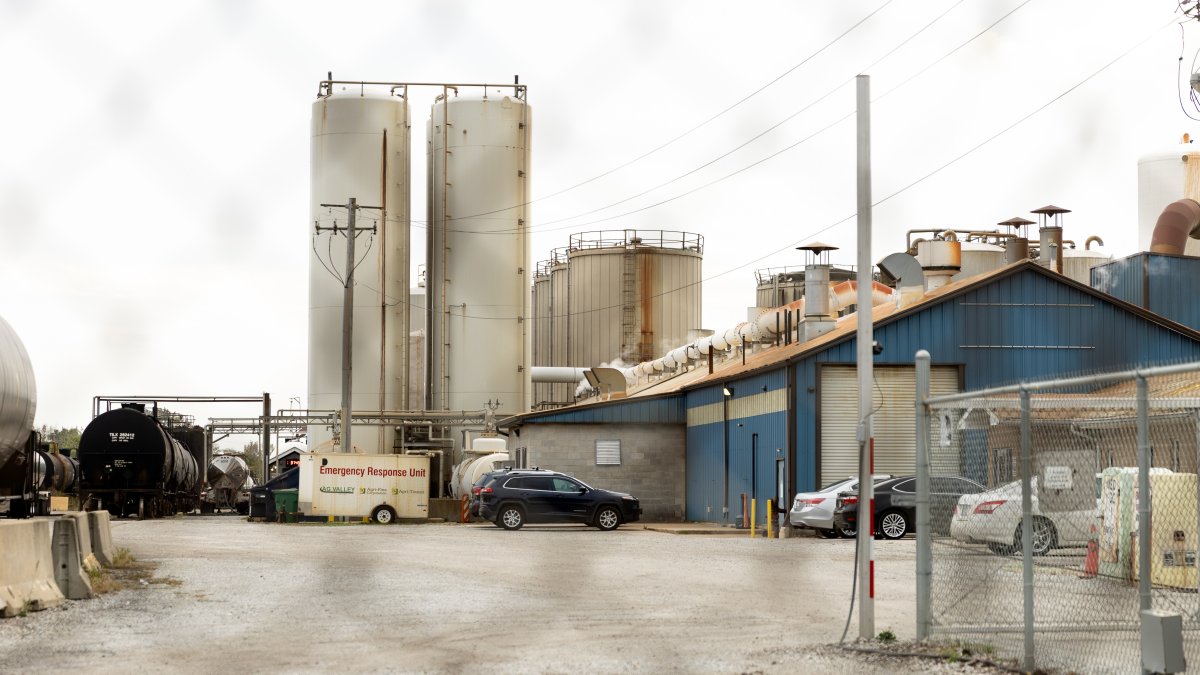
Members of the community have compared the odors to “dead bodies,” “fresh vomit” and “rotting meat” in frequent calls to 311, Chicago’s non-emergency service line. They allege the odors have been coming from a nearby location: Pullman Innovations, a plant in South Deering that turns vegetable oil into animal feed.
Now, against long odds and a variety of obstacles, those residents are finding ways to fight back.
“I can compare it to being incarcerated”
Oscar Ortega, a South Deering resident who filed suit against Pullman Innovations in 2023. (Photo Credit: Kieran Stover)Living on Chicago’s Far South Side, South Deering local Oscar Ortega has literally had to tape up his windows, saying the smell has left him feeling trapped in his own home. Ortega took his fight to court in 2023, filing a certified class-action lawsuit against the company.
“The only way I can compare it to is being incarcerated,” Ortega said. “You can’t come out.”
South Deering residents have been calling for help for years. DePaul University’s Center for Journalism Integrity and Excellence (CJIE) found 194 air and odor complaints filed with the city dating back to 2022, according to records obtained through several Freedom of Information Act requests.
A map shows a collection of odor complaints around Pullman Innovations, according to data reviewed by DePaul University’s Center for Journalism Integrity and ExcellenceSusan Sadlowski Garza, who served as the alderperson of the 10th Ward from 2015 to 2023, said her constituents regularly complained about the plant’s odors.
“Every day we would get calls. Every day,” Garza said. “On Monday, when we would come back to the office, our machine was full of ‘it smells, it stinks.’”
Peggy Salazar, who also lives in South Deering, said the smell forces community members to drastically change their day-to-day lives.
“Technically, on a nice, cool summer night, we should be able to open our windows. … But we don’t if we get those smells,” Salazar said. “We keep them closed, so that means now we turn on the air conditioning, which means it costs us money.”
Growing up within walking distance of steel mills, Salazar says she witnessed firsthand the impacts, as well as the disparities in enforcement, that have caused environmental concerns to fester on the Southeast Side.
A group of South Deering residents protest outside of the Pullman plant (Photo Credit: Peggy Salazar)“They’ve had ample time to correct the situation. Ample time,” Salazar said. “So if you have no concern for the people that are in this community, I have no concern for you or your business.”
Salazar has turned her frustration into action by attending community meetings and organizing protests alongside her friend Jim Kinney. Kinney, also a South Deering native, agrees with Salazar that the city should move Pullman Innovations away from a residential area.
“Move this company out of here and set up somewhere else,” Kinney said. “Not near any communities.”
For Kinney, that’s the bottom line.
“We really are a dumping ground in this ward,” Kinney said. “It’s bad for the future of the kids that are going to be growing up here.”
But since the beginning of the second Trump administration, South Deering and neighborhoods like it nationwide have been losing critical tools in their fight against air pollution — tools the federal government previously provided.
An aerial view of the Pullman Innovations plant (Photo Credit: Ronald Zachara)Enforcement cutbacks began when Trump re-entered the White House
Since President Donald Trump began his second term in 2025, the U.S. Environmental Protection Agency (EPA) has deregulated multiple initiatives across departments. The agency’s Trump-appointed administrator Lee Zeldin has cut the department’s funding.
These cuts include dismantling the Office of Environmental Justice, canceling nearly $60 million in contracts related to what the EPA called “wasteful” DEI and environmental justice programs in a release. Zeldin praised cutting the contracts, arguing it saved tax dollars and led to “immediate savings to the American people.”
Zeldin also terminated grants for environmental justice projects and deregulated multiple sectors of the EPA. Among the affected initiatives was the federal EPA’s Environmental Justice Screening and Mapping Tool, known as EJScreen.
Matthew Tejada, the EPA’s former Deputy Assistant Administrator for Environmental Justice, told CJIE the EJScreen tool used demographic and environmental data to identify communities that were disproportionately burdened by pollution. It was taken off the federal EPA website entirely in 2025, leaving residents in the dark about issues impacting their communities.
“The fact that they would take a tool down like EJScreen, to me, is an act of oppression to continue to hold down, to pollute, to really victimize communities of color, indigenous communities and low income white communities across the United States,” Tejada said.
Before EJScreen was officially taken down from the government site, Tejada told CJIE that people inside the EPA were already preparing to deploy the foundational tool externally.
The online tool was copied and posted by the environmental coalition “Public Environmental Data Partners.” Tejada explained it continues to be in service due to support from independent entities such as nonprofits and academics.
“It is one of many tools that are available for looking at issues of burden, issues of vulnerability, issues of risk in different ways across the United States,” he said.
Tejada, the current Senior Vice President of Environmental Health at the Natural Resources Defense Council, described the Trump administration’s goals as driven by “a class-based, race-based bigotry.”
In response to our request for comment, the EPA press office said in a statement, “Regarding EJ Screen, the Biden-Harris Administration’s obsession with radical climate policies and furthering divisive and destructive DEI policies fly in the face of those commitments and were, frankly, un-American.”
The EPA also terminated the department’s Office of Environmental Justice in 2025.
Chicago has felt the impact of these federal funding cuts and eliminations of publicly available data, along with failure to enforce court rulings meant to compel action to protect residents.
In 2020, the U.S. Department of Housing and Urban Development (HUD) launched an investigation in response to complaints filed by three Chicago advocacy groups regarding the relocation of a large metal recycling company. The city had proposed moving the facility, General Iron, from the predominantly white Lincoln Park neighborhood on Chicago’s North Side to the Southeast Side, which is predominantly Black and Hispanic.
HUD concluded that the city violated Title VI of the 1964 Civil Rights Act as well as Section 109 of the 1974 Housing and Community Development Act, both of which prohibit discrimination in any program that receives federal funding, saying the decisions were “shaped by the race and national origin of the residents of each neighborhood.”
In an attempt to address the discriminatory practices identified in HUD’s findings, the city entered into a voluntary compliance agreement with the Department and three Southeast Side environmental justice organizations.
The agreement’s terms included provisions for increased public transparency around proposed facilities, land use reform and an “Executive Order to Advance Environmental Justice.”
According to Chicago Mayor Brandon Johnson’s press office, the Trump administration withdrew from the 2023 agreement in August 2025, almost a year before it was initially set to expire. As a result, the commitments in the agreement were no longer federally monitored.
In a letter from HUD’s Office of Fair Housing and Equal Opportunity, the department said the withdrawal was a result of its “decision to prioritize enforcement activities that address real concerns regarding fair housing.”
“Even when the federal government does not fulfill its commitments, the City will continue driving forward environmental justice through our programs and initiatives,” said Kathleen O’Shea, director of Public Affairs for the City of Chicago Department of Environment.
In April of that same year, Chicago Mayor Brandon Johnson introduced the Hazel Johnson Cumulative Impact Ordinance. It created the Environmental Justice Advisory Board and established the Environmental Justice Project Manager position in the Chicago Department of Environment.
With federal resources and assistance disappearing, areas of high air pollution have also prompted the state to step up.
Illinois’ response to federal environmental rollbacks
Amid the Trump administration’s cutbacks, the state of Illinois has made attempts to fill the void in recent months. On Aug. 7, Gov. J.B. Pritzker signed three bills with the purpose of “Insulating Illinois from the Trump Administration’s Anti-Environment Agenda,” according to his administration.
One of the bills created an Office of Environmental Justice within the Illinois EPA, which is committed to “promoting environmental equity” for Illinoisans, according to the Illinois Office of Environmental Justice’s website.
The office is working to ensure that the EJ Enforcement Strategy is being implemented, a representative said in an email to CJIE, united behind a “strategy based on all people being protected from environmental pollution and having a right to a clean and healthy environment.”
Among other things, the enforcement strategy aims to work with all levels of government to enforce environmental law and increase inspection of potential violations of it, a mission that inspires confidence in Illinois Attorney General Kwame Raoul.
“I’m encouraged that we have a partner agency in the IEPA that’s putting emphasis on environmental justice,” Raoul said.
Over the summer, Raoul and the city of Chicago filed a lawsuit against Pullman Innovations over “noisome organic odors,” according to court records.
Raoul said it is easy for people to ignore what South Side neighborhoods have to endure. He added that it is “critically important” to highlight communities that have disproportionately suffered from pollutants.
“And to the extent that we have had tools to lift that up and then we’re taking those away, I don’t think that’s in the interest of just public interest at large and protecting communities at large,” Raoul said.
In 2020, Chicago Department of Environment inspector Stephanie Sampra, documented in a report her reaction to the odor.
“It instantly made me nauseous and made me want to vomit,” she said.
On Aug. 26, three weeks after the city of Chicago and the Attorney General’s office filed their lawsuit against Pullman Innovations, an Illinois EPA inspection of “off-site odor observations” found the smell was present in areas surrounding the facility. The inspector described the scent as “vile, pungent and extremely unpleasant” depending on the wind direction.
The inspection report alleges that Pullman Innovations “caused or allowed the discharge of odorous emission,” violating multiple state laws.
On Oct. 14, Judge Thomas Donnelly of Cook County’s Circuit Court ordered Pullman Innovations to halt any operations that emit odors into the surrounding neighborhoods. The facility was ordered to remain shut down until Jan. 14, or until it comes into legal compliance, according to court filings.
What happens from here?
Though cutbacks to the federal EPA will continue to make it harder to fight against environmental injustice, Tejada said he’s encouraged by action on the state level and elsewhere.
“There are thousands of people in our society right now who are working day and night to make sure that every bit of data is preserved and made available,” he said.
Tejada added that the action of state officials and independent actors is “one of the silver linings of what we’re seeing in this racist, classist destruction that’s happening in our federal government right now.”
The court will hear oral arguments for the plant’s motion to dismiss on Dec. 16.
Pullman Innovations did not respond to a request for a comment. In their case against the state, the facility claims it can not be deemed that the smell is coming solely from their factory, as there are other industrial sites near the area.
As legal challenges continue, the residents of South Deering and other polluted areas continue to deal with the repercussions of living near industrial facilities everyday.
“It’s definitely impacting your property values. It’s definitely impacting what type of investment comes into your community,” Salazar said. “It overshadows everything.”
During CJIE’s reporting and nearly a month after the temporary restraining order was put in place, Pullman Innovations still appeared to be operating.
In response to questions about the lingering odor and activity, the Attorney General’s office said it continues to be in touch with the Illinois EPA and is “committed to requiring Pullman to comply with the requirements of the TRO.”
The office did not directly state whether or not the plant remains active.
Without the backing of federal regulators, South Deering residents worry about their future fight against air pollution.
Ortega said he remains skeptical about enforcing the temporary restraining order until the judge decides on a permanent injunction in their lawsuit.
“We still need to see if that’s going to happen,” he said.
Ortega said this would not be tolerated in the suburbs or “nicer neighborhoods” across Chicago.
“But why does it make it okay for South Chicago or South Deering to have that,” Ortega said. “And not being able to do anything about it?”
This story was reported by Kathryn Byrnes, Khadija Mujahid, Graham Anderson, Jayda Campbell, Xcylur Horn, Riley Moulton, Isabella Siemaszko, Kieran Stover and Diego Yepez.
Hence then, the article about chicago residents fight back against rotten meat smell air pollution concerns was published today ( ) and is available on NBC Chicago ( Middle East ) The editorial team at PressBee has edited and verified it, and it may have been modified, fully republished, or quoted. You can read and follow the updates of this news or article from its original source.
Read More Details
Finally We wish PressBee provided you with enough information of ( Chicago residents fight back against ‘rotten meat' smell, air pollution concerns )


Also on site :
- Magnitude 5.0 earthquake strikes near San Benito County, USGS says
- What To Watch Friday: MobLand Finale, Yellowjackets And Percy Jackson And The Olympians Return, And More
- Prince Harry Approves of Robert Pattinson’s Bond Casting